

In the world of high-end travel, we're often told that bigger is better; yet, the true luxury of a remote journey is found in what's missing. On a voyage to the Antarctic Peninsula or the Kimberley coast, the most significant benefits of fewer passengers on expedition cruise ships aren't just about shorter lines at the buffet. It's about the silence of a glacier calving without a hundred cameras clicking in unison. It's about the agility to pivot the ship because a pod of orcas appeared on the horizon. When you travel with a curated group, the destination opens up in ways that a massive vessel simply can't allow.
You've likely felt that familiar frustration when a beautiful moment is diluted by a crowd or a rigid schedule. We believe your time on the ice should be defined by wonder, not by waiting for your turn in a Zodiac. This article explores why the most profound polar and remote experiences are defined by the guests you don't have to share them with. We'll look at how smaller manifests grant you maximum time on shore, deeper connections with world-class naturalists, and the freedom to embrace the spontaneous magic that defines true exploration.
Key Takeaways
- Learn why the 100-passenger landing limit in polar regions means ships with larger manifests often leave you waiting on board while others explore in shifts.
- Understand the benefits of fewer passengers on expedition cruise vessels, specifically how a higher naturalist-to-guest ratio transforms a sightseeing trip into a deep intellectual masterclass.
- Discover how smaller ships maintain the "Expedition Spirit," allowing captains to pivot the itinerary instantly for rare wildlife sightings or unique ice formations that larger ships must bypass.
- Reframe your definition of luxury from gold-plated amenities to the profound silence and uncrowded vistas found only on intimate, personally vetted ships.
- Gain insight into how a bespoke travel designer filters through complex maritime regulations to ensure your chosen vessel matches your specific temperament and desire for authenticity.
The Luxury of Space: Redefining Intimacy on the High Seas
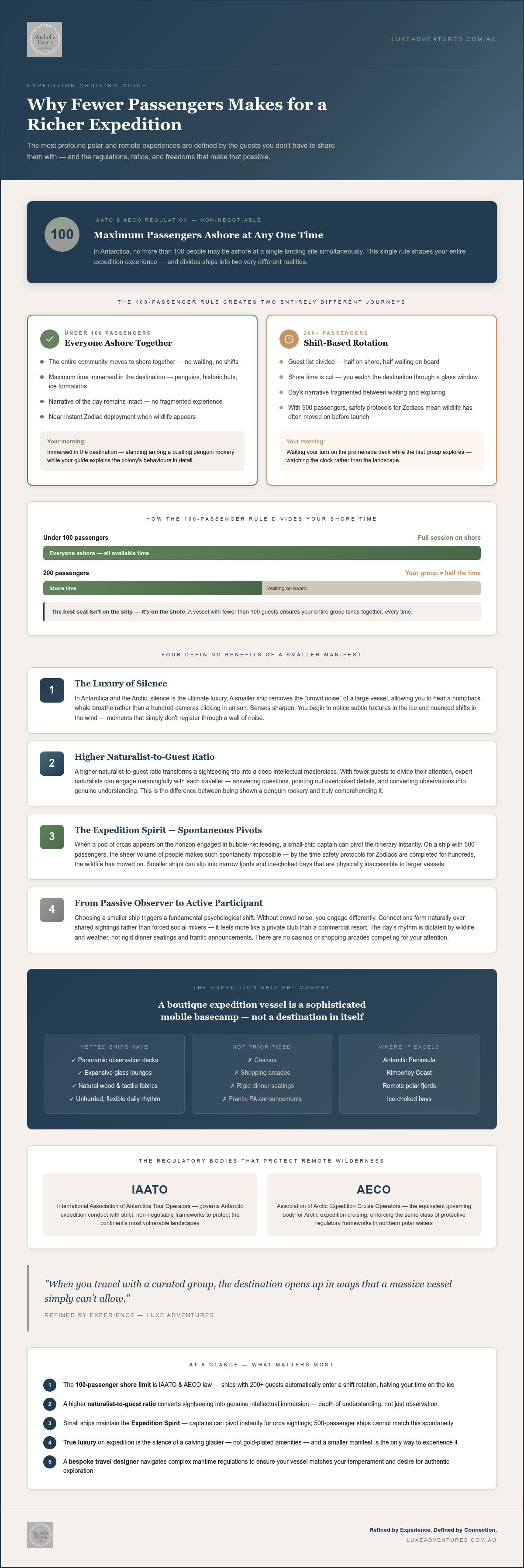
In the high-latitude reaches of our planet, space isn't just a physical measurement. It's an emotional state. We've observed a distinct pivot away from "amenity-heavy" vessels towards experience-led exploration. While traditional cruising often prioritises the ship as the destination, a true expedition cruise serves as a sophisticated mobile basecamp. It's designed to facilitate your connection with the environment, not to distract you from it. One of the primary benefits of fewer passengers on expedition cruise voyages is the reclamation of silence. In the Antarctic or the Arctic, silence is the ultimate luxury. It's the difference between hearing the breath of a humpback whale and hearing the chatter of hundreds of people on a promenade deck.
The Psychological Shift of Small-Scale Cruising
Choosing a smaller ship triggers a fundamental psychological shift. You move from being a passive observer to an active participant in the journey. Without the "crowd noise" of a large vessel, your senses sharpen. You begin to notice the subtle textures of the ice and the nuanced shifts in the wind. This intimacy fosters a unique community. You're surrounded by like-minded explorers who value depth over surface-level entertainment. Connections form naturally over shared sightings rather than forced social mixers; it feels more like a private club than a commercial resort.
Refined by Experience: Our Take on Onboard Atmosphere
When we vet ships, we look for a specific sensory texture. We prioritise observation decks over casinos and panoramic lounges over shopping arcades. A boutique vessel should feel unhurried. The materials matter. Natural wood, expansive glass, and tactile fabrics ground you in the setting. One of the quiet benefits of fewer passengers on expedition cruise itineraries is the natural rhythm of the day. There are no frantic announcements or rigid dinner seatings. Instead, the flow is dictated by the wildlife and the weather. It's a curated experience where every detail is designed to enhance your engagement with the wild.
The 100-Passenger Threshold: Why Landing Logistics Dictate Your Experience
IAATO and AECO aren't just industry acronyms; they're the governing bodies that protect the world's most vulnerable landscapes through strict regulatory frameworks. Their rules are absolute and non-negotiable. One of the most practical benefits of fewer passengers on expedition cruise ships is the ability to bypass the "waiting game" that dictates the schedule of larger vessels. In the Antarctic, for instance, the regulation is clear: no more than 100 people may be ashore at any single landing site at any one time. If your vessel carries 200 or more guests, you're automatically placed into a shift-based rotation.
The Mathematics of Shore Landings
The logistics of a shift-based landing are often glossed over in standard travel brochures, but the impact on your journey is significant. When you divide a guest list, you inevitably divide the experience. While the first group is marvelling at a historic hut or a bustling penguin rookery, the remainder of the ship must wait on board for their turn. This doesn't just cut your time on the ice; it fragments the narrative of your day. On a vessel with under 100 passengers, the entire community moves together. You spend your morning immersed in the destination rather than watching it through a glass window. Truly understanding what is expedition cruising involves recognising that the best seat in the house isn't on the ship; it's on the shore.
Zodiac Access and Remote Frontiers
The agility of a smaller vessel is its greatest asset in remote frontiers. These ships function as nimble basecamps, capable of slipping into narrow fjords and ice-choked bays that are physically inaccessible to larger ships. Deployment speed is where this advantage becomes visceral. When a pod of Orcas is spotted bubble-net feeding, a small manifest allows for an almost instantaneous launch. On a ship with 500 passengers, the sheer volume of people makes such spontaneity impossible. One of the key benefits of fewer passengers on expedition cruise vessels is the sheer speed of deployment; by the time a large ship finishes its safety protocols for hundreds, the wildlife has often moved on. We personally vet every partner to ensure they prioritise these fleeting, magical encounters. If you're seeking a journey that values every minute of exploration, you can reach out to us to find your ideal ship.
Intellectual Immersion: The Naturalist-to-Guest Ratio
Expedition cruising isn't merely about the scenery; it's a profound masterclass in the natural world. On a large vessel, you might listen to a lecture in a 500-seat theatre, feeling more like a student in a university hall than an explorer. On a smaller ship, that lecture transforms into a fireside chat. This shift is one of the most significant benefits of fewer passengers on expedition cruise voyages. When the guest manifest is refined, the naturalist-to-guest ratio often sits at a comfortable 1:10 or 1:12. This means your questions aren't just answered; they spark a conversation. You might find a geologist or a maritime historian joining your dinner table, turning a simple meal into an unhurried exchange of deep insights.
Education as an Intimate Dialogue
True learning happens in the field, not just in the lounge. On smaller ships, experts aren't distant figures; they're your companions on shore walks and Zodiac cruises. You can ask about a specific lichen or the mechanics of a glacier in real-time as you observe them. These specialists have the flexibility to tailor their talks to the group's specific interests. If the guests are fascinated by the heroic age of exploration, the historian pivots the evening's discussion. It's a curated intellectual journey that moves far beyond a scripted tour. This level of access ensures that your understanding of the destination is as deep as the waters you're navigating.
Vetted Expertise: The Luxe Adventures Standard
We prioritise partnerships with operators who deeply integrate their expedition teams into the guest experience. It's not enough to have an expert on board; they must be accessible and engaging. This integration is vital for an authentic Antarctica wildlife viewing experience. When an ornithologist identifies a wandering albatross, they're right beside you on the observation deck to explain its wing span and migratory path. One of the hidden benefits of fewer passengers on expedition cruise travel is this lack of hierarchy. Through our Virtuoso affiliations, we often secure enhanced access to specialist-led excursions, ensuring that your time in the wild is guided by the best minds in the industry. It's about substance over spectacle, where every encounter is an opportunity for genuine connection.
Spontaneity: The Art of the Pivot
Large vessels often operate on a clock; small ships operate on a heartbeat. One of the most visceral benefits of fewer passengers on expedition cruise voyages is the absolute freedom to change course. A ship carrying 1,000 guests is a logistical giant that must adhere to strict berth schedules and pre-arranged timings. It cannot simply stop because a blue whale has surfaced off the starboard bow or because a particularly sculptural ice formation beckons from a side bay. In contrast, the "Expedition Spirit" thrives on these very detours.
Comparison: Small Ship vs. Large Ship Flexibility
| Feature | Large Ship (500+) | Small Expedition (Under 200) |
|---|---|---|
| Itinerary Control | Rigid, pre-booked port times | Flexible, weather and wildlife-led |
| Wildlife Encounters | Observed from a distance | Captain can pivot or stop the vessel |
| Deployment Speed | Slow (scheduled rotations) | Rapid (opportunistic launches) |
| Weather Adaptability | Must stay on planned course | Can seek "sun holes" and sheltered bays |
The benefits of fewer passengers on expedition cruise travel extend to the very bridge of the ship. When the Captain isn't burdened by the need to ferry thousands of people, they can be nimble. If a storm front rolls in, a smaller vessel can search for a "sun hole," a local weather phenomenon where a specific fjord remains clear while the open sea is grey. This opportunistic approach often results in sightings that larger ships simply miss because they're tethered to a ledger of port commitments.
The Luxury of Not Having a Plan
There's a refined joy in embracing a "soft adventure" philosophy where the destination dictates the day. Small groups facilitate lightning-fast transitions between activities. You can move from a kayaking excursion to a tundra hike in minutes rather than hours. This creates a journey that feels like a private exploration rather than a choreographed bus tour. It's about the luxury of space and the absence of a rigid schedule. If you're ready to leave the crowds behind and embrace true spontaneity, we invite you to curate your bespoke expedition with our specialist team.
Navigating Your Choice with Luxe Adventures
The search for the "best" vessel is often a subjective pursuit. What one traveller defines as essential comfort, another might see as a distraction from the raw beauty of the wild. Understanding the specific benefits of fewer passengers on expedition cruise ships is only the first step; the second is matching those benefits to your personal travel philosophy. A 100-passenger ship offers a raw, almost private immersion, while a 200-passenger vessel might provide a slightly more social atmosphere without sacrificing the agility required for spontaneous wildlife encounters. Once you move toward 400, the experience shifts again, leaning more toward the traditional comforts of a luxury hotel. Filtering this noise requires more than a search engine.
This is where the role of a bespoke travel designer becomes your most critical asset. We don't just book cabins. We architect journeys based on firsthand validation and a deep understanding of maritime nuances. We help you navigate the subtle differences in ship manifests to ensure your chosen vessel aligns with your temperament and your desire for authenticity.
Beyond the Brochure: Vetted by Experience
Rachel Cleary’s research isn't conducted from a desk. It's done on the observation decks of Ponant and the shore landings of Swan Hellenic. This personal vetting ensures that your investment aligns with a desire for quiet luxury rather than a crowded spectacle. We know which ships truly prioritise the expedition spirit and which ones merely use it as a marketing term. As Virtuoso members, we layer your journey with refined amenities, such as room upgrades, shipboard credits, and VIP access, that enhance the value of your chosen ship without ever feeling promotional. It's about ensuring the sensory texture of the ship matches the intellectual depth of the destination.
Start Your Curated Journey
The most profound journeys begin with a conversation. We want to hear about the silence you're seeking, the wildlife you're hoping to witness, and the experts you want to learn from. By sharing your vision, you allow us to filter the vast world of expedition cruising into a single, perfect itinerary that avoids the pitfalls of mass-market travel. We invite you to register your interest for a curated expedition cruise today. Let's move beyond the itinerary to find the connection you've been looking for.
Defining Your Next Great Exploration
The true measure of a remote journey isn't found in the size of the ship's theatre; it's found in the depth of the silence you experience on the ice. We've explored how the 100-passenger threshold dictates your actual time on shore and why a high naturalist-to-guest ratio transforms a simple holiday into a profound masterclass. These benefits of fewer passengers on expedition cruise voyages ensure that your journey remains agile, spontaneous, and deeply personal. It's the difference between being a spectator and an explorer.
As a CLIA Master certified advisor and Virtuoso Preferred Partner, I personally vet our polar operators to ensure they meet the highest standards of intimacy. We don't just book trips. We curate experiences where the destination remains the protagonist. If you value quiet luxury and meaningful connection over the noise of the crowds, we're here to help you navigate the nuances of ship selection with the insight of a seasoned insider.
Begin your bespoke expedition journey here and let's find the path that leads you deeper into the wild. Your vision for exploration deserves a vessel that can actually take you there.
Frequently Asked Questions
What is the maximum number of passengers allowed on a ship for Antarctica landings?
IAATO regulations strictly prohibit ships carrying more than 500 passengers from making any landings in Antarctica. For vessels with fewer than 500 guests, the "100-at-a-time" rule applies, meaning only 100 people can be on shore at any single site simultaneously. This is one of the practical benefits of fewer passengers on expedition cruise ships; vessels with under 100 guests allow everyone to land together without waiting in shifts or rotations.
Do smaller expedition ships have stabilisers for rough seas like the Drake Passage?
Yes, modern boutique expedition ships are equipped with advanced stabilisers, often using sophisticated X-BOW designs or high-tech fin systems to mitigate roll in open water. While smaller vessels once had a reputation for being "lively," the latest generation of purpose-built polar ships is designed specifically to handle the challenging conditions of the Drake Passage. These engineering refinements ensure a stable, comfortable crossing while maintaining the agility needed to explore narrow fjords once you arrive.
Is there a significant price difference between 100-passenger and 500-passenger ships?
Generally, smaller vessels command a higher per-person investment due to the intimate naturalist-to-guest ratios and bespoke logistics involved. A 100-passenger ship carries similar operational overhead for landing permits and expert staff as larger vessels but spreads those costs across fewer guests. However, the value lies in the significantly increased "boots-on-ground" time. You aren't just paying for a cabin; you're investing in maximum access and a more authentic connection with the destination.
Are smaller ships less safe in polar regions?
Safety in polar regions is determined by a vessel's Ice Class rating rather than its physical size. Many small expedition ships carry high polar ratings, such as PC6 or PC5, allowing them to navigate safely through moderate ice conditions that larger, less specialised ships must avoid. These vessels meet the same rigorous international maritime safety standards as larger cruise liners, often exceeding them with specialised redundant systems designed specifically for remote, unassisted exploration.
What kind of fitness level is required for small-ship expedition cruising?
A reasonable level of mobility is more important than peak physical fitness. You'll need to be comfortable stepping into and out of a Zodiac, which involves a "sailor’s grip" and a bit of agility. Once on shore, many operators offer tiered walking groups, ranging from contemplative beach strolls to more strenuous hikes. Small-ship cruising is designed for "soft adventure," meaning the experience is accessible to most active adults who can manage uneven terrain.
Can I still get luxury amenities like a spa or fine dining on a 100-passenger ship?
Absolutely. The modern fleet of small expedition ships has redefined "quiet luxury" by integrating world-class spas, gyms, and fine dining into their compact designs. You won't find the sprawling casinos of a mega-ship, but you will find curated menus featuring fresh ingredients and wellness spaces that prioritise restoration. One of the benefits of fewer passengers on expedition cruise voyages is the highly personalised service, where the culinary team often remembers your specific preferences by the second day.
How far in advance should I book a small-ship expedition cruise?
We recommend booking at least 12 to 18 months in advance, particularly for peak polar seasons. Because these ships have such limited capacity, the most desirable suites and specific itineraries sell out quickly. Early booking also allows us to secure Virtuoso exclusive benefits, such as shipboard credits or private transfers, ensuring every detail is polished well before you depart. Planning ahead is the best way to guarantee your place on the most intimate, personally vetted vessels.

Article by
Rachel Cleary
Rachel Cleary is the founder of Luxe Adventures and an endlessly curious explorer with a passion for meaningful, experience-led travel. Having visited every continent and travelled to more than 100 countries — and counting — she believes travel is one of the greatest educations for both children and adults alike.
Rachel is addicted to scuba diving and gets underwater at every opportunity. When she isn't in the office you'll find her exploring remote reefs in Fiji, drift diving in the Maldives, or scuba cruising Raja Ampat or French Polynesia.
Her second home is Fiji where she has explored all the island groups and has favourite boutique resorts she returns to every year, for the diving and the authentic Fijian hospitality.
Get her talking about kayaking in Antarctica or the Arctic, African safaris and where to find the highest density of big cats, underwater adventures, remote expedition destinations, or the science and magic behind the Northern Lights — including when and where they are most likely to dance — and you may be there a while.
Through Luxe Adventures, Rachel combines firsthand experience, global industry connections, and a deep appreciation for nature, culture, food, wildlife, and human connection to help curious travellers explore the world in a way that feels seamless, personal, and unforgettable.
Refined by experience. Defined by connection.
Disclaimer
The information in this article is intended as general travel inspiration and guidance only. Travel requirements, hotel standards, airline schedules, entry regulations, weather conditions, pricing, and experiences can change without notice.
While every effort is made to ensure accuracy at the time of publishing, Luxe Adventures recommends confirming all details relevant to your personal travel plans before booking or travelling.
Opinions, recommendations, and destination insights shared in this article are based on firsthand experience, industry knowledge, and research at the time of writing. Experiences may vary depending on season, supplier changes, local conditions, and individual travel preferences.
Some articles may reference luxury travel affiliations, preferred partner programs, or value-added amenities available through Luxe Adventures. Benefits and inclusions are always subject to availability and supplier terms at the time of booking.
Luxe Adventures strongly recommends comprehensive travel insurance for all international travel.
For personalised travel advice, tailored itinerary design, or the latest destination updates, please contact Luxe Adventures directly.


