
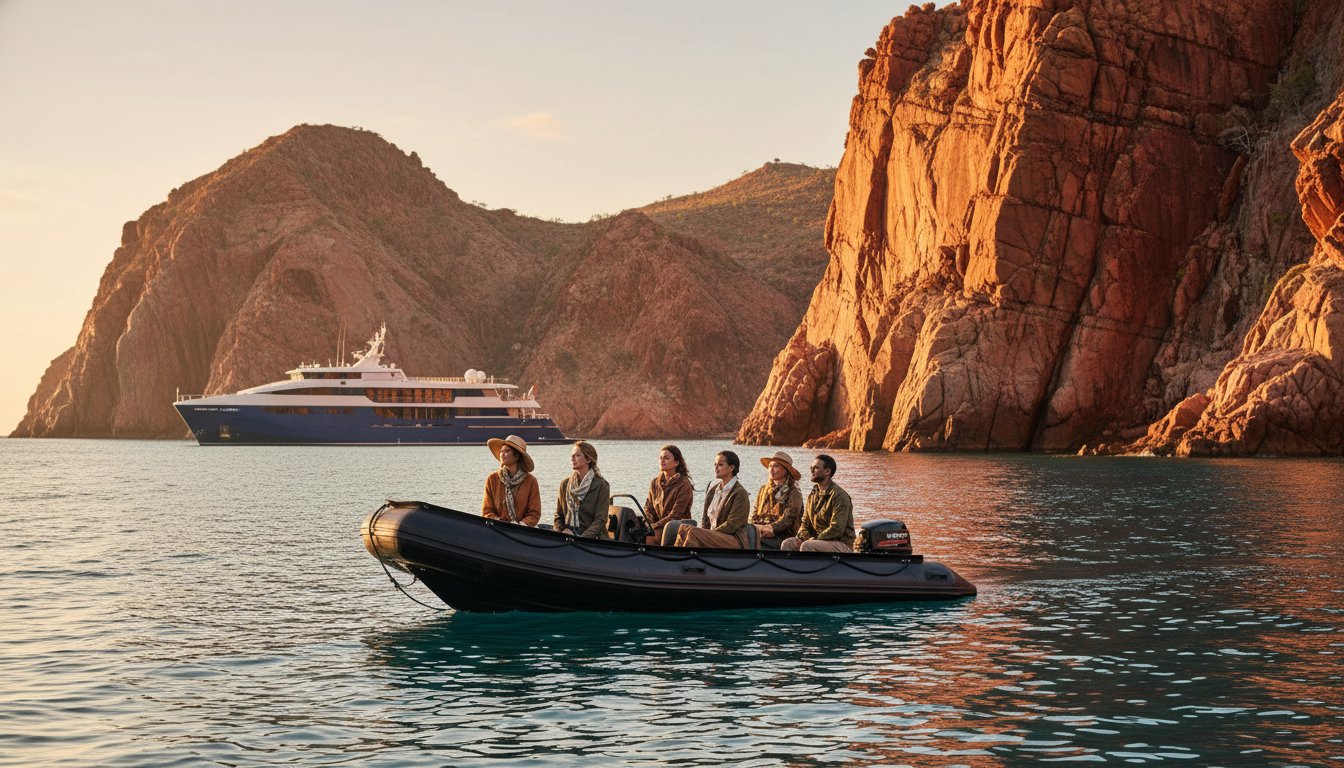
The most profound luxury in travel today isn't found in a gilded ballroom or a Broadway-style theatre at sea. It's found in the silence of a glass-still fjord where the only sound is the rhythmic exhale of a humpback whale. If you've ever worried about being just another number on a floating hotel, you're likely asking: what is expedition cruising, and how does it differ from the traditional cruise experience? At its heart, this is a deliberate shift from passive observation to active engagement with the world's most remote corners.
We understand the hesitation that often comes with the "expedition" label. You want the raw beauty of the Antarctic or the Kimberley, but you don't necessarily want to sacrifice a hot shower or a well-paired glass of wine. This guide will help you navigate the nuances of modern exploration. You'll discover how to choose a vessel that respects your physical comfort levels while providing unparalleled access to expert naturalists. We'll clarify the real value of these journeys, ensuring you feel confident stepping off the gangway and into the wild.
Key Takeaways
- Understand exactly what is expedition cruising by shifting your focus from the vessel as a destination to the ship as a sophisticated tool for deep discovery.
- Learn why the mudroom is the most critical space on board, acting as the bridge between your refined cabin and the raw, unscripted beauty of the wild.
- Discover the luxury of an opportunistic schedule, where the day is dictated by whale sightings and ice conditions rather than a rigid port-to-port itinerary.
- Identify how ship size and guest capacity directly influence your access to the shore and the frequency of your intimate encounters with nature.
- Gain clarity on the spectrum of comfort in remote environments, helping you choose a journey that balances your desire for refinement with an appetite for authentic exploration.
Defining the Expedition: A Shift in Perspective
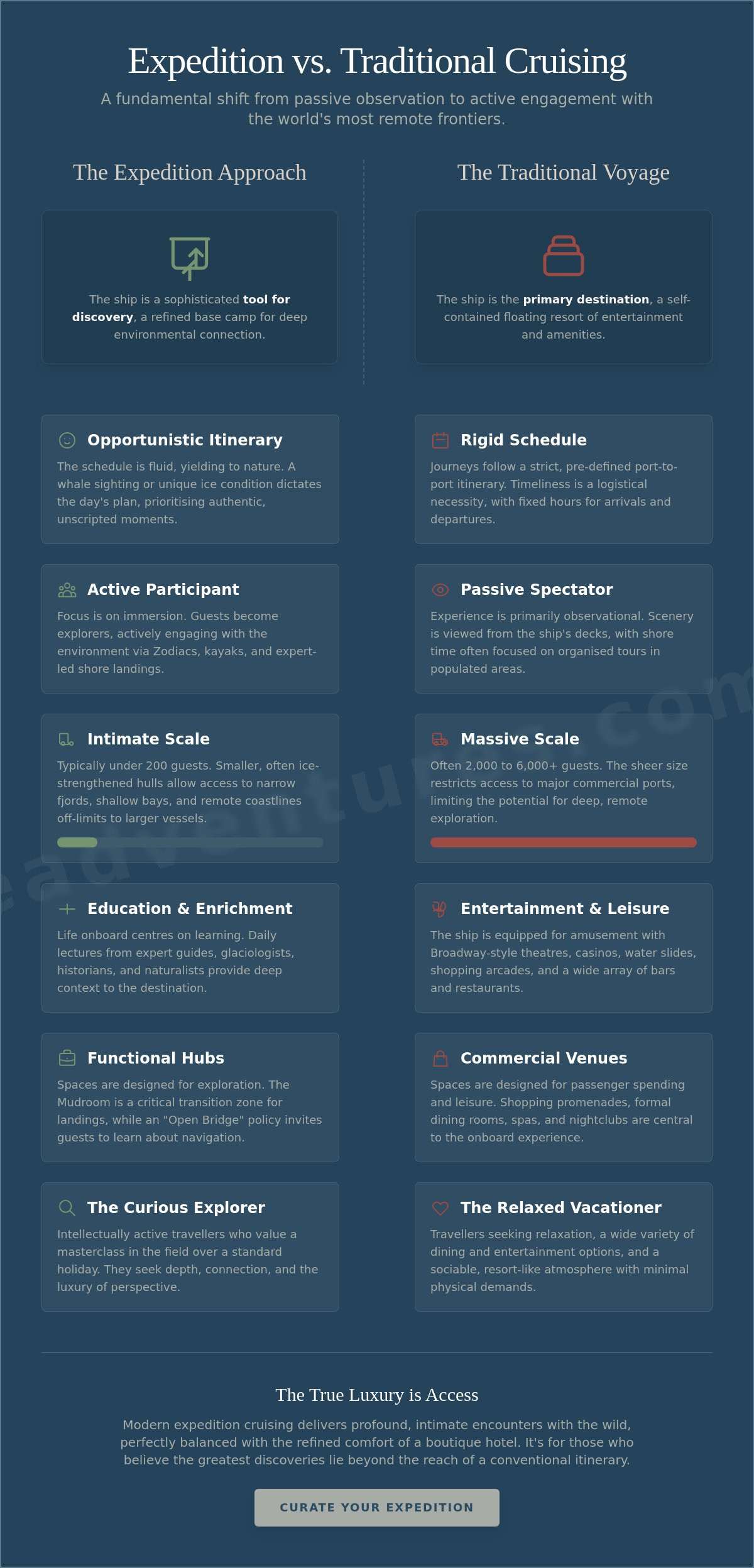
To understand what is expedition cruising, one must first abandon the notion of the ship as a floating amusement park. In the world of traditional cruise ships, the vessel is often the primary destination, a self-contained world of theatres, casinos, and high-street shopping. An expedition voyage flips this script entirely. Here, the ship is a sophisticated tool for discovery, a refined base camp designed to facilitate a deep, visceral connection with the environment outside your balcony window.
The core difference lies in the shift from spectator to participant. While a standard cruise might offer a distant view of a glacier from a towering deck, an expedition invites you to thread through the brash ice in a Zodiac or stand on a remote shore as a colony of Gentoo penguins goes about its business. It's what we call "soft adventure." It provides the physical engagement of an active journey but remains entirely accessible to mature travellers who appreciate a comfortable bed and a fine meal at the end of the day.
There's a distinct philosophy at play: nature is the captain. On a traditional itinerary, missing a port by thirty minutes is a logistical failure. In expedition cruising, a rigid schedule is the enemy of opportunity. If a pod of orcas appears off the bow or the morning light hits a limestone cliff in the Kimberley just so, the itinerary yields. This fluidity ensures that you aren't just ticking off coordinates; you're responding to the heartbeat of the wild.
The Philosophy of Access
Access is the true currency of modern exploration. Smaller, ice-strengthened hulls allow these vessels to navigate narrow fjords and shallow bays that are strictly off-limits to larger ships. This creates an atmosphere of profound intimacy. Standing in a landscape that very few humans have ever witnessed is an emotional experience that defies simple description. We've seen this sector evolve from spartan research-style vessels into the meticulously curated ships of today, where the transition from a rugged shore landing to a glass of vintage champagne is seamless.
Who is the Expedition Traveller?
The expedition mindset isn't defined by age or athletic prowess. It belongs to the curious and the intellectually active. Our clients are often accomplished professionals who seek a masterclass in the field rather than a standard holiday. They value the presence of glaciologists and historians over cabaret singers. There's a common misconception that you need to be an elite hiker to participate; in reality, the focus is on meaningful immersion. Whether you're navigating the Amazon or the Antarctic, the journey is about depth, connection, and the quiet luxury of perspective.
The Anatomy of an Expedition Ship: Your Refined Base Camp
If our previous section defined the explorer’s mindset, we must now look at the physical architecture that makes these journeys possible. When exploring what is expedition cruising, the vessel itself is best viewed as a precision instrument. Unlike the vast, insular hulls of the past, modern expedition ships are designed to bring the outside in. One of the key differences from traditional cruising is the "Open Bridge" policy. Here, you're often invited to stand alongside the officers, observing the charts and the radar as the ship weaves through ice floes or tropical archipelagos. It's a transparent, inclusive way to travel that treats you as a fellow explorer rather than a mere passenger.
The functional heart of the ship is the mudroom. This isn't a mere storage area; it's the transition point between the refined comfort of your suite and the raw elements of the frontier. It's where you swap your morning slippers for muck boots and where the scent of salt air first meets the ship’s climate-controlled interior. This space is essential for a seamless experience, providing a structured area to prepare for the day's landings without cluttering your private cabin with damp gear.
Luxury on these ships has undergone a profound evolution. We’ve moved beyond the spartan cabins of early research vessels to spaces that rival the world’s finest boutique hotels. You’ll find spas with panoramic views, fine dining that highlights regional flavours, and lounges encased in floor-to-ceiling glass. These features ensure you never miss a moment of the landscape, even while enjoying a quiet afternoon tea. If you're ready to see how these vessels compare for your next journey, you might consider requesting a curated comparison of current expedition fleets.
Zodiacs and the Art of the Landing
The Zodiac is the workhorse of the expedition. These sturdy, inflatable boats allow us to navigate shallow reefs or icy shorelines where no pier exists. There is a specific thrill in a "wet landing," where you swing your legs over the side and take your first step into the calf-deep water of a remote beach. Because these groups are small, the environmental footprint is kept to a minimum, allowing for an intimate connection with the landscape that a larger group simply cannot achieve.
The Onboard Expedition Team
Your journey is guided by a hand-picked team of naturalists, historians, and geologists. These aren't just lecturers; they are your companions at the dinner table and your guides in the field. The evening recap is a staple of the expedition experience, where the day’s sightings are decoded and put into context. This constant access to expertise ensures that every whale breach or ancient rock formation is understood as part of a larger, fascinating story.
Expedition vs. Traditional Cruising: A Study in Contrast
When distilling what is expedition cruising into its simplest form, it helps to view it as a choice between distraction and attraction. Traditional cruising often seeks to distract you from the sea with casinos, shopping malls, and Broadway-style spectacles. In contrast, an expedition vessel is designed to attract your attention outward. There are no art auctions or midnight buffets here. Instead, the evening’s entertainment might be a deep dive into glaciology or a spontaneous gathering on the deck to witness the ethereal glow of the midnight sun. It is a fundamental shift from being a passenger on a holiday to being a participant on a mission.
The most practical distinction, however, is one of scale and logistics. In sensitive regions like Antarctica, regulations from bodies like IAATO dictate that no more than 100 passengers can be ashore at any single landing site at one time. On a ship carrying 3,000 people, your chance of actually stepping onto the ice is non-existent. Even on ships with 300 or 400 guests, the logistics of ferrying everyone to shore in shifts can swallow your day. We prioritising vessels with a guest count usually under 200. This smaller footprint is the only way to ensure you spend your time exploring the frontier rather than waiting in a queue for a Zodiac.
The Itinerary is a Living Document
On a standard ocean cruise, the itinerary is a contract. On an expedition, it is a suggestion. This opportunistic approach is the hallmark of true exploration. If the Captain receives word of a pod of Orcas hunting nearby or discovers a rare break in the pack ice that allows entry into a secluded bay, the schedule yields. This "slow travel" philosophy allows us to spend four hours watching a glacier calve rather than rushing to meet a pilot boat at a commercial port. It removes the hurried, "tourist" feel of travel and replaces it with the unhurried rhythm of the natural world.
Service Refined by Experience
Luxury in this context isn't about gold-leafed ceilings; it's about the luxury of access and the calibre of the crew. These ships boast some of the highest crew-to-guest ratios in the maritime world, ensuring that service is personal, intuitive, and deeply informed. Because each vessel has a distinct personality, from rugged and research-focused to ultra-luxe and refined, the role of a bespoke travel designer is vital. We match your specific temperament and comfort requirements to the right ship, ensuring the experience feels like a natural extension of your own curiosity.
The Silent Frontiers: Where Expedition Cruising Leads
The destination is the ultimate justification for the vessel’s existence. When we define what is expedition cruising, we are essentially defining a commitment to reaching pivotal landscapes that remain largely untouched by mass tourism. These journeys follow a seasonal rhythm, with ships migrating between hemispheres to capture the brief windows of accessibility. It’s a nomadic existence that follows the sun, ensuring that whether you’re in the high south or the deep north, you’re witnessing nature at its most vibrant and unscripted.
These frontiers are best categorised by their distinct emotional and sensory "draw." The experience is a study in texture: the sharp, electric dry air of a polar plateau contrasted with the thick, scented humidity of a tropical rainforest. For those seeking to explore the hidden gems of Southeast Asia, Travel The Philippines offers the kind of tailored expertise needed to navigate remote island chains with precision. Unlike the predictable ports of a traditional cruise, these remote frontiers require a vessel or a bespoke itinerary that acts as a self-contained sanctuary, allowing you to immerse yourself in the environment without leaving a trace of your presence behind.
The Polar Giants: Antarctica and the Arctic
For many, an Antarctica cruise from Australia represents the final frontier of travel. It is a world of monochromatic brilliance where the silence is only broken by the thunderous crack of a calving glacier. There is a profound historical weight here; you’re navigating the same waters that tested the resolve of Shackleton and Mawson. The Arctic, by contrast, offers a softer palette of summer tundra and the constant, watchful presence of the polar bear. While the south is a continent of ice, the north is a frozen ocean surrounded by ancient cultures, providing a completely different narrative of survival and beauty.
Tropical and Coastal Curations
Expedition cruising isn't solely the province of the ice. A Galapagos Islands luxury cruise serves as a masterclass in evolution, where the wildlife has no innate fear of humans. Closer to home, the Kimberley region of Western Australia reveals an ancient, rugged frontier of rust-red gorges and horizontal waterfalls that is virtually inaccessible by land. From the winding tributaries of the Amazon to the isolated atolls of the South Pacific, these journeys provide a level of cultural and biological immersion that standard travel simply cannot replicate. If you are ready to venture into these pivotal landscapes, you can start planning your bespoke expedition journey here.
Navigating the Choice: Why Curation is Your Greatest Asset
Choice is the ultimate luxury, but only when it is informed. Understanding what is expedition cruising is merely the first step. The second is discerning which specific version of that reality belongs to you. The market is no longer a monolith; it is a broad spectrum that ranges from rugged, research-style vessels to ultra-luxury ships that feel like floating sanctuaries. Navigating this landscape requires more than a search engine. It requires a curated perspective that balances your appetite for adventure with your need for refinement.
Ship size remains the most critical variable in your journey. While we have discussed the regulatory limits of landings in previous sections, the practical reality is even more nuanced. A ship with 100 guests offers a level of nimbleness and landing frequency that a 200-guest vessel often cannot match. It means more time on the ice, more time in the Zodiac, and more time with the naturalists. This is a journey defined by qualitative value. You aren't just paying for a cabin; you're paying for the calibre of the expedition team and the technical capability of the hull to safely penetrate the deep wild.
This is where the role of a travel designer becomes indispensable. We look past the glossy brochures to the on-the-water reality, vetting the logistics that the average traveller might overlook. We know which ships have the most efficient mudroom layouts and which expedition leaders possess the deepest local insights. It is about ensuring that your investment in travel translates into an experience that is as seamless as it is profound.
Matching the Ship to the Soul
Deciding between a science-forward vessel and a wellness-forward luxury ship is a deeply personal choice. One might offer a state-of-the-art laboratory for citizen science projects, while another provides a glass-fronted sauna to thaw out after a morning of kayaking. We help you ask the essential questions: How many landings are scheduled each day? Is the gear provided top-tier? Who is the expedition leader? Our position within the Virtuoso network allows us to weave in layers of comfort, providing refined benefits like room upgrades or specialised credits that enhance the journey without distracting from the destination.
Beyond the Itinerary
The most successful expeditions are those that feel personally vetted. There is a profound peace of mind in knowing that every detail, from insurance to expert support in remote regions, is handled with care. This level of curation ensures that you are free to focus entirely on the landscape. Ultimately, an expedition is more than a holiday. It is an intentional act of exploration that doesn't just show you a new place; it changes your internal map. It is about depth over noise, and connection over the checklist.
Charting Your Path into the Wild
Ultimately, the answer to what is expedition cruising lies in the shift from being a passenger to becoming a participant. It is a commitment to depth over noise; it is the choice of a nimble hull over a crowded deck. We have explored how the right vessel acts as your refined base camp, where expert naturalists and flexible itineraries ensure that every moment is dictated by the environment rather than a clock. By prioritising access and intimacy, you transform a standard holiday into a profound connection with the earth’s most silent frontiers.
As a CLIA Master and Virtuoso Member, I specialise in soft adventure travel for the discerning explorer. My approach is built on personally vetted expedition partners and a deep understanding of the on-the-water reality. I don't just book a cabin. I curate a journey that matches your soul to the right ship. If you are ready to trade the traditional tourist path for a meaningful encounter with the remote, begin your curated journey with a Luxe Adventures travel designer. The world’s most extraordinary landscapes are waiting to be met on their own terms.
Frequently Asked Questions
Do I need to be in peak physical condition for an expedition cruise?
You don't need to be an elite athlete to participate in these journeys. Most expeditions are designed for anyone with reasonable mobility and a steady footing. The primary physical requirement is the ability to step in and out of a Zodiac and walk on uneven, sometimes slippery terrain. It's a form of soft adventure that prioritises accessibility, ensuring the wonders of the wild remain open to all curious travellers.
What is the difference between a "wet landing" and a "dry landing"?
A wet landing involves swinging your legs over the side of a Zodiac into calf-deep water to reach a remote beach. In contrast, a dry landing allows you to step directly onto a pier, a stable rock, or a slipway without getting your feet wet. Most polar and remote tropical landings are wet, which is why waterproof muck boots are a standard part of your provided expedition gear.
Will I get seasick on a smaller expedition ship?
Modern expedition vessels are fitted with sophisticated stabilisers that significantly dampen the ship's motion. While smaller ships do feel the swell more than a massive liner, they're also more nimble in navigating around rough weather. If you're concerned about crossing open water like the Drake Passage, we can discuss specific ship designs that handle the ocean's rhythm with exceptional grace and stability.
What kind of gear do I need to pack for a polar expedition?
Focus your packing on high-quality layers, specifically moisture-wicking wool or synthetic base layers and a mid-layer fleece. Most luxury expedition lines provide the heavy-duty, waterproof outer parka and the specialised muck boots for your shore excursions. This means you only need to bring waterproof trousers, warm socks, and a good pair of gloves to remain perfectly comfortable in the elements.
Are children allowed on expedition cruises?
Children are welcome on many vessels, though the environment is decidedly adult-focused and intellectually driven. Most lines have a minimum age requirement, often six or eight years old, to ensure safety during Zodiac operations. There are rarely dedicated kids' clubs; instead, the "entertainment" consists of educational lectures and wildlife sightings that appeal to older children with a genuine interest in nature and science.
How far in advance should I book an expedition cruise?
I recommend booking twelve to eighteen months in advance to secure your preferred suite and departure date. Because these ships carry fewer than 200 guests, the most desirable itineraries and peak-season windows fill up quickly. Booking early also ensures you benefit from any early-bird incentives and gives us ample time to curate the finer details of your pre- and post-cruise arrangements.
Is there Wi-Fi available in remote regions like Antarctica?
Reliable Wi-Fi is now widely available even in the most remote frontiers thanks to advanced satellite technology like Starlink. You'll be able to send emails, share photos, and stay in touch with family quite easily. However, speeds can vary depending on the ship's specific position and weather conditions, so it's best suited for staying connected rather than streaming high-definition video or large downloads.
What is the average age of travellers on an expedition cruise?
The average age typically sits between 45 and 75, though we're seeing an increase in younger professionals seeking deeper travel experiences. When understanding what is expedition cruising, it's helpful to know that the demographic is defined more by mindset than birth year. You'll be surrounded by well-travelled, intellectually active individuals who value quiet luxury and an authentic connection with the natural world.

Article by
Rachel Cleary
Rachel Cleary is the founder of Luxe Adventures and an endlessly curious explorer with a passion for meaningful, experience-led travel. Having visited every continent and travelled to more than 100 countries — and counting — she believes travel is one of the greatest educations for both children and adults alike.
Rachel is addicted to scuba diving and gets underwater at every opportunity. When she isn't in the office you'll find her exploring remote reefs in Fiji, drift diving in the Maldives, or scuba cruising Raja Ampat or French Polynesia.
Her second home is Fiji where she has explored all the island groups and has favourite boutique resorts she returns to every year, for the diving and the authentic Fijian hospitality.
Get her talking about kayaking in Antarctica or the Arctic, African safaris and where to find the highest density of big cats, underwater adventures, remote expedition destinations, or the science and magic behind the Northern Lights — including when and where they are most likely to dance — and you may be there a while.
Through Luxe Adventures, Rachel combines firsthand experience, global industry connections, and a deep appreciation for nature, culture, food, wildlife, and human connection to help curious travellers explore the world in a way that feels seamless, personal, and unforgettable.
Refined by experience. Defined by connection.
Disclaimer
The information in this article is intended as general travel inspiration and guidance only. Travel requirements, hotel standards, airline schedules, entry regulations, weather conditions, pricing, and experiences can change without notice.
While every effort is made to ensure accuracy at the time of publishing, Luxe Adventures recommends confirming all details relevant to your personal travel plans before booking or travelling.
Opinions, recommendations, and destination insights shared in this article are based on firsthand experience, industry knowledge, and research at the time of writing. Experiences may vary depending on season, supplier changes, local conditions, and individual travel preferences.
Some articles may reference luxury travel affiliations, preferred partner programs, or value-added amenities available through Luxe Adventures. Benefits and inclusions are always subject to availability and supplier terms at the time of booking.
Luxe Adventures strongly recommends comprehensive travel insurance for all international travel.
For personalised travel advice, tailored itinerary design, or the latest destination updates, please contact Luxe Adventures directly.


