
What if a french polynesia expedition cruise is less about going further for its own sake, and more about choosing the right islands to spend time among? Cruise descriptions can make one route sound much like another, while “expedition” may suggest a more demanding journey than you have in mind. In practice, the term points to a voyage shaped around access and discovery. Comfort and activity levels depend on the ship and itinerary.
The difference lies in how a route connects island groups, shore time and life on board. A voyage through the Society Islands feels different from one reaching the Tuamotus, the rugged Marquesas, or the Australs and Gambiers. The balance of landings, guided experiences and sailing days matters as much as the names on the itinerary.
In this guide, you’ll learn what sets expedition cruising apart, how to read an itinerary beyond its headline stops, and which experiences may suit your interests and preferred pace. Drawing on founder Rachel Cleary’s personal research into destinations and cruises, we’ll consider how to shape a French Polynesia journey around meaningful exploration, without assuming you want every day to be strenuous.
Key Takeaways
- Compare the Society Islands, Tuamotus and Marquesas by the character of their landscapes and experiences, not simply by the number of stops.
- Look beyond itinerary names to understand how shore visits and time on board shape the rhythm of a french polynesia expedition cruise.
- Expedition cruising doesn’t automatically mean roughing it. Consider the ship’s atmosphere and the activity level that feels right for you.
- Start with your priorities, then compare routes, pace and practical travel logistics.
- Personalised guidance can connect your interests with an itinerary’s character and the experience you want ashore.
What Makes a French Polynesia Expedition Cruise Different?
A French Polynesia expedition cruise is a voyage designed around how you experience each island, not simply how many ports appear on the itinerary. The distinction is in the shape of the journey: which island groups the route connects, how much time is set aside for exploring ashore, and how those days sit alongside time on board.
That matters in a Pacific destination where the character of one archipelago can differ markedly from another. French Polynesia comprises five archipelagos: the Society, Tuamotu, Marquesas, Austral and Gambier Islands. A route that includes several groups can offer contrasts in landscape and atmosphere. A voyage focused on one area may give you a more sustained sense of place. The itinerary is more than a sequence of names; it sets the pace and perspective of your journey.
How expedition cruising changes the island-to-island rhythm
A port-focused cruise may be organised around arriving, spending time ashore and moving on. An exploratory route places greater emphasis on how destinations connect and on the opportunities the itinerary provides to engage with them. The balance varies: some days may centre on time ashore, while others are devoted to sailing and taking in the changing seascape.
Look beyond the list of stops. The length and timing of visits, the planned pace and the transitions between islands all influence what a voyage feels like. Specific landings and activities depend on the itinerary, so consider them as part of its individual design rather than assuming they come with the word “expedition”. For a broader explanation of the format, see What is Expedition Cruising? A Discerning Guide to Modern Exploration.
Comfort and exploration can belong in the same voyage
“Expedition” describes an exploratory approach, not a promise of strenuous activity or roughing it. The practical question is what each day asks of you. A schedule with more time ashore may suit travellers keen to explore actively. A gentler rhythm may leave more room to observe, rest and enjoy the journey between destinations. Activity levels differ by itinerary.
Comfort, meanwhile, isn’t the opposite of discovery. Time on board can give the journey quieter intervals: a chance to absorb what you’ve seen, watch the light shift across the water and arrive at the next island unhurried. When comparing a french polynesia expedition cruise, consider the route, shore programme and onboard atmosphere together. That combination, rather than a label, tells you whether the voyage fits your preferred way of travelling.
Society Islands, Tuamotus, and Marquesas: How Route Shapes the Experience
French Polynesia isn’t one continuous stretch of similar islands. Its archipelagos bring different geographies and cultural contexts to a voyage, so the combination on your itinerary can shape the experience as much as the ship itself. Island-group combinations set the texture of a cruise: they influence what you see, what draws you ashore and how the journey unfolds between destinations.
What different island groups may bring to an itinerary
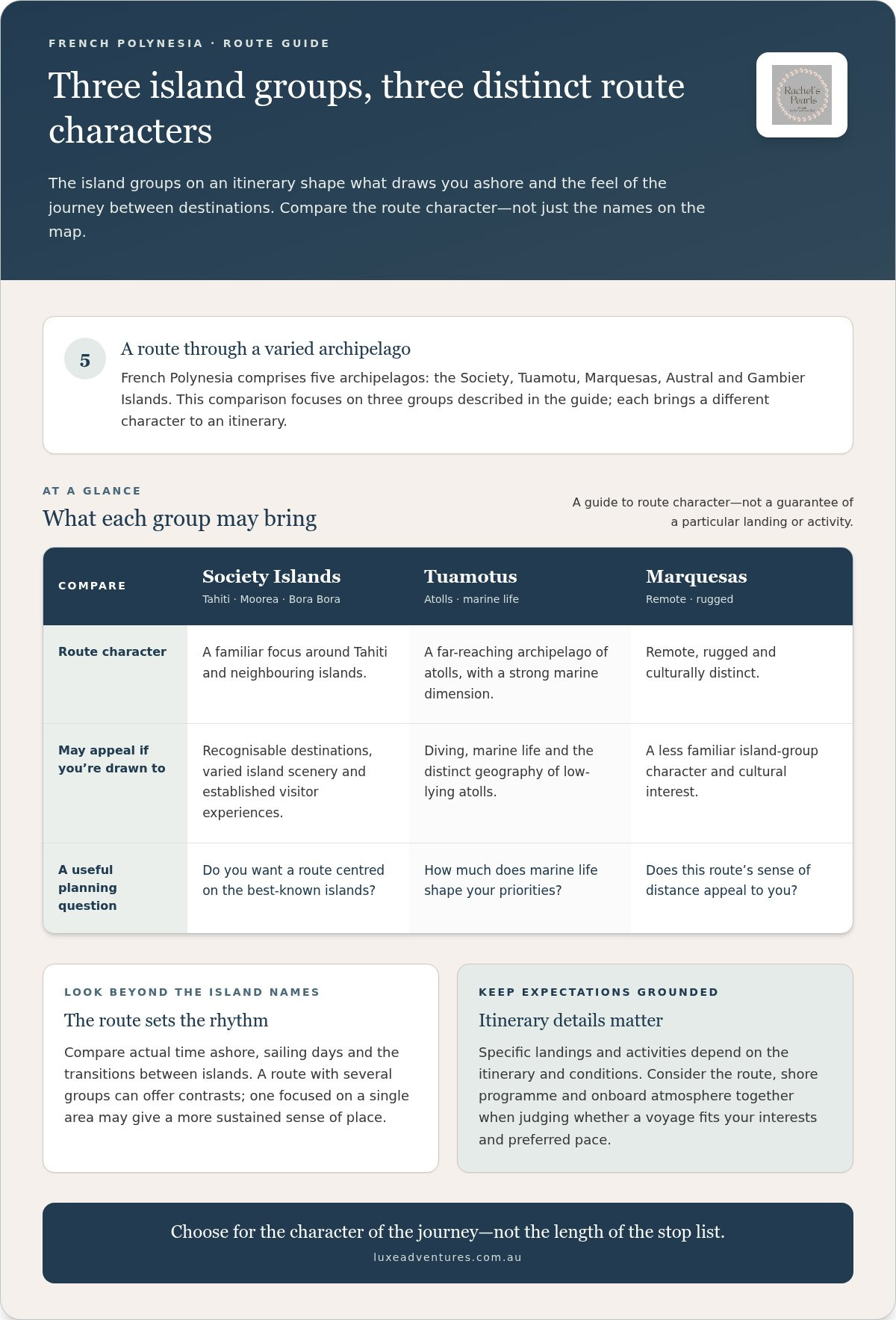
The Society Islands, including Tahiti, Moorea and Bora Bora, are the most visited group. They may suit you if you want a route anchored in familiar island names, varied scenery and established visitor experiences. By contrast, the Tuamotus are a far-reaching archipelago of atolls, often considered by travellers drawn to marine life and diving. The Marquesas offer another impression: remote, rugged and culturally distinct. They’re not simply another version of the Society Islands, and their place on a route can change its overall character.
For destination context and current island information, Tahiti Tourisme’s official website is a useful reference. The experiences available on a cruise depend on its specific itinerary and conditions. Treat an island-group name as a guide to the route’s character, not a guarantee of a particular landing or activity.
| Island group | Route character | May appeal if you’re drawn to | Planning question |
|---|---|---|---|
| Society Islands | A familiar focus around Tahiti and neighbouring islands | Recognisable destinations, varied island scenery and visitor experiences | Do you want a route centred on the best-known islands? |
| Tuamotus | Atolls and a strong marine dimension | Diving and the distinct geography of low-lying atolls | How much does marine life shape your priorities? |
| Marquesas | Remote, rugged and culturally distinct | A less familiar island-group character and cultural interest | Does this route’s sense of distance appeal to you? |
Match route character to your interests
Start with what you hope to notice: cultural connections, dramatic landscapes, marine life or variety across several island groups. Then compare how each itinerary turns those interests into actual time ashore and days at sea. A route featuring atolls may appeal to a different kind of curiosity from one focused on the Marquesas; neither is automatically the better choice. Conditions and the selected itinerary shape what’s possible.
If you’re weighing a french polynesia expedition cruise against a resort-led island stay, the contrast explored in Luxury Fiji Resort Packages: A Discerning Guide to Curated Island Travel offers another South Pacific perspective. For help matching route character with your priorities through Luxe Adventures, you can share what you’d like your voyage to centre on.
Ship, Shore Time, and Activity: Compare the Trade-offs Before Choosing
“Expedition” can sound like a polite way of saying uncomfortable. In French Polynesia, it describes an exploratory style of travel, not a requirement to trek across difficult terrain or spend every day in strenuous activity. A voyage can pair considered time ashore with a comfortable onboard routine. The balance differs from one cruise to another, and the label alone won’t tell you what a typical day involves.
What does expedition mean for activity and comfort?
Exploration might mean learning about a place through guided outings, cultural encounters or time observing the landscape, depending on the itinerary. It doesn’t automatically mean high exertion. Equally, “gentle” shouldn’t be assumed to mean effortless: transfers, uneven surfaces, heat or time spent on your feet may shape how an outing feels. Compare descriptions of activity duration, terrain and mobility considerations with your own preferences.
The onboard atmosphere is another part of the equation. Some travellers value a lively programme and regular departures ashore; others prefer space to read, watch the coast and let the day unfold. Neither approach is inherently more adventurous. Comfort and discovery can coexist, but the particular ship and voyage determine how they’re brought together.
How to assess time ashore and onboard balance
Look at the sequence of stops as well as their names. A schedule with frequent shore opportunities may feel active and varied. Longer stretches between visits can give the voyage a more measured rhythm, with more time spent at sea. The character of an outing matters too: a cultural visit, a walk and a marine-focused excursion make different demands on both energy and attention.
For a french polynesia expedition cruise, descriptions of shore time are useful indicators, not promises that every planned activity will take place. Itineraries and conditions affect what’s possible, and a wildlife encounter is never guaranteed. The Pew Charitable Trusts’ overview of marine conservation in French Polynesia offers context for why the ocean and its ecosystems are central to the region. That perspective can add depth to a marine-focused visit without implying a particular encounter.
As you compare voyages, weigh three things together: the onboard mood you’d enjoy, the amount and nature of time ashore, and the activity level you’re comfortable with. A cruise that looks compelling on a route map may feel quite different once you understand the day-to-day balance. The right fit is the one whose pace leaves you curious, not counting the hours until you can sit down.
Plan a French Polynesia Expedition Cruise Around Your Priorities
A good shortlist starts with your reasons for going, not with a ship name or an appealing photograph. A french polynesia expedition cruise can bring together very different island experiences, so decide what you most want to remember before comparing the details. Is it cultural connection, variety between island groups, time immersed in nature, or a slower rhythm with room to take it all in?
Start with the experience you want to bring home
Write down your leading priority, then separate essentials from pleasant extras. If marine life is central, the route and nature of its shore opportunities matter more than simply counting stops. If cultural experiences are the draw, look at how the itinerary describes time ashore and opportunities to engage with local places and communities. Broad images of turquoise water can be persuasive; they’re less useful as a guide to what a particular voyage includes.
Be candid about pace, too. Consider how often you’d like to go ashore, how much activity feels enjoyable and whether you want quiet stretches on board between visits. This keeps the choice grounded in the days you’ll actually experience, rather than an idealised version of travel.
Build a practical shortlist
Once your priorities are clear, compare a small number of itineraries against the same questions. This makes differences easier to see than browsing route names in isolation.
- Route: Which island groups does the voyage connect, and does that combination reflect your interests?
- Rhythm: How are time ashore, sailing days and onboard periods arranged?
- Shore opportunities: What does the itinerary describe about visits and activities? Which details are subject to conditions?
- Practicalities: How do the departure and return dates work with your travel connections and any time you’d like to spend in the region?
Then review dates and voyage particulars against the operator’s current information. Itineraries can change, and a destination name on a schedule doesn’t, by itself, explain the length or character of a visit. For broader context on the format, the guide What is Expedition Cruising? A Discerning Guide to Modern Exploration explores what expedition travel can mean beyond any one destination.
Planning is about finding coherence: the route should suit your curiosity, the pace should feel comfortable, and the practical arrangements should support the experience rather than crowd it. Luxe Adventures’ expedition-cruise specialists, with destination and cruise research led personally by founder Rachel Cleary, can help connect those considerations. Talk with Luxe Adventures about shaping your French Polynesia voyage.
Shape Your French Polynesia Expedition Cruise with Luxe Adventures
The right voyage isn’t necessarily the one with the longest itinerary or the most island names. It’s the one whose route, pace and onboard experience make sense for you. Luxe Adventures brings expedition-cruise expertise to French Polynesia planning, connecting what interests you with the character of different routes and the experience each voyage is designed to offer.
Personal research brings nuance to cruise planning
A considered shortlist goes beyond departure dates and headline stops. Each itinerary has its own character, shaped by the destinations it connects, its shore opportunities and the time spent on board. Comparing those elements together helps reveal whether a voyage’s rhythm suits you, rather than simply looking appealing on paper.
These details matter in different ways to different people. A traveller drawn to cultural connection may weigh a route differently from someone whose priority is marine life or unhurried days at sea. Luxe Adventures’ expedition-cruise specialists can interpret those distinctions and shape recommendations around your interests, preferred pace and practical needs. The aim isn’t to make every option sound perfect; it’s to make the differences clearer.
Luxe Adventures is a CLIA Master, bringing cruise-industry education and expertise to the planning process. That knowledge supports a considered comparison of voyage details, with recommendations tailored to the traveller and the specific sailing.
Begin shaping your voyage
You don’t need a fully formed itinerary to begin. A few useful starting points are enough: the island groups you’re curious about, the experiences you value most, how active you’d like your days to be, and the balance of shore time and sailing that feels appealing. From there, the route and voyage details can be considered in context, guided by current information for the sailing.
A well-designed journey leaves room for both discovery and ease. Perhaps you’re drawn to the cultural character of an island visit; perhaps it’s the quiet interval on deck as one island gives way to another. The details matter because they shape how the voyage feels, not merely what it contains.
If you’re beginning to imagine your own french polynesia expedition cruise, share what you hope to experience and the pace you prefer. Start a considered conversation about your voyage. A thoughtful first discussion can help turn broad interest into a journey with a character distinctly its own.
Let Your Priorities Set the Course
The most memorable journeys aren’t measured by how many places they include, but by how fully they reflect what matters to you. A french polynesia expedition cruise can be an invitation to travel with greater intention: to choose what you want to notice, how you want to spend your days, and how much space you’d like between moments of discovery.
There’s no need to have every detail settled before you begin. A clear sense of what draws you to French Polynesia is a useful starting point, whether that’s cultural connection, marine life, a particular island group or simply a more considered pace. From there, the route can take shape around your interests rather than an itinerary chosen by default.
When you’re ready to explore the possibilities, start shaping a French Polynesia voyage around what matters to you. A thoughtful conversation is a promising first step towards a journey that feels distinctly your own.
Frequently Asked Questions
Is a French Polynesia expedition cruise suitable if I want comfort as well as exploration?
Yes, it can be, provided the particular voyage suits your preferences. Expedition describes an exploratory focus, not a fixed standard of comfort or activity. Compare the ship’s onboard experience with the itinerary’s daily schedule, including how shore outings are described and how much time is spent travelling between stops. If you have mobility considerations or prefer gentler outings, review activity information closely before choosing.
What islands can a French Polynesia expedition cruise visit?
Routes may include Tahiti and the Society Islands, the Tuamotu Archipelago, or more remote groups such as the Marquesas, Austral and Gambier Islands. No one sailing covers the entire region, and the mix of destinations varies by voyage. Read the full stop sequence rather than relying on a broad “French Polynesia” label, then compare it with the islands and landscapes you most want to experience.
When is the best time to take a French Polynesia expedition cruise?
The best timing depends on your travel dates, chosen route and interests. Weather and wildlife conditions can vary, so a particular month can’t guarantee a specific experience. Compare current departure dates with up-to-date destination guidance and the operator’s information for that sailing. If a seasonal activity is central to your plans, treat it as a consideration, not a promised feature of the voyage.
Can I experience local culture on a French Polynesia cruise?
Yes, cultural experiences may be part of a cruise, depending on its itinerary and the opportunities available at each stop. Look for clear descriptions of time ashore and planned experiences, rather than assuming every port call offers the same access or depth. A little preparation can also help you approach visits with curiosity and respect, while staying open to the character of each place.
How long should a French Polynesia expedition cruise be?
There’s no universal ideal duration. Consider how many island groups you hope to include, the pace you enjoy and whether the cruise is part of a longer stay in the region. A useful comparison is the complete route: note the sequence of stops and the time allowed at each, not just the total number of nights. Review the voyage duration and itinerary details when comparing sailings.
What wildlife might I see on a French Polynesia expedition cruise?
Marine life and birdlife may be among the interests of a voyage, with potential sightings depending on where the route travels, the timing and local conditions. Encounters can’t be guaranteed. For a clearer sense of a particular sailing’s focus, review its naturalist or excursion information. During any wildlife viewing, follow the guidance provided and allow animals space.
How is an expedition cruise different from a conventional cruise in French Polynesia?
An expedition cruise generally gives greater emphasis to exploring destinations and the possibilities ashore, while a conventional cruise may place more weight on the overall ship-and-port itinerary. Those are broad distinctions, not promises of particular activities or landings. Compare specific voyages by looking at the route, shore programme, day-to-day schedule and onboard experience. Those details reveal more than the cruise category alone. To shape a voyage around your interests and preferred pace, talk with Luxe Adventures.
Article by
Rachel Cleary
Rachel Cleary is the founder of Luxe Adventures and an endlessly curious explorer with a passion for meaningful, experience-led travel. Having visited every continent and travelled to more than 100 countries — and counting — she believes travel is one of the greatest educations for both children and adults alike.
Rachel is addicted to scuba diving and gets underwater at every opportunity. When she isn't in the office you'll find her exploring remote reefs in Fiji, drift diving in the Maldives, or scuba cruising Raja Ampat or French Polynesia.
Her second home is Fiji where she has explored all the island groups and has favourite boutique resorts she returns to every year, for the diving and the authentic Fijian hospitality.
Get her talking about kayaking in Antarctica or the Arctic, African safaris and where to find the highest density of big cats, underwater adventures, remote expedition destinations, or the science and magic behind the Northern Lights — including when and where they are most likely to dance — and you may be there a while.
Through Luxe Adventures, Rachel combines firsthand experience, global industry connections, and a deep appreciation for nature, culture, food, wildlife, and human connection to help curious travellers explore the world in a way that feels seamless, personal, and unforgettable.
Refined by experience. Defined by connection.
Disclaimer
The information in this article is intended as general travel inspiration and guidance only. Travel requirements, hotel standards, airline schedules, entry regulations, weather conditions, pricing, and experiences can change without notice.
While every effort is made to ensure accuracy at the time of publishing, Luxe Adventures recommends confirming all details relevant to your personal travel plans before booking or travelling.
Opinions, recommendations, and destination insights shared in this article are based on firsthand experience, industry knowledge, and research at the time of writing. Experiences may vary depending on season, supplier changes, local conditions, and individual travel preferences.
Some articles may reference luxury travel affiliations, preferred partner programs, or value-added amenities available through Luxe Adventures. Benefits and inclusions are always subject to availability and supplier terms at the time of booking.
Luxe Adventures strongly recommends comprehensive travel insurance for all international travel.
For personalised travel advice, tailored itinerary design, or the latest destination updates, please contact Luxe Adventures directly.


