

The most critical feature of your polar vessel isn't the thread count of your linens or the vintage in the cellar; it is a hidden engineering grade that dictates exactly where the ice will let you pass. When planning a journey to the ends of the Earth, understanding what is an ice class rating for ships becomes the difference between a standard cruise and a true expedition. You've likely encountered cryptic codes like PC6 or 1A Super while researching. It's natural to feel a sense of confusion. These technical designations shouldn't feel like a barrier to your dream of reaching the deep south or the far north.
We understand that safety in remote polar regions is your first priority. You want the confidence that your ship is a sanctuary, not just a transport. This guide demystifies the technical nuances of polar exploration to show how these ratings define the safety and reach of your luxury expedition. We'll explore the hierarchy of the Polar Code, how hull reinforcement impacts your itinerary, and why a vessel's rating determines if you can witness the raw, untouched beauty of the high Arctic or the Antarctic interior.
Key Takeaways
- Understand exactly what is an ice class rating for ships and how these structural reinforcements dictate a vessel's ability to safely penetrate various ice conditions.
- Decode the Polar Code hierarchy, from PC1 to PC7, to identify which vessels are engineered for deep polar exploration versus those suited for seasonal summer sailing.
- Discover how a ship’s rating serves as a legal permit for geographic access, determining which secluded bays and ice-choked channels your Captain can safely enter.
- Learn why your choice of vessel must align with your specific travel dates, especially during the early season when ice remains thick and formidable.
- Gain the clarity needed to select a ship that matches your appetite for adventure through our expert curation of specialised expedition cruises.
The Language of the Frozen Frontier: Defining Ice Class
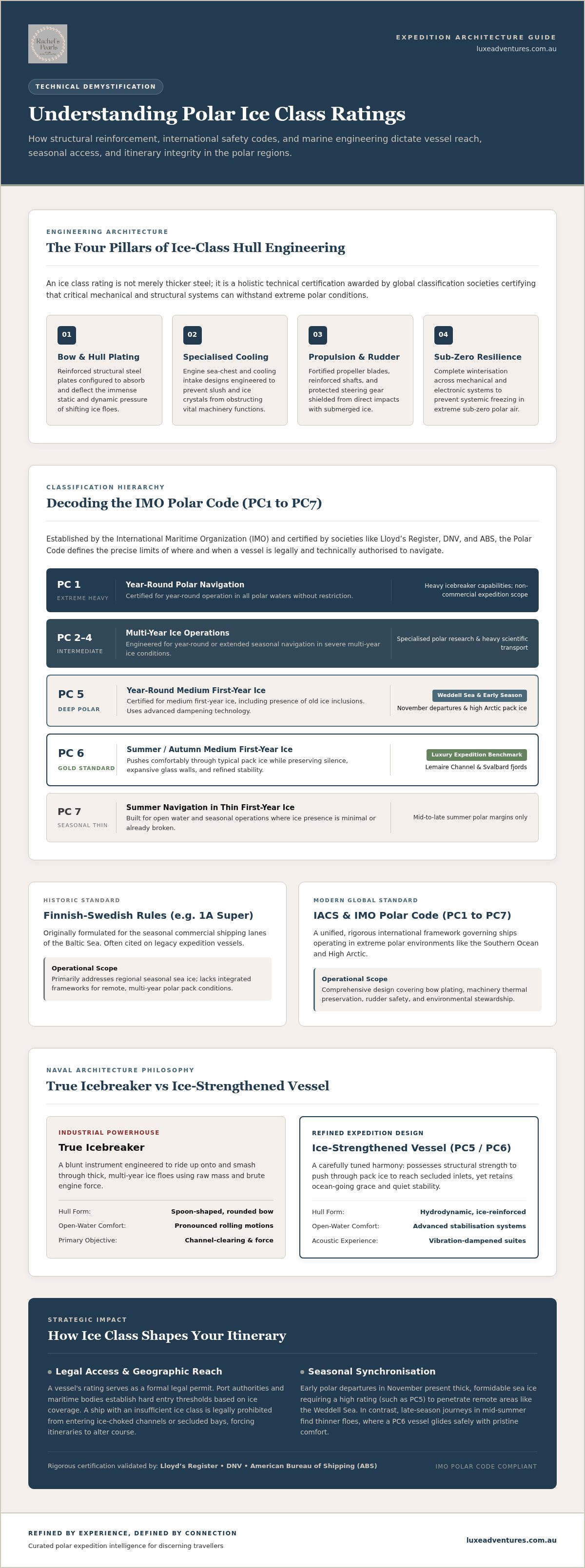
To the untrained eye, a ship is simply a vessel. To a seasoned explorer, it is a complex architecture of resilience. At its core, what is an ice class rating for ships? It is a formal notation assigned by classification societies that certifies a vessel's structural ability to navigate through specific ice conditions. This isn't merely about thicker steel; it is a holistic engineering standard encompassing engine requirements, specialised cooling systems, and reinforced propulsion machinery. These ratings form the invisible foundation of safety in the volatile waters of the Southern Ocean and the High Arctic, ensuring the hull can withstand the immense pressure of shifting floes.
The Evolution from Baltic to Global Standards
Historically, the benchmark for ice navigation was defined by the Finnish-Swedish Ice Class rules, designed primarily for the seasonal ice of the Baltic Sea. While these served the industry well for decades, the surge in polar exploration necessitated a more robust, global framework. This led to the adoption of the IACS Polar Code, which provides a unified set of ice class rating systems for ships operating in extreme environments. Modern expedition vessels often carry these newer notations, whereas older ships might still refer to Baltic standards. This distinction is vital, as a modern Polar Class vessel is built with a different philosophy of endurance than its predecessors.
Classification Societies: The Arbiters of Strength
The integrity of these ratings is upheld by prestigious classification societies such as Lloyd’s Register, DNV, and ABS. These bodies act as the ultimate arbiters of strength, conducting rigorous testing and hull inspections before a ship ever touches salt water. An ice notation on a technical certificate is the result of years of meticulous design and firsthand validation. It dictates everything from the thickness of the bow plating to the ship's ability to operate in sub-zero temperatures without critical systems failing.
In the luxury sector, you'll often hear the term 'ice-strengthened' used alongside 'icebreaker'. It's a distinction worth understanding. A true icebreaker is a blunt instrument, designed to smash through thick multi-year ice with brute force. In contrast, the hand-picked vessels we prioritise are often highly rated ice-strengthened ships. They offer a refined balance; they possess the strength to push through pack ice to reach secluded inlets, yet they retain the grace and stability required for a sophisticated travel experience. They are built not just to survive the ice, but to navigate it with intentionality and purpose.
Decoding the Polar Code: From PC1 to PC7
The IMO Polar Code serves as the definitive framework for modern exploration. It ranks ships from PC1, capable of year-round operation in all polar waters, down to PC7, suited for summer navigation in thin ice. When asking what is an ice class rating for ships in the context of your own travel, you are essentially asking about the boundaries of your vessel's reach. Most modern luxury expedition ships are built to PC6 or PC5 standards. This engineering isn't just about hull thickness. It includes protected rudders, reinforced propellers, and engine cooling systems designed to prevent ice crystals from choking the ship's vital organs.
PC6: The Standard for Modern Luxury Expeditions
A PC6 rating is widely considered the "gold standard" for contemporary polar travel. These vessels are engineered for summer and autumn operation in medium first-year ice. This rating allows a ship to glide through the Lemaire Channel or navigate the fjord systems of the Svalbard archipelago with grace. It offers an ideal balance. The ship is robust enough to handle the pack ice typical of a standard season, yet the engineering is refined enough to allow for expansive glass walls and silent, vibration-free suites. It is the perfect choice for those who want to witness the raw beauty of the ice without sacrificing the comforts of a five-star retreat.
PC5 and Above: The Heavy Hitters of Exploration
PC5 vessels are the heavy hitters of the luxury world. They are certified for year-round operation in medium first-year ice, including the presence of old ice inclusions. This rating becomes essential for those seeking "deep" expeditions, such as journeys into the Weddell Sea or very early-season departures in November. While some worry that a higher rating implies a noisier, more industrial experience, modern PC5 ships use sophisticated dampening technology to maintain a serene atmosphere. They provide the certainty needed to push further into the frozen wilderness when others must turn back. If you are debating between these technical grades, we can help you curate a vessel selection that aligns perfectly with your desired level of immersion.
Beyond the Hull: How Ratings Shape Your Itinerary
An ice class rating is far more than a technical safety badge; it is a permit for geographic access. When you ask what is an ice class rating for ships, you're essentially asking which maps your Captain is allowed to unfold. Under the International Maritime Organization's Polar Code, a vessel’s certification dictates the exact density and thickness of ice it can legally enter. This means your ship’s rating is the silent architect of your daily itinerary, deciding which secluded bays, narrow channels, and pristine inlets are open for exploration and which remain tantalisingly out of reach.
Accessing the Deep South and the High North
The quest for the Weddell Sea or the remote Ross Sea in Antarctica requires more than just ambition. It requires a hull that the ice respects. In these regions, where multi-year floes can block traditional paths, a PC5 or PC6 rating becomes the ultimate gatekeeper. Similarly, navigating the legendary Northwest Passage is a feat of engineering endurance. The experience of being on a highly rated vessel is profoundly sensory. There is a specific, resonant sound, a rhythmic crunch and thrum, as a reinforced hull gently displaces first-year ice. It is the sound of a ship that is truly in its element, allowing you to penetrate deep into the frozen heart of the wilderness where others cannot follow.
The Luxury of Time: Avoiding the 'Ice Trap'
The polar environment is famously unpredictable. A lead that is open in the morning can be choked by pack ice by the afternoon. This is where a superior ice class offers the luxury of tactical flexibility. A ship with a higher rating provides the Captain with more options during shifting weather patterns. Rather than being forced into a premature retreat to open water, an over-engineered vessel can wait for a lead to open or safely "push" through a belt of ice to reach a calmer harbour.
This peace of mind is central to what is expedition cruising at its most refined level. Knowing your vessel is built to exceed the demands of the environment allows you to focus entirely on the transformative experience of the journey. You aren't just a passenger on a ship; you're a guest on a platform designed for total immersion, where the technical specs of the hull serve only to enhance the depth and reach of your discovery.
Safety, Seasonality, and the Sensory Experience
Navigation in the polar regions is a rhythmic dance with the seasons. While mid-summer offers clear leads and melted fjords, the early spring requires a deeper understanding of what is an ice class rating for ships. In November, the Antarctic ice is at its most formidable. It is pristine, unbroken, and demands a vessel with a high degree of structural respect. This seasonality determines not just where you can go, but how close you can get to the raw, visceral action of the ice edge. A ship's rating acts as a silent guarantee that your journey remains on schedule even when nature remains stubborn.
Early Season Expeditions: The PC5 Advantage
Witnessing the 'giant' tabular icebergs of early spring before they fracture into smaller bergy bits is a highlight of early departures. For those booking an Antarctica cruise from Australia, a PC5 rating often provides a distinct edge. It allows the vessel to reach emperor penguin colonies or penetrate shore-fast ice that remains locked tight until December. These ships possess the sheer mass and reinforcement needed to nose into the ice, providing a stable platform for photography and wildlife observation that lesser-rated ships simply cannot match.
Wildlife viewing is a game of proximity and patience. A ship’s rating determines if you can safely park against the ice edge to observe crabeater seals or wait for a pod of orcas. This technical capability is masterfully utilised by the 'Ice Pilot'. These are seasoned mariners, often with decades of polar experience, who interpret the ice's subtle movements and work in tandem with the ship’s hull strength. Safety protocols under the Polar Code also mandate that every vessel carries specialised survival gear and polar-grade lifeboats. These requirements ensure that the crew is as prepared as the ship itself, providing a layer of security that matches the raw power of the environment.
The Quiet Luxury of Polar Engineering
Modern luxury is defined by silence. Newer PC6 vessels often employ advanced Azipod propulsion systems that can rotate 360 degrees. These systems allow the Captain to navigate through ice floes with surgical precision while significantly reducing the noise and vibration found in older, converted research ships. It’s a common misconception that 'soft adventure' implies soft engineering. In reality, the most refined and quietest experiences are built upon the most robust engineering foundations. You can enjoy a glass of champagne in a silent suite while the ship effortlessly handles the pressure of the pack ice outside. To ensure your journey matches your expectations for both comfort and access, you can enquire about our vetted polar vessels today.
Refined by Experience: Choosing Your Polar Vessel
Selecting the right vessel is an exercise in discerning curation. While brochures often focus on the aesthetics of the observation lounge, we look deeper into the engine room and the hull’s certification. Understanding what is an ice class rating for ships is only the first step. The true value lies in knowing how that rating interacts with a specific cruise line's operational philosophy. A mass-market ship might carry an ice-strengthened hull, but it often lacks the specialised equipment and maneuverability of a purpose-built expedition vessel. We prioritise ships that offer the highest safety margins without compromising the intimate, raw connection to the landscape that defines true exploration.
The Curation Factor: Why We Vette Every Ship
Our vetting process is rigorous and personal. We investigate the actual build specs of every new expedition ship, looking beyond marketing jargon to verify their PC5 or PC6 credentials. This firsthand validation is why we maintain deep relationships with expedition leaders and captains who have navigated these waters for decades. They provide the ground-truth on how a ship performs when the ice closes in or how it handles the swells of the Drake Passage. This level of insight is exactly why a bespoke travel designer is critical. We don't just book a cabin; we architect a journey based on the vessel’s technical soul. As Virtuoso members and CLIA Masters, we also ensure our clients receive exclusive benefits, such as shipboard credits or private shore excursions, that enhance the luxury of the expedition.
Your Next Chapter in the Ice
In the world's most remote regions, substance will always outweigh style. A beautiful suite is of little comfort if the ship cannot reach the specific penguin colony or glacier you’ve dreamed of visiting. When you ask what is an ice class rating for ships, you are really asking for a guarantee of experience. We match your specific appetite for adventure with a ship that possesses the structural integrity to deliver it. Whether you seek the early-season silence of the Antarctic or the historic leads of the Northwest Passage, your journey should be as safe as it is transformative. It's about finding that rare vessel that feels like a private sanctuary while acting like a formidable explorer.
It's time to look beyond the surface. Design your bespoke polar expedition with Luxe Adventures and ensure your next chapter in the ice is written with confidence and expertise.
Charting Your Course Through the Ice
A polar expedition is one of the most profound commitments a traveller can make. It's a journey where technical integrity determines the very texture of your experience. Understanding what is an ice class rating for ships empowers you to look beyond the aesthetic allure of a suite and into the structural soul of the vessel. Whether you seek the early-season majesty of tabular icebergs or the historic leads of the Northwest Passage, the right rating ensures your safety and guarantees your reach. Access is the ultimate luxury.
At Luxe Adventures, we specialise in translating these technical nuances into transformative journeys. As a CLIA Master and Virtuoso member, we offer more than just industry insight; we provide a curated selection of personally vetted expedition partners. This firsthand expertise ensures that your ship is not only a sanctuary of refinement but a formidable tool for discovery. Your next chapter in the frozen frontier deserves the precision of a seasoned architect. We invite you to step into the quiet authority of a perfectly planned voyage.
Begin your curated polar journey with Luxe Adventures and discover the ends of the Earth with absolute confidence.
Frequently Asked Questions
Is a PC6 ship safe for Antarctica?
A PC6 vessel is exceptionally safe and remains the gold standard for modern luxury expeditions to the Antarctic Peninsula. These ships are engineered to navigate medium first-year ice during the summer and autumn seasons. While they aren't designed to smash through thick multi-year ice, they provide a robust safety margin for the conditions most travellers encounter. We prioritise PC6 and PC5 vessels because they offer the ideal balance of structural integrity and refined passenger comfort.
What is the difference between an icebreaker and an ice-strengthened ship?
The primary difference lies in their design intent and hull shape. A true icebreaker features a reinforced, blunt bow designed to ride up onto thick ice and crush it using the ship's weight. In contrast, an ice-strengthened ship has a reinforced hull and protected machinery to resist ice pressure and push through first-year floes. Most luxury vessels are ice-strengthened, as this design offers better stability and a smoother ride in open water than a traditional icebreaker.
Does a higher ice class rating make the ship more stable in rough seas?
An ice class rating focuses on structural strength rather than sea-keeping abilities. While a higher rating implies a reinforced hull, it doesn't automatically guarantee better stability in the open ocean. Stability in rough seas, such as the Drake Passage, is primarily managed by advanced stabiliser fins and the ship's geometry. When discussing what is an ice class rating for ships, it's vital to remember it's a measure of ice resistance, not a shield against swell.
Can a ship with a lower ice rating still visit the Arctic?
Ships with lower ratings, such as PC7 or older Baltic 1D notations, can visit the Arctic during the peak of summer when many coastal areas are ice-free. However, these vessels face significant geographic limitations. They cannot safely enter ice-choked fjords or navigate narrow channels where pack ice might linger. If your goal is to reach the high Arctic or follow the path of historic explorers, choosing a vessel with a higher rating is essential for itinerary flexibility.
How do I find out the ice class rating of a specific cruise ship?
You can typically find this information in the technical specifications section of a cruise line’s digital brochure or website. However, these ratings are sometimes listed under older Baltic systems or newer Polar Code notations, which can be confusing. As specialised travel designers, we maintain a database of build specs for every ship we recommend. We'll verify the exact rating of a vessel to ensure it aligns with the ice conditions expected during your travel dates.
Do ice class ratings expire or change over time?
A ship's ice class rating doesn't expire, but it is subject to rigorous, periodic inspections by classification societies like Lloyd's Register or DNV. These surveys ensure the hull's integrity remains intact after years of service. While the rating itself is permanent, the introduction of the mandatory Polar Code in 2017 required many older vessels to undergo assessments to receive a Polar Ship Certificate. This ensures that every ship operating in these regions meets current international safety standards.
Why is the Finnish-Swedish ice class still mentioned alongside the Polar Code?
The Finnish-Swedish system remains relevant because it was the global benchmark for decades before the Polar Code was unified. Many existing expedition ships were built to these Baltic standards, such as 1A Super or 1A. When learning what is an ice class rating for ships, you'll see these terms used to describe a vessel's capability in seasonal ice. Modern builders now prioritise Polar Class (PC) notations, but the industry still references Baltic rules for comparison.
Does insurance require a certain ice class for polar travel?
Maritime insurance providers require ship operators to adhere to the operational limits defined by their ice class. If a Captain enters ice that exceeds the vessel's certified capacity, the insurance coverage could be voided. For travellers, this provides an extra layer of safety, as it legally prevents ships from entering dangerous conditions. We always recommend that our clients take out comprehensive travel insurance that specifically covers polar regions and the costs of emergency medical evacuation.

Article by
Rachel Cleary
Rachel Cleary is the founder of Luxe Adventures and an endlessly curious explorer with a passion for meaningful, experience-led travel. Having visited every continent and travelled to more than 100 countries — and counting — she believes travel is one of the greatest educations for both children and adults alike.
Rachel is addicted to scuba diving and gets underwater at every opportunity. When she isn't in the office you'll find her exploring remote reefs in Fiji, drift diving in the Maldives, or scuba cruising Raja Ampat or French Polynesia.
Her second home is Fiji where she has explored all the island groups and has favourite boutique resorts she returns to every year, for the diving and the authentic Fijian hospitality.
Get her talking about kayaking in Antarctica or the Arctic, African safaris and where to find the highest density of big cats, underwater adventures, remote expedition destinations, or the science and magic behind the Northern Lights — including when and where they are most likely to dance — and you may be there a while.
Through Luxe Adventures, Rachel combines firsthand experience, global industry connections, and a deep appreciation for nature, culture, food, wildlife, and human connection to help curious travellers explore the world in a way that feels seamless, personal, and unforgettable.
Refined by experience. Defined by connection.
Disclaimer
The information in this article is intended as general travel inspiration and guidance only. Travel requirements, hotel standards, airline schedules, entry regulations, weather conditions, pricing, and experiences can change without notice.
While every effort is made to ensure accuracy at the time of publishing, Luxe Adventures recommends confirming all details relevant to your personal travel plans before booking or travelling.
Opinions, recommendations, and destination insights shared in this article are based on firsthand experience, industry knowledge, and research at the time of writing. Experiences may vary depending on season, supplier changes, local conditions, and individual travel preferences.
Some articles may reference luxury travel affiliations, preferred partner programs, or value-added amenities available through Luxe Adventures. Benefits and inclusions are always subject to availability and supplier terms at the time of booking.
Luxe Adventures strongly recommends comprehensive travel insurance for all international travel.
For personalised travel advice, tailored itinerary design, or the latest destination updates, please contact Luxe Adventures directly.


