

A world tour is a route, not a race. Knowing how to plan a world tour from Australia starts with choosing an eastbound or westbound direction, then shaping a route that starts and finishes in Australia without backtracking. A Star Alliance round-the-world ticket can include two to 15 stops.
It’s tempting to fit in every destination you’ve dreamed about. But the most rewarding itineraries leave room to settle in, linger over a long lunch and enjoy each place between arrivals and departures.
This guide explains what a world tour can involve, how to choose destinations and set a comfortable pace, and how to coordinate accommodation and transport. You’ll also learn how to shape the final leg around rest, whether that means a quiet island stay or a few unhurried days somewhere far from the airport lounge.
Key Takeaways
- Choose a trip length that gives your priority destinations room to breathe, rather than squeezing in stops for the sake of a longer list.
- Build a realistic pace by weighing time in each destination against the travel days between them.
- Match accommodation and transport to the shape of your itinerary, and leave space for a restorative final stay.
- For a journey centred on wildlife and a sense of place, consider how an African safari could become a defining part of your route.
How many destinations should I choose?
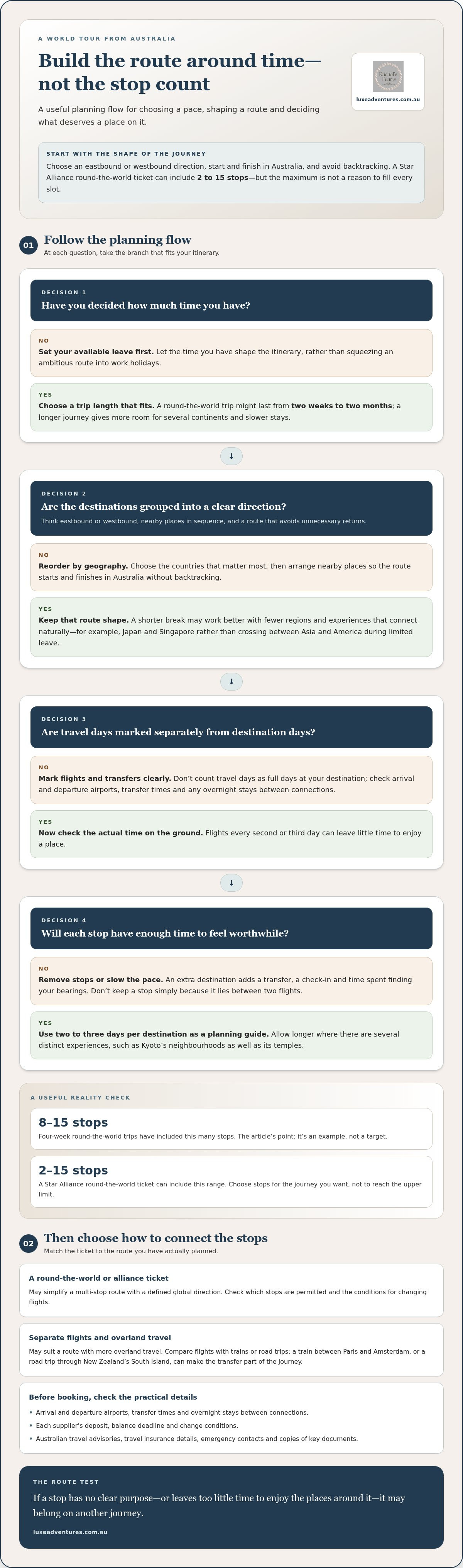
Choose destinations by the time you have, not by how many names fit on a map. Four-week round-the-world trips have included 8 to 15 stops, but that range isn’t a target. Each extra stop adds a transfer, a check-in and time spent finding your bearings. A clear first step in how to plan a world tour from Australia is choosing a route that leaves time to enjoy each stop.
Protect time for the experience itself. Flights every second or third day can leave little time to enjoy the sights, while two to three days per destination is a useful planning rule. Allow longer stays in places with several distinct experiences, such as exploring Kyoto’s neighbourhoods as well as its temples.
First, group destinations by geography and choose an eastbound or westbound direction. Then compare flights with overland routes: a train between Paris and Amsterdam may make more sense than returning to an airport. Mark travel days clearly in your itinerary instead of counting them as full days at your destination.
If you’re deciding how to plan a world tour from Australia, compare a round-the-world ticket with separate bookings for each leg. An alliance ticket can simplify a multi-stop route, while separate flights may suit an itinerary with more overland travel. Before booking, map arrival and departure airports, transfer times and any overnight stays needed between connections.
Overland travel can turn a transfer into part of the journey. For example, take the train from Florence to Rome or plan a road trip through New Zealand’s South Island. Allow enough time for each route, and avoid adding a stop simply because it lies between two flights.
Build payment dates and travel support into your booking plan. Suppliers set their own deposits, balance deadlines and change conditions, so record each date beside the relevant flight, hotel or tour. Keep confirmations and emergency contacts together, and decide whom to contact if a connection or experience changes.
For safety, review Australian travel advisories for every destination and prepare emergency contacts, travel insurance details and copies of key documents. Check how to reach local emergency services and your insurer while travelling between destinations.
What is a Round the World Trip?
A round-the-world trip links several countries into one broad journey, often using a ticket with a defined route. Some travellers use an alliance ticket; others combine separate one-way bookings to build a route around the places they most want to experience.
There’s no universal best month to start from Australia. Choose a Sydney departure date by comparing seasonal conditions and priority experiences across your planned countries, then work backwards to fit the route.
Trip Length and Time Off Work
Let your available leave shape the itinerary, rather than planning an ambitious route and trying to squeeze it into work holidays. A round-the-world trip might last from two weeks to two months; a longer journey gives more room for several continents and slower stays. Most round-the-world tickets have a minimum duration of 10 days, while many airline alliances allow up to one year to use a ticket.
For a shorter break, choose fewer regions and focus on experiences that connect naturally. For example, combine Japan with Singapore rather than crossing between Asia and America during limited leave. If friends can join only part of the trip, agree on a shared meeting point and dates before booking the remaining legs.
Multi-Country Itinerary Combinations
A typical round-the-world ticket follows one global direction, east or west, usually starts and finishes in the same country, and avoids backtracking. That structure can link Australia, Europe and North America, or connect Asian countries before continuing towards America. Some itineraries can instead be assembled from separate one-way tickets.
Start with the countries that matter most, then arrange nearby places in a sequence that avoids unnecessary returns. Check which stops the ticket permits, the conditions for changing flights and how each leg connects with your planned experiences. The best combination isn’t simply the longest list; it’s a route where every stop has a purpose.
If you’re balancing work leave with a complex route, personalised world tour planning can help turn those priorities into a coherent itinerary.
Ending the trip with a relaxing destination
The final stop can change the feel of a world trip. After cities, connections and long-haul flights, finish somewhere that invites a slower rhythm, such as Fiji, Tahiti or a quieter part of Australia. Choose somewhere distinct from the rest of your route, not simply the next available airline connection. A few unhurried days by the water can give the journey a gentler landing before you return home.
Choose your final destination alongside your route highlights, rather than adding it as an afterthought. If the journey centres on Japan, India and Europe, a final stay in Fiji offers a different pace. If New Zealand’s South Island is a priority, finish with time in a coastal town instead of rushing straight to the airport. Match the stay to your energy and remaining holiday time.
Budget for the final leg by comparing the full journey, not just the airfare. Include accommodation, transfers and the cost of getting from the arrival airport to your resort or town. A direct flight to Fiji may simplify the return; Tahiti may suit a route already crossing the Pacific. Allow flexibility for a longer stay while balancing that choice against transport and accommodation costs elsewhere.
Asia and Oceania offer several ways to close a trip around the world. Consider Bali for a restorative pause, Fiji for an island stay or Australia’s coast for an easy return to familiar surroundings. Check the season, arrival time and onward connection before choosing your final destination. The best finish isn’t necessarily the most distant; it’s the one that leaves room to enjoy the holiday’s last chapter.
Tour itineraries, accommodation and transport
Keep Europe central when its cities, landscapes and cultural experiences anchor your route. Qantas, Lufthansa, Swiss Airlines and Finnair have fares to Europe that may allow routing via the Americas. Compare those flight paths with your alliance ticket, then plan accommodation around arrival times and onward travel. A night in a connection city can add breathing room when you’re travelling on separate tickets.
For Central and South America, sketch a sequence before booking individual flights. For example, pair Peru with Chile or Brazil, then compare travel times between stops with the experiences you want. Long distances can make flying practical, while a shorter overland leg may reveal more of the landscape. Check that each transfer’s arrival point works with your hotel and next departure.
Build a sample itinerary in a spreadsheet, with columns for dates, flights, accommodation, transfers and activities. Then create a separate budget by category, including international and regional transport, hotel nights, meals and guided experiences. The total depends on your route, season, accommodation style and balance of air and overland travel. Keep a reserve for changes instead of allocating every dollar to booked plans.
A private-jet itinerary calls for a different sequence of decisions. Map the destinations first, then consider airport access, ground transfers, accommodation and the time needed at each stop. Private flights can shape a route around your priorities, but local transport and hotel check-ins still need coordination. Compare this approach with commercial flights and alliance connections before settling on the itinerary.
For an alliance ticket, most airline alliances allow up to one year to use it. Read the ticket’s routing and change conditions before booking accommodation that’s difficult to alter. If separate tickets form part of your trip around the globe, allow at least one night in a connecting city: airlines don’t guarantee connections between separately booked flights.
Discuss your world tour itinerary and bring the route, stays and transport into one considered plan.
Luxe Adventures: African Safaris
Luxe Adventures can shape an African safari into a world tour, connecting time in the wild with the wider route and its pace. A safari has a distinct rhythm, with early starts, time in the landscape and close attention to wildlife. It suits travellers seeking meaningful encounters with nature rather than another city stop between flights.
Founder Rachel Cleary personally researches destinations, hotels and expedition cruises. When planning a safari itinerary, she considers how the lodge setting, wildlife experiences and travel connections work together, rather than treating each booking as a separate decision. Luxe Adventures can also combine an African safari with a Fiji luxury resort or an expedition cruise, guided by your priorities and preferred pace.
If an African safari feels like the natural centrepiece of your itinerary, contact Luxe Adventures or visit luxeadventures.com.au to discuss your plans.
Give your world tour a defining thread
The most meaningful journeys aren’t measured by how many borders they cross. They’re shaped by moments that stay with you: the stillness of a dawn safari, the hush of an island evening or the changing light along an expedition cruise route. Choosing a central experience can give your travels a sense of purpose instead of leaving them as a sequence of departures and arrivals.
If you’re considering how to plan a world tour from Australia, begin with the experience you most want to carry home. Luxe Adventures can shape an itinerary around African safaris, Fiji luxury resorts or expedition cruises, connecting those possibilities with the wider journey you have in mind. Each offers a different kind of immersion, and the right fit depends on what you want the journey to mean.
When you’re ready to turn your ideas into a considered route, contact Luxe Adventures to plan your tour. Start with what draws you in. The rest can take shape from there.
Frequently Asked Questions
What else do I need to know for a RTW trip?
Keep booking records and emergency details accessible offline as well as on your phone. On a round-the-world itinerary, missing a booked flight is likely to lead the airline to cancel later flights on that itinerary. Save each carrier’s contact details and your travel insurance information separately, so you can find them if your phone is unavailable. Leave a trusted person at home with your general itinerary.
How long does a world tour from Australia typically take?
A world tour can last from a short break of two weeks to a longer journey of six months or more, depending on the number of destinations and time available. When planning, count travel days, rest days and time to settle back into work, not just hotel nights. A compact route through a few regions suits limited leave; broader travel needs a more generous calendar.
What are the best routes and destinations for a world tour departing from Australia?
The best route connects places that matter to you in one direction, rather than chasing a fixed list of famous stops. An eastbound itinerary can connect Australia with destinations across several regions before returning. Choose destinations around a shared interest, such as architecture, food or wildlife, then compare seasonal conditions and flight connections for each stop. Leave room to stay longer somewhere that captures your interest.
How much does a world tour from Australia cost, including flights, accommodation, food and activities?
There’s no single total, because the cost depends on your route, travel season, accommodation standard and how you move between destinations. Estimate separate categories for international and regional flights, hotels, meals, transfers, activities and travel insurance. Then compare a comfortable version of the itinerary with a more flexible one. This shows which choices affect the overall budget most, without relying on a broad average that may not suit your plans.
Is a round-the-world ticket cheaper than booking flights separately from Australia?
Not automatically. Compare the complete route under both options, including permitted stops, flight dates, change conditions and any separately booked transfers or accommodation that could be affected by delays. An alliance ticket can make a set global route easier to coordinate; separate flights can suit an itinerary with unusual stops or substantial overland travel. The better value is the option that fits your route and flexibility needs, not simply the one with the lower headline fare.
What visa and passport requirements should Australians check for a world tour?
Entry and transit requirements vary by destination, so list every country where you’ll enter or change planes and review its rules for Australian passport holders. Check permitted stay lengths and any conditions tied to your travel purpose. Plan for your passport to remain valid for at least six months after your planned return date. Match the names on flight bookings to your passport to avoid preventable document mismatches.

Article by
Rachel Cleary
Rachel Cleary is the founder of Luxe Adventures and an endlessly curious explorer with a passion for meaningful, experience-led travel. Having visited every continent and travelled to more than 100 countries — and counting — she believes travel is one of the greatest educations for both children and adults alike.
Rachel is addicted to scuba diving and gets underwater at every opportunity. When she isn't in the office you'll find her exploring remote reefs in Fiji, drift diving in the Maldives, or scuba cruising Raja Ampat or French Polynesia.
Her second home is Fiji where she has explored all the island groups and has favourite boutique resorts she returns to every year, for the diving and the authentic Fijian hospitality.
Get her talking about kayaking in Antarctica or the Arctic, African safaris and where to find the highest density of big cats, underwater adventures, remote expedition destinations, or the science and magic behind the Northern Lights — including when and where they are most likely to dance — and you may be there a while.
Through Luxe Adventures, Rachel combines firsthand experience, global industry connections, and a deep appreciation for nature, culture, food, wildlife, and human connection to help curious travellers explore the world in a way that feels seamless, personal, and unforgettable.
Refined by experience. Defined by connection.
Disclaimer
The information in this article is intended as general travel inspiration and guidance only. Travel requirements, hotel standards, airline schedules, entry regulations, weather conditions, pricing, and experiences can change without notice.
While every effort is made to ensure accuracy at the time of publishing, Luxe Adventures recommends confirming all details relevant to your personal travel plans before booking or travelling.
Opinions, recommendations, and destination insights shared in this article are based on firsthand experience, industry knowledge, and research at the time of writing. Experiences may vary depending on season, supplier changes, local conditions, and individual travel preferences.
Some articles may reference luxury travel affiliations, preferred partner programs, or value-added amenities available through Luxe Adventures. Benefits and inclusions are always subject to availability and supplier terms at the time of booking.
Luxe Adventures strongly recommends comprehensive travel insurance for all international travel.
For personalised travel advice, tailored itinerary design, or the latest destination updates, please contact Luxe Adventures directly.


