

The cheapest-looking route can become the more expensive journey when its flights, transfers and stays don’t fit together. For a multi-country itinerary with connected logistics, booking the full program makes it easier to compare the overall cost. Choose one route when that segment stands on its own and you’re comfortable coordinating the rest. A travel agent for complex multi-country trips can help weigh the options against the journey you want to take.
It’s sensible to focus on the headline fare, but that’s only one part of the comparison. Real value depends on what each option covers, how documentation and disruption support are handled, and whether extras add comfort or simply clutter the plan. This guide explains how to compare a single route with a full program, what to look for in the inclusions, and when expert coordination can make a more intricate itinerary feel straightforward.
Key Takeaways
- Compare the full journey cost, not just the fare for one route; a complete program can make connected flights, transfers and stays easier to assess together.
- Start passport and visa planning early: routine passport processing takes 4 to 6 weeks, and the guide recommends a 90-day minimum lead time for visa-required destinations.
- Assess disruption support by how rebooking and alternative arrangements are coordinated across the different parts of your itinerary.
- Look beyond package extras to whether benefits such as cabin upgrades or onboard credit genuinely suit your travel plans.
- Use the decision guide to weigh itinerary complexity, documentation and the level of coordination you want before choosing one route or a full program.
International travel documentation and lead times
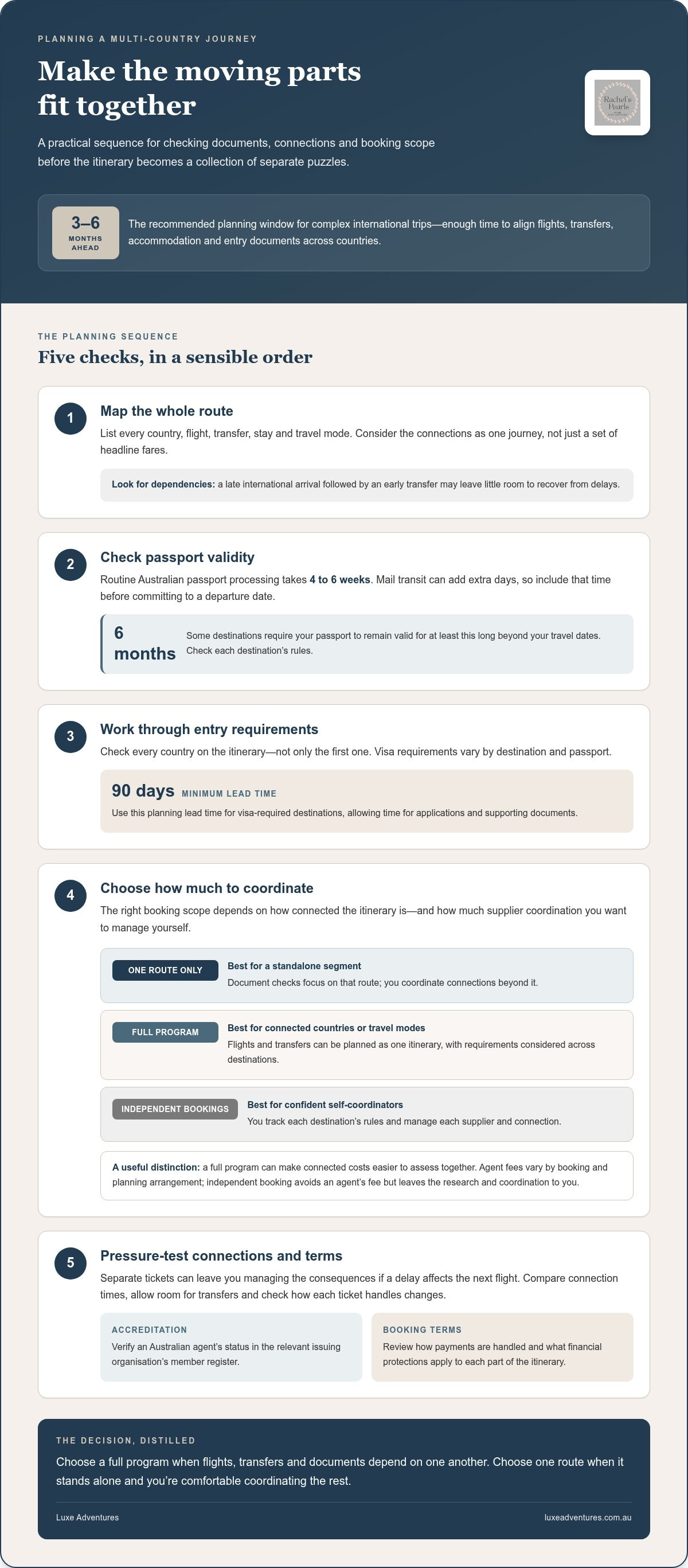
For complex international trips, start planning 3-6 months ahead. That gives time to align flight booking, transfers, accommodation and entry documents across several countries. Routine Australian passport processing takes several weeks, and mail transit can add extra days. Build that time into your schedule before committing to a departure date.
Check every destination’s entry requirements, not just the first country on the itinerary. Some international destinations require passports to remain valid for at least 6 months beyond travel dates. Visa requirements also vary by destination and passport. For visa-required destinations, plan around a 90-day minimum lead time so applications and supporting documents don’t become a last-minute scramble.
Working with a professional travel agent for complex multi-country trips can help coordinate the moving parts: compare flight schedules, arrange port or airport transfers, and check documentation requirements. Looking at these together makes gaps easier to spot. For example, a late-arriving international flight followed by an early transfer can leave little room to recover from delays.
Use this comparison to decide how much coordination you want:
| Booking option | Document coordination | Flight and transfer planning | Best suited to |
|---|---|---|---|
| One route only | Focused on that route | You coordinate connections beyond it | A standalone segment with simple onward plans |
| Full program | Requirements considered across destinations | Flights and transfers can be planned as one itinerary | Several connected countries or travel modes |
| Independent bookings | You track each destination’s rules | You manage each supplier and connection | Travellers comfortable coordinating separate bookings |
Choose a full program when flights, transfers and documents depend on one another. Choose one route when you can manage the rest independently.
Agent fees vary by booking and planning arrangement. Booking independently avoids an agent’s fee but leaves the research and coordination to you. There’s no single charge for multi-country planning: the cost depends on the itinerary, including its complexity, countries, ticketing and coordination.
To check an Australian agent’s accreditation, verify its status in the relevant issuing organisation’s member register. Then review the booking terms to understand how payments are handled and what financial protections apply to each part of your itinerary.
Separate tickets can create connection risks: if one flight is delayed, the next airline may treat its flight as a separate booking. You could miss your departure and have to arrange a replacement. Compare connection times, allow room for transfers, and check how each ticket handles changes before booking.
Travel agents can also advise cruise travellers about cabin categories, port transfers, visa requirements, shore excursions and cancellation policies. Utilizing an expert travel agent for complex multi-country trips ensures that every leg of your journey is thoroughly managed from start to finish.
When planning intricate global itineraries across multiple time zones, partnering with Luxe Adventures guarantees meticulous attention to detail. Professional planning streamlines complex schedules, secures appropriate documentation, and ensures your multi-destination holiday runs seamlessly without unexpected travel complications.
Support during cancellations and other disruptions
A cancelled flight can disrupt more than one booking on a multi-country itinerary. A missed connection may affect a hotel arrival, airport transfer, cruise departure or guided excursion. Travel agents can assist with rebooking and coordinating alternatives when cancellations, missed connections, itinerary changes, weather disruptions or medical emergencies interrupt travel.
Support matters most when several suppliers are involved. If a flight delay threatens a cruise embarkation, the traveller may need to contact the airline, cruise operator and accommodation provider. An agent coordinating the itinerary can help manage these conversations and identify practical alternatives. Travel agents provide 24/7 support for international travel disruptions, according to the research findings for this article.
The response involves practical steps: establish the traveller’s location and next confirmed booking, identify which supplier controls the affected service, and arrange the next viable option. A cancelled flight before a hotel stay, for example, may require changing the arrival details and transfer timing as well as the flight. Agents can resolve international flight cancellations or hotel issues within a day or two, according to the same market findings.
- Flight cancellation: compare rebooking options and assess how each affects onward connections.
- Missed connection: identify which ticket or supplier needs attention first, then coordinate onward arrangements.
- Weather disruption: review revised departure times against transfers, accommodation and scheduled activities.
- Medical emergency: prioritise immediate assistance and coordinate changes to affected travel arrangements.
For traveller safety, separate urgent local assistance from itinerary administration. In an emergency, contact local emergency services first, then notify the relevant travel providers and insurer. Keep booking references, policy details and essential contact information accessible offline. A phone battery rarely chooses a convenient moment to fail.
What travel insurance covers multi-country trips and connecting flights? Cover depends on the policy wording, including how it treats cancellations, missed connections, medical expenses and travel between countries. Before departure, read the policy definitions, exclusions, claim steps and limits, and check how it treats separately booked flights.
An agent can coordinate travel arrangements, while the insurer assesses claims under the policy. Keep receipts and written records of cancellations, revised bookings and extra costs. If a cruise departure changes after a weather disruption, those records help explain the sequence of events and support a claim where the policy applies.
For a journey with several flights, stays or cruise segments, consider discussing your travel plans before departure. Clear coordination gives each supplier the information needed when an itinerary changes.
Package deals and added extras
A package can bundle a cruise with flights, hotels or transfers, while added extras enhance particular parts of the journey. Cruise booking benefits can include onboard spending credit, cabin upgrades, complimentary excursions, prepaid gratuities, beverage packages, free Wi-Fi or bonus hotel stays. The useful comparison is not the length of the list, but whether each inclusion fits your itinerary.
Start with the core price and inclusions. Cruise fares are often similar whether booked directly or through an agent, because cruise lines generally control base fares. Compare the same sailing, cabin category and travel dates, then assess any extras alongside the fare. A beverage package has little appeal if you rarely drink onboard; prepaid gratuities may matter more to your budget.
Next, match each benefit to a real moment in the trip. Onboard credit could offset purchases during sea days, while a complimentary shore excursion might suit a port where independent transport is complicated. A bonus hotel stay can be useful before an early cruise departure, especially when it avoids a rushed transfer between the airport and ship.
- Cabin upgrade: compare the assigned category, location and sailing dates before valuing the difference.
- Shore excursion: check the destination and activity against your interests and available time in port.
- Prepaid gratuities: note exactly which charges the benefit covers.
- Wi-Fi or beverage package: consider how you’ll use it during the voyage.
- Onboard credit: understand where it can be spent and whether it suits your plans.
For a multi-country itinerary, examine extras across the whole program, not just one cruise segment. A hotel night near the port, for example, may simplify embarkation day, while a separate stay elsewhere may add little if it creates another transfer. Value depends on timing, location and how neatly the inclusion connects with other bookings.
Ask for an itemised comparison of what is included, optional and outside the package. Check the cabin category, hotel dates, transfer arrangements and excursion details side by side. An extra should improve the experience or simplify logistics, not merely make the offer look longer.
Direct booking can suit travellers who want to select each component themselves. An agent’s package comparison can help when cruise dates, flights, accommodation and port transfers need to work together. Compare the complete arrangements and the benefits you’ll genuinely use, rather than judging by the number of extras alone.
What Australian travel agents specialise in complex multi-country trips?
Australian travel agents are useful when an itinerary combines several countries with flights, cruises, visas or extensive transfers. These trips involve more than choosing appealing destinations. Each leg must connect in a workable sequence, from the first international flight to the final hotel departure. A specialist can compare itineraries, arrange flights and transfers, check documentation requirements, and coordinate travel insurance across the journey.
International cruise itineraries show the value of joined-up planning. A voyage may visit several countries while relying on flights, port transfers and shore excursions. An agent can help compare sailing routes and cabin categories, see how airport arrival times align with embarkation, and review visa requirements and cancellation policies. The practical question is how each element fits, not simply which cruise looks attractive.
Expedition cruises and river cruises also call for focused knowledge. Expedition travel can involve remote ports and a tightly organised schedule; river journeys may connect multiple cities through a sequence of stops. In either case, a specialist can bring the cruise itinerary together with flights, transfers and accommodation. This coordination is especially useful when a missed connection could affect a scheduled departure.
- Multi-country cruise: compare ports, flights, transfers, visa needs and shore excursions together.
- Expedition cruise: coordinate the voyage with the flights and travel arrangements around it.
- River cruise: map the sequence of stops against arrival and departure plans.
- Visa-heavy itinerary: organise document checks alongside the country-by-country route.
- Extensive transfers: assess how ground connections fit between airports, ports and stays.
Look for relevant specialisation, not a broad claim to handle every kind of holiday. A travel agent for complex multi-country trips should explain how the proposed route connects, where transfers fit, and which documents matter for each destination. Ask for a clear itinerary showing the order of flights, cruise segments, stops and accommodation. Specifics are more useful than a glossy overview.
Specialisation also means recognising when a full-service approach adds little. A straightforward point-to-point journey, with one destination and no linked cruise or transfer sequence, may be easy to arrange independently. Specialist help is most useful when several countries and travel modes depend on one another. Combining international flights, a cruise and multiple transfers, for example, takes more coordination than booking a standalone hotel stay.
Use the itinerary’s moving parts to guide your choice. If visas, flights, cruises and transfers interact, look for an Australian agent who regularly handles those arrangements together. If the trip centres on one simple route, focus on that route rather than adding complexity for its own sake.
How do I choose a travel agent for a multi-country itinerary?
Start with the itinerary’s most complicated connection, not a glossy destination list. If your route combines international flights, a cruise and several transfers, look for an agent who can explain how those parts fit together. A useful plan shows the sequence clearly, including where you change transport and which bookings depend on one another.
Next, assess relevant experience through the details of your proposed trip. An agent familiar with expedition cruises, for example, should be able to discuss how flights, embarkation timing and port arrangements connect. For a visa-heavy route, documentation checks need to account for every destination, not only the first arrival. Clear, specific answers matter more than a broad claim of expertise.
Compare the proposed itinerary and booking scope in writing. The outline should distinguish flights, accommodation, transfers, cruise arrangements, excursions and insurance coordination. It should also clarify which components are booked together and which remain separate. That distinction helps you understand where responsibilities lie if a schedule or supplier arrangement changes.
- Itinerary logic: check the order of destinations, travel modes and overnight stays.
- Documentation: confirm that country-specific visa and passport requirements are part of the planning process.
- Connections: review how flights, transfers and cruise departures align.
- Disruption planning: understand how rebooking and alternative arrangements are coordinated.
- Inclusions: compare excursions, accommodation and package extras against your actual plans.
Pay attention to how the itinerary reflects your priorities. If you value time ashore over additional destinations, the proposal should show how the pace supports that preference. If a cruise is central, consider cabin category, port sequence and time ashore alongside flights. Personalisation is visible in these choices, not merely in a document bearing your name.
Before committing, review the booking terms, payment schedule, cancellation conditions and any planning fees. Understand how changes are handled across separate suppliers, such as an airline and cruise operator. The practical test is whether the plan makes responsibilities and key arrangements easy to follow, rather than leaving important details scattered across messages.
A travel agent for complex multi-country trips should bring clarity to the whole route while respecting when independent booking suits you better. A simple point-to-point trip may need little coordination; a route joining several countries, cruises and transfers can benefit from a connected plan. Choose according to the itinerary’s moving parts and the level of coordination you want.
For a tailored conversation about your route, share your multi-country travel plans.
Luxe Adventures: African Safaris
Luxe Adventures can shape an African safari around the places and experiences that matter to you. Founder Rachel Cleary personally researches destinations and stays, bringing an informed, experience-led perspective to the choices behind a journey. The aim is a thoughtful fit, not a collection of impressive-sounding stops.
That same care can inform a wider itinerary, perhaps pairing a safari with an expedition cruise or a stay at a Fiji luxury resort. Rachel’s research helps each element reflect how you want to travel, from the journey’s pace to the character of each stay.
If you’re considering an African safari or a journey that combines destinations, contact Luxe Adventures or visit luxeadventures.com.au.
Shape the journey around what matters most
Before choosing how much of the program to book together, decide what you want the journey to make room for. Perhaps it’s unhurried time in one place, a particular expedition, or the freedom to change pace between destinations. That priority gives the itinerary a centre of gravity, so each leg earns its place rather than simply filling the calendar.
A travel agent for complex multi-country trips can help turn that intention into a coherent plan, balancing your preferred experiences with the practical shape of the route. You remain the author of the journey; expert coordination helps its moving parts support the same idea.
If you’re ready to explore what your route could look like, contact Luxe Adventures to plan your trip. A thoughtful first conversation can help clarify what belongs in the itinerary, and what can be left out. Start with the experience you care about most, then let the journey take shape around it.
Frequently Asked Questions
Should you source one route or the whole program?
To compare costs fairly, ask for two versions built around the same fixed elements, such as travel dates, hotel standard and chosen cruise. Then identify which route components are settled and which remain flexible. Treating a pre-booked stay as fixed can make the cost of planning the remaining route easier to judge. The better fit depends on whether you value one overall view or control over separate choices.
What services do specialist travel agents provide for complex international trips?
Specialist agents create tailored travel plans and arrange experiences suited to your brief, rather than simply supplying transport. Depending on their expertise, this can include researching safari lodges, selecting a cruise style and balancing guided activity with independent time. A traveller who prefers slower mornings, for example, might prioritise fewer hotel changes and longer stays. This service is useful when destination choices call for considered curation.
How should I plan flights, rail, and transfers across several countries?
For rail, begin with the exact station names, not just the city names. Large cities can have multiple stations, and transferring to the wrong one is an avoidable complication. Check whether each train requires a seat reservation, how tickets are stored, and what happens if an earlier leg runs late. Keep rail confirmation details with flight information in one accessible itinerary, including an offline copy.
What questions should I ask a travel agent before booking a complex itinerary?
Ask how the proposed pace reflects your priorities: how many hotel changes are planned, which days remain open, and where a longer stay could replace another stop. Ask what the advisor personally knows about the suggested lodges, cruise experiences or local guides. You could also ask what they would remove if the schedule felt crowded. Specific answers help show whether the itinerary reflects your preferences, rather than simply collecting attractive components.

Article by
Rachel Cleary
Rachel Cleary is the founder of Luxe Adventures and an endlessly curious explorer with a passion for meaningful, experience-led travel. Having visited every continent and travelled to more than 100 countries — and counting — she believes travel is one of the greatest educations for both children and adults alike.
Rachel is addicted to scuba diving and gets underwater at every opportunity. When she isn't in the office you'll find her exploring remote reefs in Fiji, drift diving in the Maldives, or scuba cruising Raja Ampat or French Polynesia.
Her second home is Fiji where she has explored all the island groups and has favourite boutique resorts she returns to every year, for the diving and the authentic Fijian hospitality.
Get her talking about kayaking in Antarctica or the Arctic, African safaris and where to find the highest density of big cats, underwater adventures, remote expedition destinations, or the science and magic behind the Northern Lights — including when and where they are most likely to dance — and you may be there a while.
Through Luxe Adventures, Rachel combines firsthand experience, global industry connections, and a deep appreciation for nature, culture, food, wildlife, and human connection to help curious travellers explore the world in a way that feels seamless, personal, and unforgettable.
Refined by experience. Defined by connection.
Disclaimer
The information in this article is intended as general travel inspiration and guidance only. Travel requirements, hotel standards, airline schedules, entry regulations, weather conditions, pricing, and experiences can change without notice.
While every effort is made to ensure accuracy at the time of publishing, Luxe Adventures recommends confirming all details relevant to your personal travel plans before booking or travelling.
Opinions, recommendations, and destination insights shared in this article are based on firsthand experience, industry knowledge, and research at the time of writing. Experiences may vary depending on season, supplier changes, local conditions, and individual travel preferences.
Some articles may reference luxury travel affiliations, preferred partner programs, or value-added amenities available through Luxe Adventures. Benefits and inclusions are always subject to availability and supplier terms at the time of booking.
Luxe Adventures strongly recommends comprehensive travel insurance for all international travel.
For personalised travel advice, tailored itinerary design, or the latest destination updates, please contact Luxe Adventures directly.


