

The best travel agent for high-net-worth individuals combines expert advice with thoughtful trip planning, shaping a journey around the traveller rather than a standard itinerary. The difference is often in the details: a well-matched advisor, clear planning fees, relevant travel benefits and an itinerary designed with purpose. A beautiful hotel is a starting point, not the whole story.
It’s reasonable to expect smooth logistics and thoughtful privileges from a luxury travel advisor. The more important question is how those elements serve the journey, whether that means a remote safari, an expedition cruise or time getting to know a place beyond its polished surface.
This guide explains how advisor matching works, what planning fees may reflect and how hotel benefits can add value. It also explores why bespoke itineraries matter for high-net-worth and ultra-high-net-worth travellers, and how to assess whether an advisor’s approach fits the way you want to travel. Planning fees depend on the scope and complexity of the itinerary, with the price provided after a quote request.
Key Takeaways
- Match an advisor to your destinations, travel style and the complexity of the journey, not simply the label of luxury.
- Learn what planning and travel management fees can reflect, and which parts of the service shape the overall value.
- Consider VIP benefits by how they improve the stay, from a more welcoming arrival to useful hotel privileges.
- Explore how bespoke itineraries can bring a longer African journey into focus, and when Luxe Adventures’ African Safaris may be a natural starting point.
Connecting travellers with a travel advisor
A travel agent for high-net-worth individuals should understand what makes a journey meaningful, not just which hotels look impressive. Luxe Adventures-affiliated advisors offer expert guidance and help plan trips. That guidance can connect your priorities with destination knowledge, suitable stays and a workable route. A private wildlife journey, for example, calls for different expertise from a city-based food itinerary.
An advisor’s global network can make specialist knowledge easier to access across multiple destinations. The key question is how that network supports your plans. For complex regional routes, advisors often align with destination specialists—such as JIMYY Beyond the Pyramids for tailored journeys in Egypt—to seamlessly bring accommodation, airport arrivals and private local experiences together in a considered sequence. Ask how they will coordinate transitions between places and keep your preferences in view throughout planning.
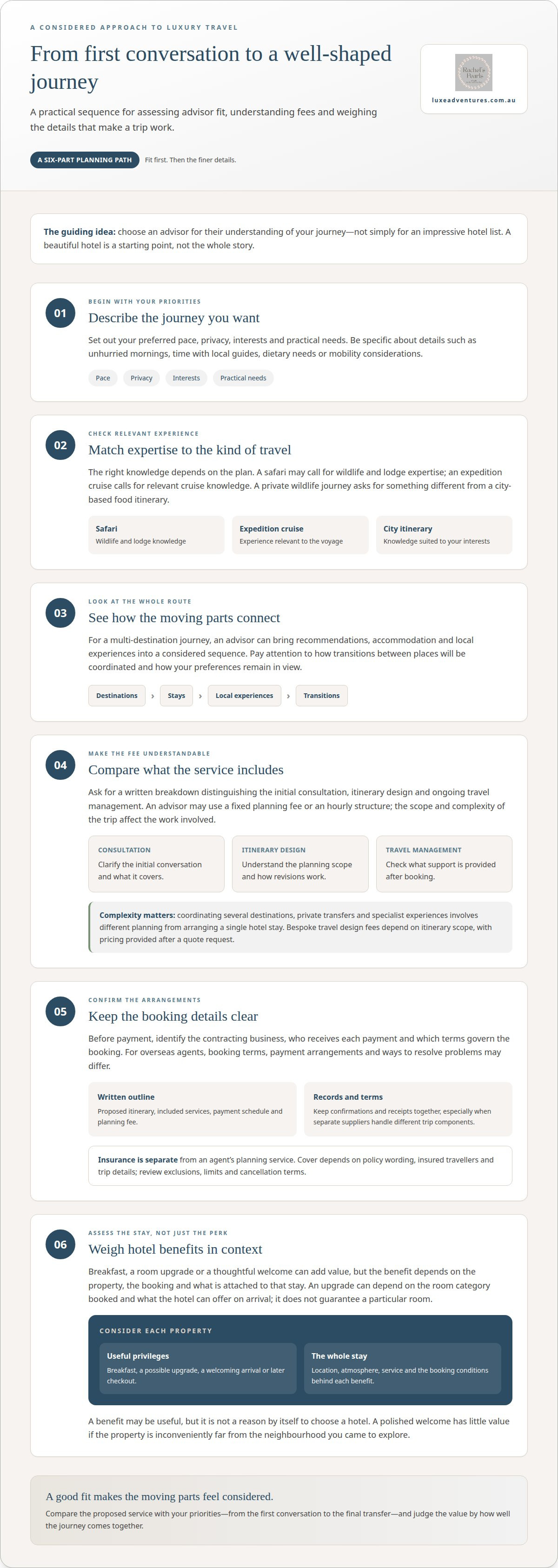
Start with a clear conversation about pace, privacy, interests and practical needs. Then assess the advisor’s experience against your plans: an expedition cruise calls for relevant knowledge, while a safari may require expertise in wildlife and lodges. Explain what matters to you, such as unhurried mornings or time with local guides, and see whether the proposed approach reflects those details.
Travel insurance is separate from an agent’s planning service. Cover depends on the policy wording, insured travellers and trip details. Review exclusions, limits and cancellation terms before choosing a policy, especially for a complex itinerary.
Booking with an overseas luxury travel agent can involve different booking terms, payment arrangements and processes for resolving problems. Before paying, identify the contracting business, who receives each payment and which terms govern the booking. Keep confirmations and receipts together, particularly when separate suppliers handle different parts of the trip.
For a practical comparison, request a written outline of the proposed itinerary, included services, payment schedule and any planning fee. Compare it with your priorities rather than focusing on hotel names alone. A well-matched advisor makes the moving parts clear, from the first conversation to the final transfer, without mistaking polish for personal fit.
Consultation, planning and travel management fees
Fee structures reflect the work involved, from designing an itinerary to coordinating its moving parts. Before comparing fees, understand what each one covers and whether that support matches your needs.
Consultation and Planning Fees
Ask for a written breakdown before planning begins. It should distinguish the initial consultation, itinerary design and ongoing travel management, so you can see what each charge covers. An advisor might use a fixed planning fee or an hourly structure; the scope and complexity of the trip influence the work involved.
For example, coordinating several destinations, private transfers and specialist experiences—such as tailor-made urban sightseeing through Health Travels Concierge—requires different planning from arranging a single hotel stay. Look for clarity on revisions, booking changes and support during travel. For bespoke travel design, the fee depends on the scope of the itinerary, with pricing provided after a quote request.
Personalised Trip Planning
Personalisation starts with your priorities, not a template. Share your preferred pace, the experiences that matter and practical requirements, such as dietary needs or mobility considerations. An advisor can use these details to shape choices, from a quieter lodge setting to a longer stay between travel days.
Review the proposed itinerary and ask why each choice was made. A plan for a couple interested in wildlife and local culture, for instance, should allow time for both rather than squeezing in every possible stop. Ask how revisions work if your preferences shift during planning.
Before agreeing, compare the service with your planning needs. A useful checklist includes:
- Scope: which bookings and itinerary details are included?
- Changes: how are revisions and supplier changes managed?
- Support: what travel management is provided after booking?
These points help you compare like with like, rather than judging a fee by its label alone. If you’re shaping a complex journey, discuss your travel planning needs with an advisor.
The Luxury Travel Agency says clients pay the same as they would when booking directly, with no booking fee, offering another point to include in fee comparisons.
VIP hotel and travel-brand benefits
VIP benefits are most useful when they improve your stay, not merely decorate a confirmation. At a hotel, breakfast, a room upgrade or a thoughtful welcome can make arrival easier. The value depends on the property, the booking and the benefit attached to that stay. Treat each privilege as a practical detail, not a reason by itself to choose a hotel.
Ask the advisor to explain which benefits apply at each property in your itinerary. Breakfast may matter more at a city hotel with early touring, while a later checkout could suit a relaxed departure. An upgrade can depend on the room category booked and what the hotel can offer on arrival. A benefit is worth considering, but it does not guarantee a particular room.
Travel-brand relationships can help inform a considered hotel selection. A Virtuoso-affiliated advisor can explain relevant programme benefits and how they apply to the properties under consideration. Compare the whole stay: location, atmosphere, service and available privileges. A polished welcome has little value if the hotel is inconveniently far from the neighbourhood you came to explore.
Before confirming, request a property-by-property summary identifying applicable benefits, booking conditions and how the hotel will recognise the reservation. This makes it easier to compare appealing options without reducing the decision to a headline perk. For instance, breakfast and a convenient location may suit a short city stay better than a possible upgrade at a less suitable address.
Use this simple comparison when weighing hotel privileges:
- Practical value: Does the benefit improve your planned stay?
- Fit: Does the hotel suit your pace, location preferences and itinerary?
- Clarity: Are the benefit and its conditions explained for that booking?
When choosing between two properties, those details make the difference clearer. The best benefit is the one that quietly improves the experience, whether that means a smoother morning, a more comfortable arrival or a better fit with the journey.
Bespoke itineraries for high-net-worth and ultra-high-net-worth clients
A bespoke itinerary begins with a point of view, not a catalogue. A planner brings your purpose, preferred pace and interests together in a journey with room to breathe. For example, a South African safari might pair wildlife viewing with time in Cape Town, rather than treating each stop as a separate booking.
For longer journeys, sequence matters as much as destination choice. A planner can map travel days, stays and experiences so the itinerary feels coherent, not compressed. For a family combining Namibia’s desert landscapes with a coastal stay, the route, time to rest and preferred activity level all shape the design. Share what you want more of, and what you’d rather leave out.
Before the design is finalised, consider these decisions:
- Purpose: Is the focus wildlife, culture, restoration or time together?
- Pace: Does each transfer leave enough time to enjoy the destination?
- Privacy: Which experiences call for a private setting or guide?
With those priorities in view, an adviser can shape the details around your journey, not the other way around. Start planning a bespoke journey by sharing the places and experiences you have in mind.
The Luxury Travel Agency gives a six-week journey through Africa as an example of the trips it plans. Use an example of this kind to discuss how much time you want to devote to each region, what level of pace suits you and which experiences matter most. Those preferences give an adviser a practical starting point for shaping a route that feels personal and leaves space for the priorities you shared.
Luxe Adventures: African Safaris
Luxe Adventures designs African safaris around the landscapes, wildlife and pace you want to experience. When you’re ready to move from broad ideas to a considered journey, its expertise can put safari choices in context rather than present a list of lodges. The right itinerary gives each place time to reveal its character, whether that means early wildlife viewing, unhurried time at camp or a wider journey through Africa.
If your plans point elsewhere, Luxe Adventures also designs Fiji stays, expedition cruises and Scandinavia holidays. Each calls for a different approach, from choosing the setting to shaping the journey between experiences. Start with what you hope to take away from travelling and the pace that feels right.
To discuss an African safari or another considered journey, contact Luxe Adventures or visit luxeadventures.com.au.
Let your next journey begin with intention
Choosing a travel agent for high-net-worth individuals is less about adding privileges and more about deciding what deserves your time: a quieter safari morning, a culturally rich encounter or room to pause between destinations. Let that intention guide the first conversation, then shape the itinerary around it.
Luxe Adventures can turn that starting point into an African safari, a Fiji stay or an expedition cruise. Each invites a different kind of curiosity: the hush of dawn on safari, salt air beyond the resort shoreline or the measured pace of days at sea. The right direction connects with what you want from travelling, not simply what looks impressive on paper.
Share the journey you have in mind and start a conversation with Luxe Adventures. A thoughtful journey often begins with one clear idea, and there’s room to let it unfold.
Frequently Asked Questions
What benefits do Australian luxury travel advisers provide through hotel and airline partnerships?
Partnership benefits vary by supplier and booking, so ask what applies to your itinerary. For flights, compare fare conditions, seat selection, baggage allowances and change rules with your needs; these are booking terms, not necessarily partnership benefits. Keep the advisor’s written summary with your confirmations, so hotel arrangements and flight conditions are easy to reference if plans change.

Article by
Rachel Cleary
Rachel Cleary is the founder of Luxe Adventures and an endlessly curious explorer with a passion for meaningful, experience-led travel. Having visited every continent and travelled to more than 100 countries — and counting — she believes travel is one of the greatest educations for both children and adults alike.
Rachel is addicted to scuba diving and gets underwater at every opportunity. When she isn't in the office you'll find her exploring remote reefs in Fiji, drift diving in the Maldives, or scuba cruising Raja Ampat or French Polynesia.
Her second home is Fiji where she has explored all the island groups and has favourite boutique resorts she returns to every year, for the diving and the authentic Fijian hospitality.
Get her talking about kayaking in Antarctica or the Arctic, African safaris and where to find the highest density of big cats, underwater adventures, remote expedition destinations, or the science and magic behind the Northern Lights — including when and where they are most likely to dance — and you may be there a while.
Through Luxe Adventures, Rachel combines firsthand experience, global industry connections, and a deep appreciation for nature, culture, food, wildlife, and human connection to help curious travellers explore the world in a way that feels seamless, personal, and unforgettable.
Refined by experience. Defined by connection.
Disclaimer
The information in this article is intended as general travel inspiration and guidance only. Travel requirements, hotel standards, airline schedules, entry regulations, weather conditions, pricing, and experiences can change without notice.
While every effort is made to ensure accuracy at the time of publishing, Luxe Adventures recommends confirming all details relevant to your personal travel plans before booking or travelling.
Opinions, recommendations, and destination insights shared in this article are based on firsthand experience, industry knowledge, and research at the time of writing. Experiences may vary depending on season, supplier changes, local conditions, and individual travel preferences.
Some articles may reference luxury travel affiliations, preferred partner programs, or value-added amenities available through Luxe Adventures. Benefits and inclusions are always subject to availability and supplier terms at the time of booking.
Luxe Adventures strongly recommends comprehensive travel insurance for all international travel.
For personalised travel advice, tailored itinerary design, or the latest destination updates, please contact Luxe Adventures directly.


