

A travel designer earns their fee when the value lies in the thinking, not simply the booking. Whether a travel designer is worth the fee depends on your trip’s complexity, how much time you want to spend planning, and the value you place on considered, personal recommendations. For straightforward travel, DIY booking or AI tools may be enough; intricate itineraries call for more human judgement.
Digital tools can make planning quicker and help generate ideas or compare options. But a polished list is not the same as a journey shaped around your priorities, with each detail working together. This article compares a designer’s planning value with DIY booking and AI, and explains when personalised expertise may justify the cost. Fees depend on the trip’s scope and complexity and are provided after a quote request.
Key Takeaways
- Compare the fee with the time and coordination DIY planning requires, not just the price of the bookings themselves.
- Use AI to explore ideas and organise options, while recognising where destination knowledge and human judgement can shape a more cohesive trip.
- Understand how percentage-based fees relate to the overall itinerary, and consider which planning work they cover.
- Personalised design can be especially valuable when a journey involves complex logistics, distinctive experiences or a destination such as an African safari.
Responding to DIY booking objections
DIY booking avoids a separate design fee, but leaves the research and coordination to you. A designer’s fee covers planning, not just pressing “book”. Whether a travel designer is worth the fee depends on the itinerary. Comparing a flight and hotel for a weekend away may be manageable. A multi-stop journey adds transfers, timing and different cancellation conditions.
That’s a booking-related cost, not a travel designer’s quoted fee. Add it to the fare when comparing DIY options. Factor in the time spent checking schedules and fare conditions, too. A low headline fare can become less attractive when baggage or flexibility matters.
A booking portal is one way to arrange travel, but it isn’t a like-for-like comparison with a designer’s service. Compare the cash price, points required and booking terms for the same itinerary. Then check whether the baggage, flexibility and hotel inclusions suit your needs.
Points earned can affect the comparison, but the card and loyalty-program terms matter. Booking channels may interact differently with earning rules. Before paying, consider whether the points earned offset any difference in cash price or convenience. Treat points as part of the total value, not as a discount by default.
A travel designer can compare airfares and hotel options, including rates with different inclusions. The lowest price isn’t always the best fit. Compare the same cabin, baggage allowance, room category, breakfast and cancellation conditions. A cheaper room without breakfast may cost more over a two-night stay. A designer can also coordinate suitable options and reduce mismatches between transport and accommodation. DIY suits travellers who enjoy researching each detail; design can help when decisions connect across the itinerary.
How does a travel designer compare to AI tools?
AI can quickly organise ideas, while a travel designer brings human judgement to your priorities and itinerary choices. Rachel Cleary personally researches destinations, hotels and expedition cruises, considering how each choice fits your interests and the journey as a whole.
Planning Services and Fee Structures
A planning fee pays for research and itinerary design, not just reservations. Its value depends on the agreed scope. Services may include destination research, accommodation and transport choices, itinerary coordination and booking support. Planners may charge a fixed fee, a percentage or use another structure. Complex plans take more coordination than simple stays. Ask for a written breakdown of the fee, deliverables and changes covered. Compare like with like, rather than weighing a complete itinerary against a list of AI suggestions.
Designer and Agent Roles, Fees, and Commissions
A travel designer shapes a journey around the traveller’s interests; a travel agent may focus more directly on arranging bookings. The roles can overlap, so compare the work being offered. A designer may receive commission from hotels, airlines or tour operators, depending on supplier arrangements. Commission doesn’t automatically replace a planning fee. Ask how the professional is paid and whether commission affects the options presented. AI can suggest routes or properties, while a travel professional can discuss what matters to you.
Credentials, Terms, and Trip Disruptions
For an Australian booking, review business details, independent reviews and written terms before paying. Look for the fee, payment schedule, cancellation terms and included support. If a trip is cancelled or disrupted, supplier conditions shape refunds or changes. A designer can help communicate with suppliers and coordinate alternatives; the agreement should explain the support provided. For a complex itinerary, discuss your travel-planning needs as a considered next step.
That figure applies to the stated trip type and group size; it should not be treated as a general rate for other itineraries. When weighing designer support against AI suggestions, compare the written fee and work covered with the needs and complexity of your own trip.
Percentage-based fees
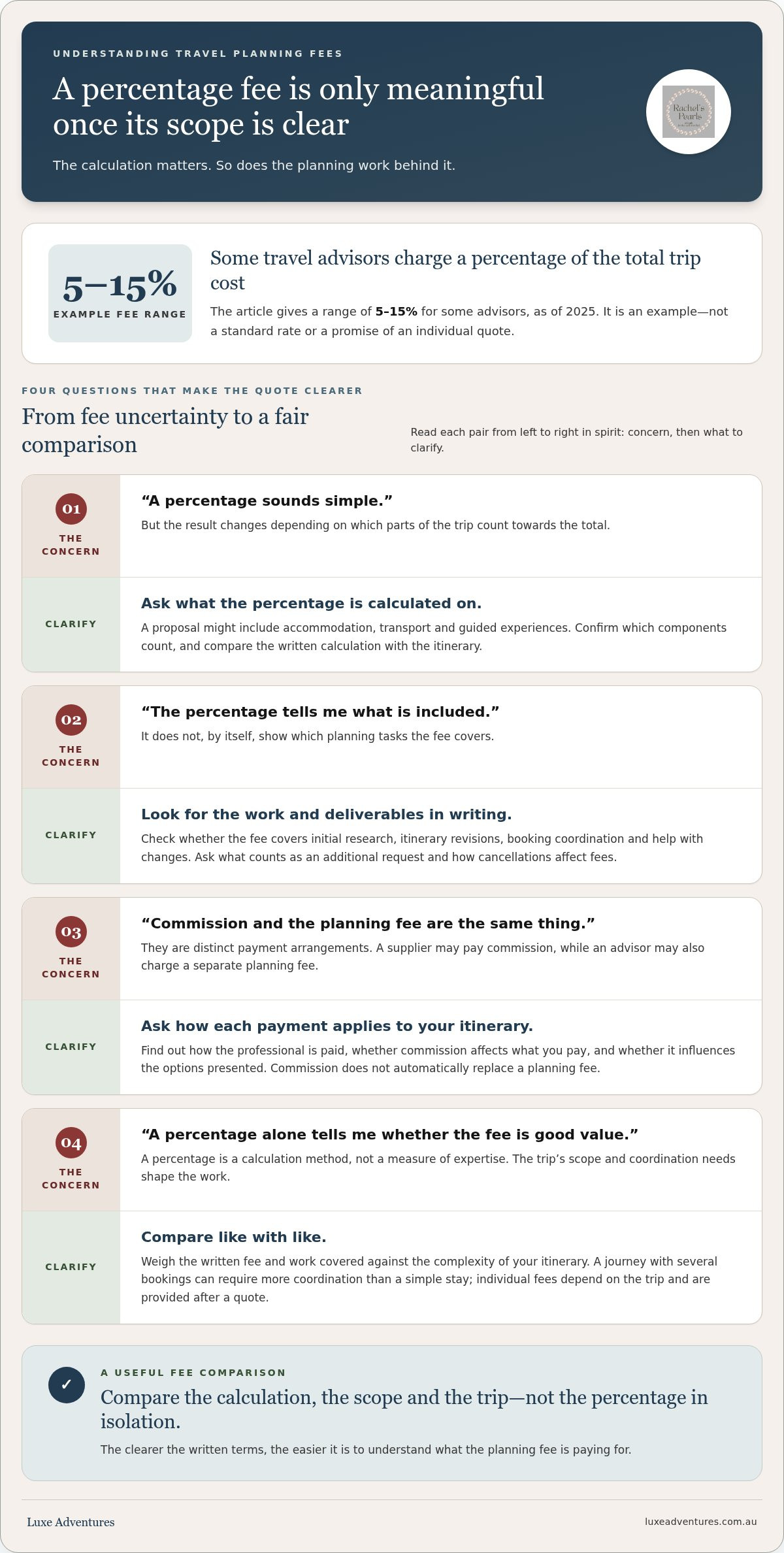
Some travel advisors charge a planning fee of 5-15% of the total trip cost, as of 2025. Unlike a fixed amount, this model rises or falls with the itinerary’s stated value. A percentage can suit a journey involving several bookings, but the calculation needs clear boundaries. Ask which trip components count toward the total and when the fee becomes payable.
For example, a proposal might combine accommodation, transport and guided experiences. If the percentage applies to the whole package, adding a costly component may also increase the planning fee. If it applies only to selected bookings, the result will differ. Compare the written calculation with the itinerary, rather than relying on a percentage alone.
Check whether the fee covers initial research, itinerary revisions, booking coordination and help with changes. A percentage doesn’t automatically mean every planning task is included. One designer may include revisions; another may set a defined scope. The agreement should specify the work covered, what counts as an additional request, and how cancellations affect fees.
Commission can also affect how a trip is funded. A hotel or tour operator may pay commission on a booking, while an adviser may charge a separate planning fee. These are distinct payment arrangements. Ask how each applies to your itinerary and whether commission changes the amount you pay or the recommendations presented.
For an individual itinerary, the fee depends on the trip and is provided after a quote request. Destination, trip length, party size and coordination needs shape the work. To judge value, compare the fee with the planning tasks included, the trip’s complexity and the clarity of the terms. A percentage is a calculation method, not a measure of expertise. The work behind it matters most.
Other fee structures offer a comparison when assessing a percentage quote. In 2023, service fees accounted for 20% of hosted travel advisors' total income.
The figures are examples, not guarantees of an adviser’s quote. Ask whether the proposed percentage covers comparable work and request its calculation and scope in writing.
Reasons to use a travel designer
A designer is most useful when itinerary decisions affect one another. A simple city stay may need little help; a multi-stop journey can involve layered logistics.
When the Cost Is Worthwhile
Hiring a designer can be worthwhile when their planning solves a real problem for you. Consider a journey with several destinations, limited time to plan or specific accommodation and experience priorities. The value lies in shaping those details into a workable itinerary, rather than handing you a collection of options.
Before deciding, identify what you’d otherwise handle yourself. If comparing routes, coordinating transfers and aligning bookings feels like a second job, the fee may buy meaningful time and a more coherent plan. For a familiar weekend with one hotel, or a straightforward getaway organised via destination-specific tools like vegaswizzard.com, DIY booking may be simpler.
Trips That Benefit from a Designer
Trips with multiple stops, specialist interests or complicated connections can benefit from joined-up planning. An African safari, for example, may involve different regions, accommodation and transfers. A designer can consider how each part fits, including the pace between stays and the experiences you want to prioritise.
Expedition travel and journeys built around a particular interest can also benefit from informed curation. A traveller weighing ship, route and time ashore has more to consider than the departure date. Likewise, a family coordinating different preferences may value an itinerary that gives everyone room to enjoy the journey.
Use a simple test: list the decisions, dependencies and personal priorities involved. If one change affects several bookings, or you’re unsure which experiences suit your interests, tailored planning may be valuable. If the plan is familiar and straightforward, independent research may meet your needs.
If your plans involve several destinations or a distinctive travel focus, discuss your itinerary as a next step.
Luxe Adventures: African Safaris
Luxe Adventures can shape an African safari around the experiences and pace that matter to you. Turn to a travel designer when deciding where to go, how to connect each part of the journey and which stays suit your priorities feels more involved than a straightforward booking.
Thoughtful planning brings an itinerary into focus, from the overall shape of the journey to the details that make each stop feel considered. Luxe Adventures also designs luxury Fiji resort stays, expedition cruises and Scandinavia holidays for travellers drawn to different kinds of exploration.
If a personalised safari or another considered journey is on your mind, contact Luxe Adventures or visit luxeadventures.com.au.
Begin with the journey you want to have
Whether a travel designer is worth the fee depends on more than the itinerary on paper. Consider the experiences you want to make room for, the pace that feels right and the details you’d rather not leave to chance. A conversation about those priorities can help you decide whether personalised planning fits the way you want to travel.
You don’t need every detail settled before you begin. A destination, a particular interest or even a sense of how you want the journey to feel can give the planning direction. Thoughtful choices can then turn a broad idea into a trip shaped around what matters to you.
Contact Luxe Adventures to plan your trip, and start shaping a journey that feels distinctly your own.

Article by
Rachel Cleary
Rachel Cleary is the founder of Luxe Adventures and an endlessly curious explorer with a passion for meaningful, experience-led travel. Having visited every continent and travelled to more than 100 countries — and counting — she believes travel is one of the greatest educations for both children and adults alike.
Rachel is addicted to scuba diving and gets underwater at every opportunity. When she isn't in the office you'll find her exploring remote reefs in Fiji, drift diving in the Maldives, or scuba cruising Raja Ampat or French Polynesia.
Her second home is Fiji where she has explored all the island groups and has favourite boutique resorts she returns to every year, for the diving and the authentic Fijian hospitality.
Get her talking about kayaking in Antarctica or the Arctic, African safaris and where to find the highest density of big cats, underwater adventures, remote expedition destinations, or the science and magic behind the Northern Lights — including when and where they are most likely to dance — and you may be there a while.
Through Luxe Adventures, Rachel combines firsthand experience, global industry connections, and a deep appreciation for nature, culture, food, wildlife, and human connection to help curious travellers explore the world in a way that feels seamless, personal, and unforgettable.
Refined by experience. Defined by connection.
Disclaimer
The information in this article is intended as general travel inspiration and guidance only. Travel requirements, hotel standards, airline schedules, entry regulations, weather conditions, pricing, and experiences can change without notice.
While every effort is made to ensure accuracy at the time of publishing, Luxe Adventures recommends confirming all details relevant to your personal travel plans before booking or travelling.
Opinions, recommendations, and destination insights shared in this article are based on firsthand experience, industry knowledge, and research at the time of writing. Experiences may vary depending on season, supplier changes, local conditions, and individual travel preferences.
Some articles may reference luxury travel affiliations, preferred partner programs, or value-added amenities available through Luxe Adventures. Benefits and inclusions are always subject to availability and supplier terms at the time of booking.
Luxe Adventures strongly recommends comprehensive travel insurance for all international travel.
For personalised travel advice, tailored itinerary design, or the latest destination updates, please contact Luxe Adventures directly.


