

A sabbatical travel planner in Australia can shape a trip around longer stays and a flexible route, rather than a blur of airport lounges. One Asia-Pacific example travels through India and Nepal in November, Thailand and Laos in December, Vietnam and Cambodia in January, Bali in February, then Japan in March. The aim isn’t to squeeze in more, but to give each place time to settle.
It’s natural to want a clear itinerary before stepping away from work, especially when a trip spans different countries, climates and styles of travel. But breathing room can be just as valuable as choosing the right destinations.
Here, you’ll see how destination choices, accommodation and slower stretches can shape a sabbatical across Asia, Australia and New Zealand. We’ll look at sample routes and practical ways to leave space for rest, local discoveries and changes of plan. Even a carefully considered itinerary benefits from flexibility.
Key Takeaways
- Give key destinations longer stays so the trip has room for rest, local rhythm and the practicalities of life on the road.
- Shape a 100-day route around regional flow, then balance ambitious travel with time to pause between countries.
- Choose accommodation to suit each stretch, from a settled base to a more mobile way of travelling.
- Keep alternative destinations in mind and leave unplanned space, so changing course feels like part of the journey rather than a disruption.
- Plan in stages: clarify what you want from the break, map a realistic route, arrange the essential stays and preserve slow days for rest or administration.
Accommodation and travel plans for each destination
A sabbatical itinerary works best when each stop has a purpose and enough time to experience it. In Krabi, Thailand, a family plans 7 nights, allowing time to settle into one base, explore the coastline and leave room for quieter days. In Brisbane, 5 nights offer a different rhythm: urban comforts, local outings and a pause between longer travel legs.
Match accommodation to the destination, not simply to a standard you want everywhere. A well-positioned hotel can make a short city stay easier, while an apartment may suit a longer stop, with laundry facilities and space to unwind. In a coastal destination such as Krabi, choose a base around the experiences you value, whether that means easy beach access or a quieter setting.
Balance activity with recovery. After several travel days, schedule a slower stretch before adding another guided excursion or transfer. For example, pair a busy Brisbane visit with an unscheduled morning, then travel onward after a full night’s rest. Longer stays also leave room for everyday pleasures, such as finding a favourite café or returning to a local market.
For long-term sabbatical travel from Australia, choose travel insurance whose written terms cover the full trip duration, planned destinations and activities. Before departure, review medical expenses, cancellation, baggage limits and exclusions, especially if your itinerary includes hiking, diving or other active experiences.
To budget for flights, accommodation, food and activities, create a separate estimate for each destination and record the main cost drivers. Compare a Brisbane hotel stay with a longer apartment stay in Krabi, then set aside a contingency for route changes. This makes trade-offs visible without assuming every day will cost the same.
Manage Australian Medicare, tax, super and bills with a departure checklist. List recurring payments, note due dates, arrange secure access to banking and tax accounts, and record contact details for Medicare and your super fund. Set reminders for bills that will continue while you’re away.
Reduce risks by sharing your itinerary with someone at home, keeping digital and offline copies of key documents, and planning transport between destinations in advance. In Thailand, for example, save your accommodation details before leaving a reliable internet connection. Allow a flexible day after a long transfer instead of booking an immediate excursion.
Example, situation: A family has 7 nights in Krabi and 5 nights in Brisbane, but wants both coastal experiences and city time. Action: They choose one base in each place and avoid changing accommodation mid-stay. Result: Fewer check-ins leave more time for rest and exploration.
Prepare backup destinations before departure, especially for a route with several connecting legs. Keep alternatives that suit the same season and travel style, then identify which bookings can be changed. If weather or transport disrupts your plans, a considered alternative can preserve the trip’s overall rhythm without forcing every day into a rigid schedule.
Planning a 100-day trip through Asia, Australia and New Zealand
A 100-day sabbatical can connect several regions, but it needs a clear centre of gravity. One sample route follows changing seasons through Asia, then makes room for Australia and New Zealand. A separate family plan considered 3-4 months suitable for its world trip, showing how a sabbatical’s length can shape the route.
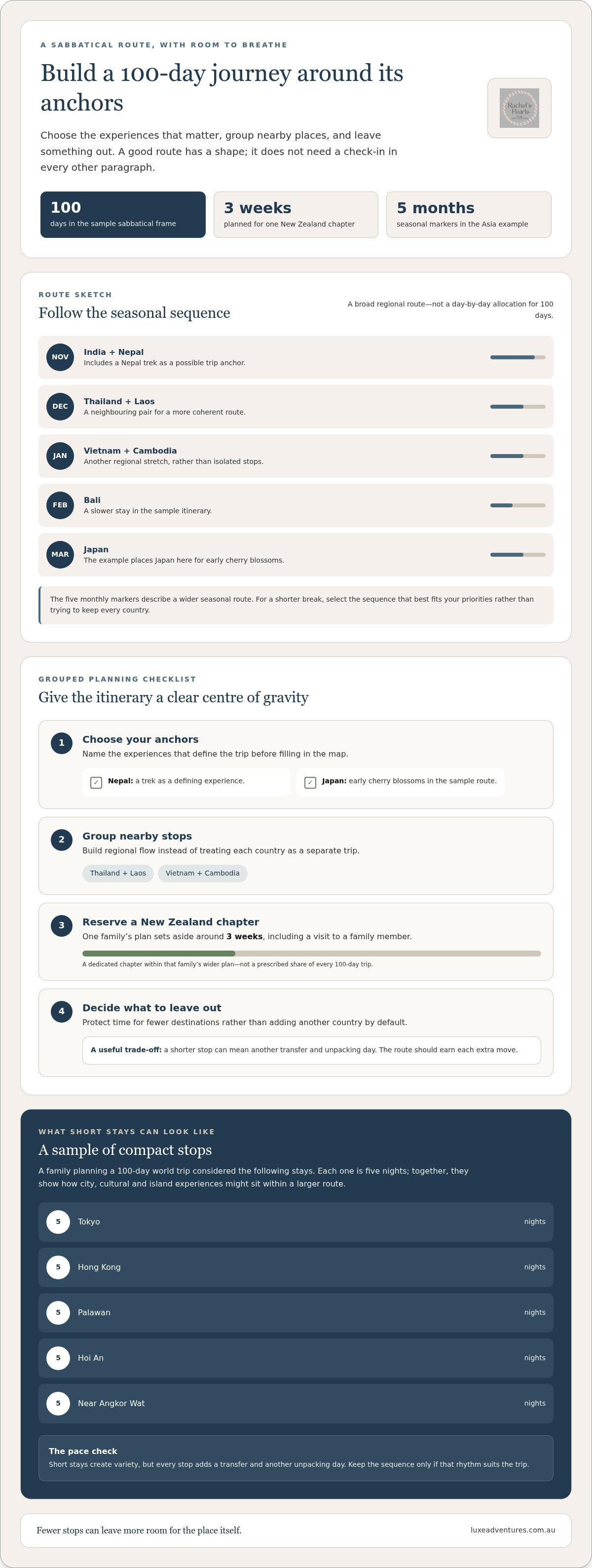
Start by choosing the experiences that matter most, then group destinations by geography and season. One sample itinerary includes India and a Nepal trek in November, followed by Thailand and Laos in December. Vietnam and Cambodia come next in January, before a slower stay in Bali in February and Japan in March for early cherry blossoms.
Those five monthly markers describe a broader seasonal route, not a day-by-day allocation for 100 days. To fit a shorter break, select the regional sequence that best suits your priorities. For example, choose mainland Southeast Asia with Bali, or pair Japan with an Australia and New Zealand journey. Trying to keep every country can turn the trip into a procession of check-outs.
Use a simple planning sequence:
- Choose your anchors: name the experiences that define the trip, such as trekking in Nepal or seeing early blossoms in Japan.
- Group nearby stops: place Thailand and Laos together, then Vietnam and Cambodia, to create a more coherent route.
- Reserve a New Zealand chapter: one family plans around 3 weeks there, including a visit to a family member.
- Decide what to leave out: protect time for fewer destinations rather than adding another country by default.
A family planning a 100-day world trip considered 5 nights in Tokyo, 5 nights in Hong Kong and 5 nights in Palawan. It also planned 5 nights in Hoi An and 5 nights near Angkor Wat. These examples show how a route can combine compact city stays with cultural and island experiences. They also reveal a trade-off: every short stop adds another transfer and unpacking day.
Situation: A traveller wants Asia, Australia and New Zealand in one sabbatical. Action: They anchor the route around a Nepal trek, a Southeast Asian stretch and a 3-week New Zealand visit, then choose how Australia fits. Result: The itinerary has a recognisable shape without treating every destination as equally essential.
For an Australia-led itinerary, consider how domestic travel connects with the international route, rather than treating Australia as a brief transit stop. A carefully arranged Australia-focused sabbatical route can bring regional contrasts into view while keeping the broader journey legible.
That sequence gives the trip a clear seasonal structure: visit India before the Nepal trek in November, then begin the Banana Pancake Trail in Thailand and Laos in December. Vietnam and Cambodia follow in January, keeping the mainland stretch together rather than scattering its stops.
Bali then offers a slower month in February, before Japan in March for early cherry blossoms. Treating these destinations as anchors can help you decide where to shorten or pause, while preserving the route’s shift from trekking and regional travel to a quieter island stay and a seasonal finish.
Accommodation options
Accommodation can change how a sabbatical feels day to day. A hotel in Brisbane offers a simple base for city outings; an apartment can suit a longer stay when you want space to unpack and settle into a routine. On a road journey, a campervan brings the landscape closer, with a new view outside your window at each stop. The right choice depends on how you want to experience each place.
Consider the mood and practical rhythm of each destination. In Tokyo, a hotel near the neighbourhoods you plan to explore can make evenings easier after a full day out. In Bali, an apartment or villa may suit a slower stretch, with room for a quiet breakfast before the day begins. In New Zealand, combining town accommodation with rural stays can make transitions feel deliberate rather than purely logistical.
Look beyond the room itself. Compare location, privacy, laundry, meal options and how easy it is to reach the day’s activities. A hotel may be the more comfortable choice for a short city stop, while a longer stay benefits from space to read, rest and handle everyday tasks. Even refined travel involves laundry. Choose a setting that supports the experience rather than dictates it.
Situation: Ellen and her partner spent 9 months travelling around Australia in a campervan during their career break. Action: They made a mobile base part of the journey, moving through changing landscapes instead of returning to one fixed address. Result: The campervan brought travel and accommodation together, giving each stop a different sense of arrival.
A campervan suits travellers who enjoy the road as much as the destination. Think about the route, driving days and when a fixed stay would offer a welcome change. A journey through Australia, for example, might pair mobile travel with a hotel stop in Brisbane. That shift lets you leave the road behind for a while and enjoy a different pace.
Use these prompts to match your stay to the destination:
- Short city visit: choose a hotel close to the neighbourhoods and experiences you want to discover.
- Longer stay: consider an apartment when extra living space or a more independent routine matters.
- Nature-led stop: choose a lodge or retreat that connects your accommodation with the landscape.
- Road journey: use a campervan for mobility, then add fixed stays when a change of pace would enrich the route.
Finally, plan arrival and departure details around each booking. A late arrival in Auckland or an early departure from Cairns can make a distant property less appealing than it first seems. Leave space around accommodation changes to settle in and enjoy the destination. A well-chosen base gives a place time to become familiar, rather than just another address between transfers.
Allowing flexibility and spontaneity
A sabbatical route needs structure, but a calendar filled from morning to evening leaves little room for discovery. Build flexibility into the itinerary before departure. Mark the experiences that matter most, then leave some days open for rest, local recommendations or a change of direction. This gives culture room to emerge beyond scheduled stops, especially when an unexpected festival, conversation or weather shift changes the day.
Keep backup destinations in the same region and season. If a coastal stay no longer suits the conditions, an inland alternative may preserve the journey’s character without requiring a complete reroute. Note what matters about each destination, such as walking, food or time by the water. Then choose an alternative that offers a similar experience, rather than selecting somewhere simply because it looks close on a map.
Use flexible booking options selectively. Secure essential arrival and departure arrangements, then leave some accommodation or activity decisions open where the route allows. Before choosing a changeable booking, compare its conditions with the likelihood of changing that part of the trip. A fixed stay can make sense around a special experience; a more flexible plan may suit a stretch where you’re still deciding how long to stay.
Situation: A family considering Vietnam has a 1-night Ha Long Bay tour in mind, alongside 2 nights in Ninh Binh. Action: They decide which experience is central and keep the surrounding days less tightly scheduled. Result: The route can adapt if they prefer more time in one place, without forcing every other stop to change.
There’s a practical reason to protect open space. One couple experienced an unexpected 3-month lockdown at the start of their career break. That experience illustrates how external events can reshape even a carefully imagined sabbatical. It doesn’t mean every itinerary should be left unplanned; it means avoiding a chain of bookings where one disruption immediately affects every following stop.
Try these steps when you map a flexible route:
- Choose non-negotiables: identify the destinations and experiences that give the trip its purpose.
- Mark adaptable days: leave space between longer journeys for rest, errands or an unplanned local experience.
- List alternatives: note nearby destinations that match your interests and the route’s seasonal conditions.
- Review the sequence: check whether changing one stop would affect transport or accommodation later.
For example, someone planning a long stay in Southeast Asia might leave a few days unassigned after arriving in a new region. They can use that time to recover from the journey, discover a neighbourhood or extend a stay they’re enjoying. The key is deliberate flexibility: know what can move, what should stay fixed and why each choice matters.
A sabbatical feels more personal when there’s room for the unscripted. Keep the route’s essential shape, but let the details respond to the place, the pace and the people you meet along the way.
How to plan a sabbatical trip from Australia step by step
Start with how you want to feel at the end of your sabbatical, rather than a map covered in pins. A trek, a family reunion or time among unfamiliar landscapes can each shape a very different journey. Once that intention is clear, practical decisions become easier to weigh. A good itinerary considers the details, but should still feel like yours.
- Define what matters. Write down the experiences you’d regret leaving out. A Nepal trek, for example, may influence the season and the pace of the surrounding route. Let those meaningful anchors guide the itinerary, rather than adding destinations simply because they sit nearby.
- Set the trip’s boundaries. Consider leave arrangements, family commitments and the kind of return you want. One family considered 3-4 months suitable for its world trip. That timeframe helped frame the possibilities before individual bookings entered the picture.
- Choose a route with character. Decide what you want to discover in each region, then connect places in a sensible sequence. Tourism Western Australia features holiday itineraries of up to 14 days, a useful reference for thinking about regional journeys without trying to see everything at once.
- Test the transitions. Look closely at how you’ll move between each stop. An arrival followed by a long transfer and a full day of activities can make even a beautiful destination feel like work. Give the first day a gentler purpose.
- Match stays to the experience. A city base, a rural retreat and a road-based journey each create a different daily rhythm. Choose accommodation around the landscape, your plans and the kind of evening you want to come home to.
- Keep breathing room. Build in time for rest, small discoveries and the practical tasks that don’t disappear just because you’ve left home. Those slower intervals can give a place room to reveal itself beyond its headline attractions.
- Review the essentials. Gather your bookings and travel documents in one accessible place. For an Australian road trip, NRMA advises drivers to check that roadside assistance and car insurance are up to date before setting off.
Situation: A traveller wants a Western Australia journey with nature and time to unwind. Action: They use a regional itinerary as a starting point, select the landscapes that matter most, then shape travel days around those priorities. Result: The plan has direction without turning each stop into a deadline.
Before departure, read the route as if you were arriving tired, carrying luggage and finding your bearings. Notice which transitions feel rushed and where a gentler start would improve the experience. If you’d like a considered hand with shaping an Australia itinerary around your sabbatical, start planning your tailored journey.
Luxe Adventures: African Safaris
Luxe Adventures can help turn a sabbatical’s broader ambitions into a considered African safari journey. For travellers drawn to wildlife, changing landscapes and time immersed in a different rhythm, an African safari can become a defining chapter rather than another stop on a packed itinerary.
The same thoughtful approach can suit other interests, including Fiji luxury resorts, expedition cruises and Scandinavia holidays. The right fit depends on what you want this break to offer: quiet restoration, active discovery or a deeper connection with place. A safari won’t suit every sabbatical, particularly if your priorities lie elsewhere. That’s part of choosing well.
To shape a journey around your interests, contact Luxe Adventures and start a conversation.
Give your sabbatical a shape of its own
A sabbatical isn’t defined by how many places you cover. It’s shaped by what you want to notice, how you want to spend your days and the room you leave for plans to change. Begin with the experience you most want from this chapter, then let the route take shape around it. That shift can turn a long itinerary into a journey with intention.
If you’re ready to move from possibilities to a considered plan, a sabbatical travel planner in Australia can help bring your priorities, destinations and pace into focus. Luxe Adventures can shape a journey around the experiences that matter to you, with thoughtful planning from the first conversation.
Contact Luxe Adventures to plan your sabbatical, and take the first step towards a break that feels distinctly yours.
Frequently Asked Questions
What are the best destinations and itineraries for an Australian sabbatical?
The best itinerary depends on the season, the experiences you value and how much time you want between travel days. For a nature-led break, consider combining Australia’s varied landscapes with time in New Zealand; for cultural variety, build a route through several Asia-Pacific countries. A sabbatical travel planner in Australia can align destinations with your preferred pace, so the journey feels coherent rather than like a checklist.
Sabbatical travel planning tools, apps, and itinerary templates
Use a simple itinerary template: choose your anchor experiences, group nearby destinations, reserve time for key stays such as a New Zealand chapter, and decide what to leave out. Add slower days and keep backup destinations in mind in case plans change.

Article by
Rachel Cleary
Rachel Cleary is the founder of Luxe Adventures and an endlessly curious explorer with a passion for meaningful, experience-led travel. Having visited every continent and travelled to more than 100 countries — and counting — she believes travel is one of the greatest educations for both children and adults alike.
Rachel is addicted to scuba diving and gets underwater at every opportunity. When she isn't in the office you'll find her exploring remote reefs in Fiji, drift diving in the Maldives, or scuba cruising Raja Ampat or French Polynesia.
Her second home is Fiji where she has explored all the island groups and has favourite boutique resorts she returns to every year, for the diving and the authentic Fijian hospitality.
Get her talking about kayaking in Antarctica or the Arctic, African safaris and where to find the highest density of big cats, underwater adventures, remote expedition destinations, or the science and magic behind the Northern Lights — including when and where they are most likely to dance — and you may be there a while.
Through Luxe Adventures, Rachel combines firsthand experience, global industry connections, and a deep appreciation for nature, culture, food, wildlife, and human connection to help curious travellers explore the world in a way that feels seamless, personal, and unforgettable.
Refined by experience. Defined by connection.
Disclaimer
The information in this article is intended as general travel inspiration and guidance only. Travel requirements, hotel standards, airline schedules, entry regulations, weather conditions, pricing, and experiences can change without notice.
While every effort is made to ensure accuracy at the time of publishing, Luxe Adventures recommends confirming all details relevant to your personal travel plans before booking or travelling.
Opinions, recommendations, and destination insights shared in this article are based on firsthand experience, industry knowledge, and research at the time of writing. Experiences may vary depending on season, supplier changes, local conditions, and individual travel preferences.
Some articles may reference luxury travel affiliations, preferred partner programs, or value-added amenities available through Luxe Adventures. Benefits and inclusions are always subject to availability and supplier terms at the time of booking.
Luxe Adventures strongly recommends comprehensive travel insurance for all international travel.
For personalised travel advice, tailored itinerary design, or the latest destination updates, please contact Luxe Adventures directly.


