

A luxury Scandinavia holiday itinerary works best over three weeks when it balances Copenhagen, Stockholm and Oslo with time in Norway’s fjord country. For a 21-day trip, allow extra time in the capitals, then connect the cities and landscapes by train, boat, car and plane rather than trying to make every leg a race.
It’s tempting to treat the capitals as the whole story. They’re a compelling starting point, but the shift from Copenhagen’s harbour-side ease to Stockholm’s island setting and Norway’s dramatic fjords gives a longer journey its rhythm. This guide explains how to shape the route, where to linger and how to compare package prices with a tailored private tour. You’ll also find practical ways to combine capital sightseeing and fjord travel, with enough breathing space to enjoy the transitions as much as the destinations.
Key Takeaways
- Give Copenhagen, Stockholm and Oslo enough time, then shape the route around the Norwegian landscapes you most want to experience.
- Use trains and boats for scenic connections, and consider a car or flight where it better suits the route and pace.
- Balance Stockholm’s historic streets and museums with time on the water in its island archipelago.
- Compare package inclusions and solo-traveller supplements, not just the headline price, when deciding how to travel.
- Allow room for Norway’s fjords, waterfalls and glacier country; a slower pace makes these transitions part of the journey.
Private luxury touring in Denmark, Sweden and Norway
A luxury Scandinavia holiday itinerary is easiest to shape when you choose your pace before deciding on every stop. For a three-week trip, combine the capitals with regional visits and Norway’s fjord country, leaving breathing room between transfers.
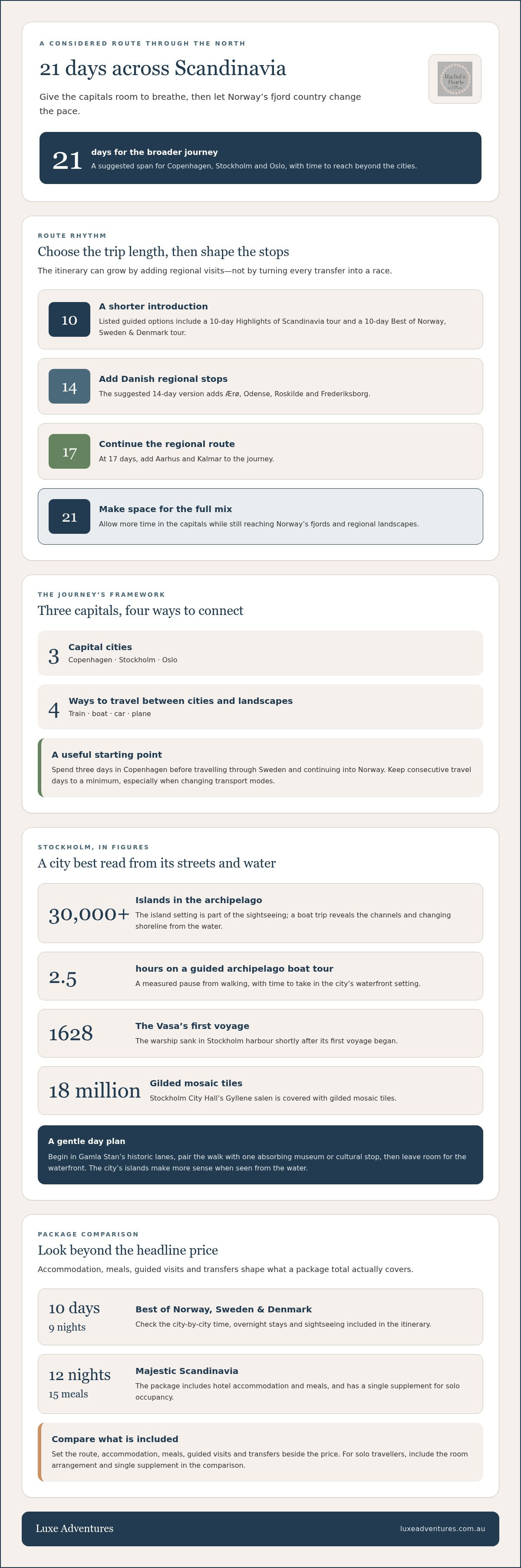
Twenty-one days allows for a broad journey through Denmark, Sweden and Norway, with time for capital sightseeing and a more deliberate route beyond the cities.
-
Plan Guided Touring Across the Countries
Choose whether a guided tour or private touring better suits your preferred pace. Listed options include a 10-day Highlights of Scandinavia tour and a 10-day Best of Norway, Sweden & Denmark tour. Compare each route’s overnight stays, sightseeing and time in each city. A guided schedule brings structure to the journey; private touring can leave more room for personal interests, such as Copenhagen’s palaces or Norway’s landscapes.
- Build the longer route around Copenhagen, Stockholm and Oslo, then add regional stops. Spend three days in Copenhagen before travelling through Sweden and continuing into Norway. For 14 days, recommendations add Ærø, Odense, Roskilde and Frederiksborg in Denmark. At 17 days, add Aarhus and Kalmar. With 21 days, a luxury Scandinavia holiday itinerary can give the capitals more time while still reaching beyond them. Keep consecutive travel days to a minimum, especially when changing transport modes.
-
Add Northern Lights Tours
Place a northern lights tour in the Norway portion of your journey. Winter travel from December to February suits this experience, but keep evenings flexible rather than treating the lights as a scheduled show. Consider how the tour fits with your daytime plans and overnight location. If fjord scenery matters just as much, balance after-dark excursions with time to explore Norway in daylight.
- Choose a 10-day itinerary when you want a shorter introduction to the three countries. The listed tours offer a guided framework, while a private route can prioritise particular interests, such as Stockholm’s museums or Norway’s fjords. For a longer adventure, use 21 days to add capital stays and regional experiences without compressing every visit. Whichever format you choose, compare actual days spent exploring with total trip duration; travel days shape the pace as much as sightseeing does.
Stockholm sightseeing, museums and canal cruises
Plan Stockholm around its waterfront, historic centre and museums, then use a boat trip to see the city from the water. With more than 30,000 islands in the archipelago, the setting is part of the sightseeing.
- Start in Gamla Stan, where colourful stone houses date from the 17th and 18th centuries. Walk the old lanes before visiting Stockholm City Hall, whose Gyllene salen is covered with 18 million gilded mosaic tiles. This pairing balances street-level history with an interior rich in detail. Keep the rest of the day light, leaving time for a café stop or a slow walk along the waterfront.
- Choose a museum based on the story you want to follow. At the Vasa Museum, see the warship that sank in Stockholm harbour in 1628, immediately after its first voyage began. The ship’s scale makes the museum compelling even for visitors with little interest in naval history. Pair it with a nearby cultural stop rather than filling the day with galleries; one absorbing collection often leaves a stronger impression than a hurried checklist.
- Set aside 2.5 hours for a guided Stockholm archipelago sightseeing boat tour. From the water, the city’s islands, channels and changing shoreline become easier to read, while the boat provides a welcome pause from walking. Choose a departure that leaves space for a meal before or after. For a more tailored day, discuss your Stockholm itinerary around the museums and waterfront experiences you value most.
- Extend the route beyond Stockholm if the wider journey allows. A 10-day Scandinavia itinerary can add an overnight cruise from Stockholm to Helsinki and Tallinn, bringing three Baltic capitals into the same trip. Treat the sailing as part of the experience, not merely a transfer. It changes the rhythm of the itinerary and gives you a different perspective on how Sweden connects with neighbouring countries.
- Connect Stockholm with Gothenburg for a broader view of Sweden. In Gothenburg, the boat-and-bus sightseeing trip includes five boat stops around the city, while tram 11 reaches Saltholmen, the ferry departure point for nearby islands. These villages and coastal settings offer a quieter contrast to Stockholm’s museum-rich centre. Allow the transition to feel deliberate: the two cities reward different kinds of wandering.
Package prices and solo-traveller supplement
Compare package inclusions before choosing a three-week route. Hotel nights, meals, guided visits and transfers all affect what a headline price covers. For Australian travellers, passport and visa conditions for Denmark, Sweden and Norway depend on your passport, purpose and length of stay. Factor the requirements for each destination into your planning.
- Compare the itinerary and inclusions, not just the package total. A listed Best of Norway, Sweden & Denmark tour runs for 10 days and 9 nights, while the Majestic Scandinavia package includes 12 nights of hotel accommodation and 15 meals. Check how much time each option gives Copenhagen, Stockholm, Oslo and Bergen. A lower headline figure can reflect a different balance of accommodation, transport and guided sightseeing.
- Account for solo occupancy when comparing package options. The Majestic Scandinavia package has a single supplement, so solo travellers should compare the total room arrangement with the itinerary’s inclusions. Couples can compare the same package on a shared-room basis. Focus on the full trip structure, including hotel nights, meals and transport, rather than a per-person figure on its own.
- Match the departure date to the experience you want. Advertised Majestic Scandinavia dates run from 5 May to 13 October 2027. Summer brings longer days for walking around Copenhagen or visiting a fortress, while shoulder-season dates can alter the feel of city sightseeing and restaurant reservations. Set your preferred travel period first, then compare the departures that suit your pace and planned sights.
- Use rail and bus journeys to understand the route’s real pace. The direct train from Copenhagen to Stockholm takes 5 to 6 hours; the train from Gothenburg to Oslo takes 3 hours 50 minutes. A bus from Gothenburg to Oslo takes around 3.5 hours. Compare arrival times and the number of hotel changes, not only journey duration. That helps preserve an afternoon for a castle visit or a relaxed meal.
- Set your budget around the choices that most affect the trip: accommodation, private guiding, transport, meals and optional experiences. Package pricing varies with inclusions and travel dates, while a tailored itinerary depends on its route and arrangements. A travel concierge can help organise the moving parts, from city stays to a Bergen extension, but clear priorities make planning more useful. List your preferred hotels, key sights and flexibility before requesting a quote.
Norwegian fjords, waterfalls and glaciers
Pair Norway’s fjord cruises and glacier landscapes with a northern lights tour for a varied journey. The right experiences depend on your route and season, so leave space between scenic transfers and excursions.
-
Explore the Fjord Landscapes
Choose a route that gives you time on the water and among Norway’s mountains. The Flåm Railway and a cruise through Sognefjord, Aurlandsfjord and Nærøyfjord offer two distinct ways to experience the region. For more time in fjord country, add overnight stays in Sognefjord rather than treating it as a quick passage. Jostedal Glacier is described as the largest icecap in continental Europe, a striking contrast to the famous fjords and waterfalls.
-
Choose a Geiranger Fjord Experience
Decide whether a boat cruise or a RIB experience better suits your pace and preferred perspective. A boat gives you time to take in Geiranger Fjord’s steep sides and waterfalls; a RIB offers a more active way to explore the water. Compare the route, duration and inclusions before choosing, and leave room around the excursion. A two-night stay in Geiranger gives you more opportunity to enjoy the setting beyond a single boat departure.
-
Compare Fjord Cruise Options
Compare Havila and Hurtigruten by the route and sailing dates that fit your wider itinerary. Check which ports and fjord stretches each sailing visits, how long you spend ashore, and whether the cruise replaces or complements a land transfer. These details shape the experience more than the name alone. If scenery is your priority, look closely at time spent along the Norwegian coast; for a broader journey, consider how the sailing connects with cities and inland stops.
-
Plan a Geiranger Visit
Build Geiranger into your route as a destination, not just a photograph from the deck. A two-night stay creates space for a fjord excursion and time on land, with waterfalls and mountain views changing as you move through the village. For a shorter connection, the one-day Norway in a Nutshell train and fjord cruise can link Oslo and Bergen without an overnight stay. Choose the longer stay if fjord country is central to your adventure.
Three-week Scandinavia itinerary by car, train, boat and plane
Give a 21-day journey a transport plan, not simply a list of destinations. In Denmark and Sweden, use rail and city stays to keep the route legible; reserve a boat or car for legs where the journey itself adds something. In Norway, consider whether a flight or road segment best connects your chosen stops. A little variety works; changing transport for its own sake does not.
- Start by deciding where you want to arrive and depart, then arrange the route between those points. Flying into Copenhagen and out of Bergen can make a Scandinavia trip more efficient, although a transfer in Copenhagen is likely. This open-jaw approach avoids retracing your route at the end. Choose it when your journey naturally travels west through the countries, rather than adding a return leg simply to match your arrival airport.
- Choose the Copenhagen-to-Oslo overnight ferry when you want a sea crossing to replace a hotel night. The route uses an inside B-class cabin, so treat the sailing as a practical overnight connection rather than assuming a scenic cabin view. Compare it with your preferred rail or flight connections, and consider how the arrival time affects the next day. An overnight journey works best when it reduces backtracking without leaving you short of rest.
- Choose a car for a planned stretch of Norwegian countryside, not as the default for every country. Driving gives you flexibility to pause between overnight bases, while rail can simplify longer intercity legs. Plan the car segment around the places you want to reach, then return to public transport where it better suits the route. This avoids turning a three-week holiday into a continuous exercise in parking and repacking.
- Keep the capital sequence adaptable instead of fixing every transfer too early. If Oslo is a priority, a flight from Stockholm is one possible connection, but it is not included in the itinerary described here. Account for the separate leg when planning the day, and avoid scheduling a major guided tour immediately after a late arrival. A calm first morning can be more valuable than squeezing in another sight.
- Use the extra days only when they add a different texture to the trip. At 24 days, recommendations allow more Norwegian countryside or additional time in Stockholm’s archipelago. Choose one extension according to your interests, rather than trying to fit both into the same spare days. The aim is a route with contrast: city time, a well-chosen crossing and a slower regional stay.
Luxe Adventures: African Safaris
Luxe Adventures can shape your Scandinavian route into a considered holiday through its Scandinavia Holidays offering. If you’re weighing private touring against a guided package, or balancing capital stays with fjord travel, bring your priorities together first. Share the destinations and experiences that matter most, such as time in Copenhagen, a Stockholm museum visit or a slower journey through Norway, and use them to shape the itinerary’s pace.
The same thoughtful approach can guide a future journey elsewhere, including an African safari, when you’re ready to explore a different landscape. For now, let your Scandinavia trip reflect how you like to travel: with room for discovery and without treating every transfer as a race. Contact Luxe Adventures to discuss your Scandinavia holiday.
Shape the journey around what matters to you
A thoughtfully designed luxury Scandinavia holiday itinerary is more than a sequence of destinations. It reflects how you want to spend your time, whether in conversation with local culture, watching the coastline unfold or taking a quieter pause between journeys. Before you book, consider which moments you want to carry home and which details can stay flexible. That clarity makes planning decisions feel purposeful rather than purely logistical.
Luxe Adventures can help shape a Scandinavia holiday around your priorities, and also offers Fiji luxury resorts and Expedition Cruises for travellers considering a different kind of escape. The best next step is a conversation about your travel style, preferred experiences and the pace that feels right. Plan your trip with Luxe Adventures, and begin shaping a journey that feels distinctly yours.
Frequently Asked Questions
What is the best itinerary for a tour of the Scandinavian capitals?
For a compact capitals visit, prioritise Copenhagen and Stockholm, then add Oslo if you have more time. With four days, focus on Copenhagen and Stockholm; use six days to include Oslo. Keep arrival and departure logistics separate from full sightseeing days. Choose one signature experience per city, then leave unplanned time for neighbourhood walks, cafés and the occasional detour that turns out better than planned.
What is the best itinerary for a tour of the Norwegian fjords?
The strongest fjord itinerary centres on one region rather than trying to collect distant landscapes in a short visit. Choose a base that gives you water-level views and access to the surrounding countryside, then plan excursions around it. If waterfalls, glaciers or mountain roads are priorities, allow time for those inland experiences too. The best route offers more than a brief glimpse from a transfer.
When is the best time to visit Scandinavia?
The best time depends on whether your priority is outdoor exploration, city culture or winter scenery. Longer daylight makes it easier to walk and travel through the landscape, while darker months suit travellers drawn to winter experiences and northern lights tours. Consider the daylight you want alongside your preferred activities. A city-focused trip can work in varied conditions; a countryside-heavy route benefits from a schedule shaped around available light.
What is the best time of year for a luxury Scandinavia holiday?
Choose a travel period that supports the experiences you value, rather than assuming one season suits every itinerary. For long days outdoors, favour a period with extended daylight; for a quieter, winter-led journey, plan around activities available in colder conditions. Think about how much time you want outside, your preferred pace and whether the trip centres on cities or remote scenery. Let these preferences guide your choice of season before you book hotels and transport.
What are the best luxury hotels in Copenhagen, Stockholm, Oslo, Bergen and Helsinki?
The best hotel in each city is the one that fits your daily plans and preferred atmosphere. In Copenhagen, Stockholm, Oslo, Bergen and Helsinki, compare central access with a quieter setting, then consider room character, dining and how easily you can return between outings. A waterfront address may suit a slower stay, while a central location can simplify cultural visits. Prioritise the hotel experience you want, not a label alone.
What are the best ways to travel between Scandinavian cities: private transfers, flights, trains or cruises?
Choose trains for connected city routes, flights when distance makes overland travel less convenient, and cruises when you want the journey itself to be part of the holiday. Private transfers can help with direct journeys between hotels and less-connected locations. Compare the full journey, including station or port access, waiting time and arrival point. The most efficient option on paper may not best protect your time at each destination.
Which luxury fjord cruises and scenic rail journeys are worth booking?
Look for a cruise that offers sustained views of the fjord landscape and a rail journey where scenery is central rather than incidental. Before booking, compare departure points, route length, stops and how each experience connects with your accommodation. A cruise and train combination can offer contrasting perspectives, but only if the transfers between them are manageable. Prioritise a route that leaves time to enjoy the scenery, rather than spending the day watching the clock.
What should travellers know about seasonal weather, daylight and packing for Scandinavia?
Pack adaptable layers, a weather-resistant outer layer and comfortable footwear suited to your route’s activities. Conditions can vary between city streets, coastal outings and countryside, so keep an extra layer accessible on travel days. Check your planned excursions before packing, especially if they involve extended time outdoors. A small day bag is useful for carrying essentials between hotel visits, rail journeys and boat trips without bringing your full luggage along.

Article by
Rachel Cleary
Rachel Cleary is the founder of Luxe Adventures and an endlessly curious explorer with a passion for meaningful, experience-led travel. Having visited every continent and travelled to more than 100 countries — and counting — she believes travel is one of the greatest educations for both children and adults alike.
Rachel is addicted to scuba diving and gets underwater at every opportunity. When she isn't in the office you'll find her exploring remote reefs in Fiji, drift diving in the Maldives, or scuba cruising Raja Ampat or French Polynesia.
Her second home is Fiji where she has explored all the island groups and has favourite boutique resorts she returns to every year, for the diving and the authentic Fijian hospitality.
Get her talking about kayaking in Antarctica or the Arctic, African safaris and where to find the highest density of big cats, underwater adventures, remote expedition destinations, or the science and magic behind the Northern Lights — including when and where they are most likely to dance — and you may be there a while.
Through Luxe Adventures, Rachel combines firsthand experience, global industry connections, and a deep appreciation for nature, culture, food, wildlife, and human connection to help curious travellers explore the world in a way that feels seamless, personal, and unforgettable.
Refined by experience. Defined by connection.
Disclaimer
The information in this article is intended as general travel inspiration and guidance only. Travel requirements, hotel standards, airline schedules, entry regulations, weather conditions, pricing, and experiences can change without notice.
While every effort is made to ensure accuracy at the time of publishing, Luxe Adventures recommends confirming all details relevant to your personal travel plans before booking or travelling.
Opinions, recommendations, and destination insights shared in this article are based on firsthand experience, industry knowledge, and research at the time of writing. Experiences may vary depending on season, supplier changes, local conditions, and individual travel preferences.
Some articles may reference luxury travel affiliations, preferred partner programs, or value-added amenities available through Luxe Adventures. Benefits and inclusions are always subject to availability and supplier terms at the time of booking.
Luxe Adventures strongly recommends comprehensive travel insurance for all international travel.
For personalised travel advice, tailored itinerary design, or the latest destination updates, please contact Luxe Adventures directly.


