

A career break can be carefully planned, not simply time away. A sabbatical is an extended period away from work, typically agreed with an employer, with the employee returning to the same job afterwards. It often lasts from one month to six months, though some employees may be offered 12 months, and leave can sometimes extend to two years.
It’s natural to wonder whether a sabbatical is realistic, how it fits around work and what a longer journey might cost. The answers depend on your employer’s policy, whether leave is paid, partially paid or unpaid, and the kind of trip you have in mind. Corporate sabbatical travel packages can help turn time away into a considered itinerary, rather than a hurried list of places to see.
This guide explains what a sabbatical involves, how long it may last and what to include in your budget. It also looks at how to plan a tailored trip around the season, the experiences you want and the practical details that help an extended journey feel rewarding from departure to return.
Key Takeaways
- A sabbatical is an extended break from work, usually agreed with an employer, with the employee returning to the same job. Its length and pay arrangements depend on workplace policy.
- Before planning a journey, understand the eligibility rules, approval process and return-to-work conditions in your employer’s sabbatical policy.
- Build a realistic budget around the time away, destination costs, planned activities and everyday expenses at home and abroad.
- Allow a longer itinerary room for slower travel and deeper exploration, rather than trying to fit too many destinations into the calendar.
- Shape the route around seasonal experiences, course schedules and practical arrangements such as visas and vaccinations.
Typical sabbatical duration
A sabbatical is an extended period away from work, usually agreed with an employer, after which the employee returns to the same job. Unlike annual leave, it can last long enough for study, personal development or a sustained journey. In Australia, its length and conditions depend on the employer’s policy and the agreement with the employee.
What Australian workplace policies and tax rules apply to employer-funded sabbaticals? Workplace policies set conditions such as eligibility, duration, pay and return-to-work commitments, so record the agreed terms in writing. Tax treatment of employer-funded travel is separate from leave approval and depends on the funding arrangement. Assess that arrangement before including employer support in your personal travel budget.
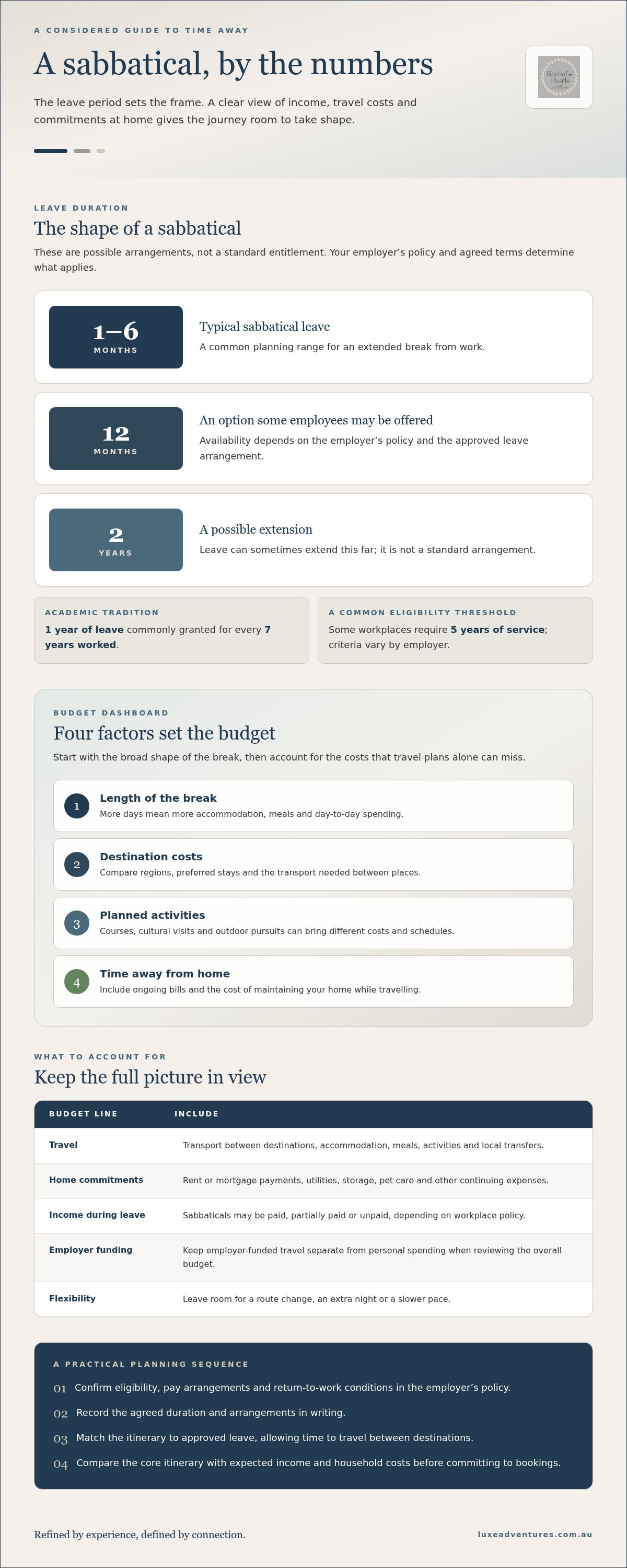
Typical sabbatical leave lasts from one month to six months. Some employees may be offered a 12-month sabbatical, while leave can sometimes be extended to two years. These are possible arrangements, not a standard entitlement: the employer’s policy, operational needs and approved leave terms shape the actual period. For planning, distinguish the approved absence from the travel itself, since preparation and returning to work also take time.
Academic sabbaticals have a separate tradition, commonly granting one year of leave for every seven years worked. In other workplaces, a common minimum service requirement for eligibility is five years. Employers may also consider performance, the purpose of the leave and whether the team can manage the absence. These criteria help explain why colleagues may receive different sabbatical terms.
What are corporate sabbatical travel packages? They are travel arrangements planned around an extended work break, bringing elements such as a route, accommodation and experiences together in a coherent itinerary. A package can reflect the approved leave period and the traveller’s aims, whether that means staying in one region or travelling through several destinations.
How long do corporate sabbatical trips usually last, and can itineraries be customised? Sabbatical contracts commonly range from one month to one year, and sometimes longer. The trip itself can be shaped around the approved leave. Customisation can account for personal interests, destination seasons and a pace suited to an extended stay.
Before settling on a departure date, take these practical steps:
- Read the employer’s sabbatical policy for eligibility, pay and return conditions.
- Get the agreed duration and arrangements in writing.
- Match the itinerary length to approved leave, allowing time for travel between destinations.
- Keep employer-funded travel arrangements distinct from personal spending in your budget.
A sabbatical may last weeks or years, but its shape depends on aligning the workplace agreement with the reason for taking leave. That clarity makes it easier to plan an extended journey around the time actually available, rather than an optimistic calendar.
Budgeting for a sabbatical
A sabbatical budget needs to cover more than the journey. Start with four factors: the length of the break, planned activities, time away and destination costs. Add everyday living expenses, including commitments that continue at home. A month in one city has a different financial shape from several months moving between regions, even before you book.
Separate your budget into travel and household spending. Travel costs may include transport between destinations, accommodation, meals, activities and local transfers. Household costs can include rent or mortgage payments, utilities, storage, pet care and other commitments that continue while you’re away. If you’re keeping your home in Australia, plan for those expenses alongside accommodation abroad.
Then consider how your income will change during leave. Sabbaticals may be paid, partially paid or unpaid, depending on the organisation’s policy. Compare expected income during the break with regular expenses, and decide how much savings will cover the difference. If your employer funds part of the travel, keep that separate from personal spending to see the overall picture clearly.
Use separate budget lines for the main choices:
- Time away: A longer itinerary means more days of accommodation, meals and day-to-day spending.
- Destination: Compare the costs of each region, including transport between places and the style of stay you prefer.
- Activities: A language course, guided cultural visits or outdoor pursuits may bring different costs and schedules.
- Home commitments: Include regular bills and any costs for maintaining your home while you travel.
- Flexibility: Allow room in your plan for a change of route, an extra night or a slower pace.
Prioritise the experiences that give the break meaning. If learning a language is central, course fees and a suitable stay may matter more than frequent changes of location. If culture is the focus, allow more time for local encounters and fewer transfers. Your budget should reflect the purpose of the sabbatical, not just a checklist of places.
Review your figures against the approved leave period before committing to bookings. A useful approach is to price the core itinerary first, then compare it with the income and household costs already mapped. If the totals feel tight, adjust the route, duration or pace before sacrificing the experiences that matter most. For help shaping travel plans around your priorities, discuss a tailored itinerary as you refine the budget.
As plans take shape, revisit your estimate whenever the itinerary or daily routine changes. The sabbatical’s length, planned activities, time away, destination costs and basic living expenses all affect how much to set aside. A change in one area can alter the balance elsewhere. Keep assumptions visible, such as your accommodation style and travel pace, and check that they still match your priorities.
Before leave begins, make sure your savings and expected income can cover both travel and continuing commitments. A clear estimate can help you decide whether to simplify the route, change the pace or revise activities while protecting the experiences that matter most.
Longer trips for deeper exploration
Sabbatical contracts commonly range from one month to one year, and sometimes longer. That span can support a different kind of travel: fewer rushed transfers, longer stays and time to understand a place beyond its first impressions. A big trip can be a rewarding way to spend time away from work, especially when the journey has a personal purpose.
Consider a seven-week route through Greece, Morocco and India. Each country has a distinct rhythm, so the itinerary needs time for arrival, adjustment and meaningful experiences. A schedule built around constant flights may cover more ground, but leave little space for the everyday details that give a destination its character.
Longer travel works best when the route has a clear centre of gravity. A traveller drawn to food, for example, could spend much of their leave exploring regional cooking, markets and shared meals, rather than treating every stop as a brief visit. Someone seeking a fresh perspective might combine city time with quieter surroundings. The point is not to fill every day, but to choose what deserves attention.
Before adding another country, consider what the transition brings. A new destination can offer a different language, landscape or cultural perspective, but it also means packing, travel time and settling in again. On a seven-week journey, removing one transfer may create more time for a class, a guided visit or unplanned conversations. A slower route can be a more considered itinerary.
A longer break may also make room for personal development, one purpose a sabbatical activity can support. Learning a language, practising a skill or experiencing a different routine gives the journey a thread beyond sightseeing. If study is part of your plan, let the course schedule shape the route instead of fitting lessons around frequent moves.
Use these questions to give an extended trip its shape:
- Purpose: What do you want to learn, experience or reconsider during the leave?
- Pace: Which destinations deserve a longer stay, and which are passing through?
- Transitions: Does each move add enough value to justify the travel time?
- Return: Will the final stretch leave room to rest and prepare for work again?
A sabbatical trip does not need to reach the furthest point on the map. A carefully paced journey through Greece, Morocco and India, or a longer stay in one region, can offer depth without turning every week into a departure day. Choose a route that uses your leave for experiences that matter to you.
Tailor-made sabbatical itineraries
A tailored itinerary begins with a reason for taking leave, not a map crowded with pins. Learning a language, exploring a particular culture or changing your daily routine can each shape the route. A traveller interested in Japanese design, for example, might combine time in Tokyo with visits to quieter regional settings. The itinerary then has a clear thread, rather than a collection of disconnected stops.
Destination events can provide a useful anchor. Japan’s cherry blossom season and Carnival in Brazil are examples of occasions that may shape when and where you travel. Planning around a specific event gives the journey a focal point, but also affects travel dates, accommodation and the order of destinations. Decide whether the event is the centrepiece or one element among several.
Build the route around the experience, then consider its practical rhythm. A Japan itinerary focused on cherry blossoms might include time in more than one area, with pauses between transfers. A Brazil journey centred on Carnival could leave space before or after the celebrations for a quieter contrast. These are planning examples, not fixed formulas: the right sequence depends on your interests and available leave.
Season matters beyond headline events. Consider the conditions that make each experience enjoyable, whether you plan to walk around a city, spend time outdoors or travel between regions. A route that looks elegant on screen can feel tiring if it involves constant packing and long transfers. Choose a manageable number of bases, then allow enough time to settle into each one.
Personal development can also shape a sabbatical. Someone learning a language may prefer an extended stay where regular lessons and everyday conversation fit naturally into the week. If you’re gaining a new skill, consider the relevant course schedule before choosing travel dates. In either case, the itinerary works best when learning has room to become part of daily life.
Use these questions to refine an initial route:
- Purpose: What do you hope to learn or experience during the leave?
- Anchor: Is a named event, such as Carnival in Brazil, central to the journey?
- Season: Does the timing suit the experiences planned in each destination?
- Pace: Can you reduce transfers to make time for local connection?
- Structure: Do course dates or other commitments need to shape the route?
Finally, keep the itinerary personal without prescribing every day. A well-chosen reservation or guided experience can add context, while unscheduled time leaves room for an unexpected conversation or a return visit to a favourite neighbourhood. For a sabbatical, that balance matters: the plan should offer direction while leaving space for the journey to change your perspective.
Trip logistics and planning
Compared with arranging travel independently, a sabbatical package coordinates selected bookings and itinerary planning, while independent arrangements leave each choice in your hands. The itinerary sets out inclusions and exclusions, so treat accommodation, transport, experiences, meals and insurance as separate items unless they are expressly listed.
Package Inclusions
A corporate sabbatical package is a tailored travel arrangement that brings specified trip components together in one itinerary. A clear schedule shows how accommodation, transport between destinations and selected experiences fit the leave period. Read each inclusion as a defined booking or service, not as an assumption that every travel expense is covered.
Package Exclusions
Package exclusions are costs and arrangements outside the agreed itinerary. They matter because meals, personal spending, travel insurance and activities beyond the planned programme can affect your budget. Written terms should distinguish included bookings from items you arrange separately, so you can plan the full journey without mistaking a curated itinerary for an all-inclusive arrangement.
Independent planning can suit travellers who enjoy researching each stay and booking every transfer themselves. A coordinated package can reduce separate decisions by bringing selected elements into a single travel plan. Neither approach replaces employer approval: a travel itinerary and workplace leave agreement serve different purposes.
Start logistics with your sabbatical dates. Give your employer plenty of notice and consider team responsibilities, destination seasons and any event anchoring the trip. If a language or skills course is part of the plan, use its schedule to choose departure dates and length of stay. Course timetables are less forgiving than a leisurely afternoon.
Before departure, organise practical details for each destination. Consider visa and vaccination requirements, confirm the sequence of stays and keep booking details accessible during travel. For a multi-country itinerary, make sure transfer days leave enough time to reach your next accommodation and settle in before a scheduled activity.
Work arrangements need their own calendar. Get sabbatical terms in writing, including approved leave and return expectations. Agree who will handle responsibilities during your absence, then plan a handover meeting a few weeks before your return date. A short update on industry news or relevant training can also help you reconnect with work after an extended break.
For a tailored journey that fits your leave dates, interests and practical arrangements, start planning your sabbatical itinerary.
Course commitments can shape the wider itinerary. If you plan to learn a skill during your sabbatical, consider relevant course schedules. Also think about the best season for your chosen destinations and experiences, so the trip’s timing reflects planned activities as well as course dates.
People requesting a sabbatical should give plenty of notice and consider the timing. Travellers planning a sabbatical should consider visa and vaccination requirements for their chosen destinations. Include the return transition in the work calendar, too: people preparing to return from a sabbatical should plan a handover meeting a few weeks before their return date.
Luxe Adventures: African Safaris
Luxe Adventures can shape an African safari into a considered journey for your sabbatical. Founder Rachel Cleary personally researches destinations, hotels and expedition cruises, bringing a well-travelled perspective to itinerary choices. Her approach helps connect the experience with your interests, from wildlife and landscapes to the character of each stay.
For a wider journey, Luxe Adventures also offers Fiji luxury resorts, expedition cruises and Scandinavia holidays. Contact Luxe Adventures to discuss your sabbatical plans, or visit luxeadventures.com.au.
Give your time away a clear direction
A sabbatical can create room to return with a different perspective, but the journey needn’t be mapped down to its final afternoon. Begin by deciding what you want the time to make possible: a deeper connection with a place, a new skill or simply a slower rhythm. That intention can guide important choices without turning the trip into another work project.
Luxe Adventures can shape your travel around that purpose, with African safaris, Fiji luxury resorts and expedition cruises among its offerings. Consider the experience that feels most meaningful, then build a journey that gives it room. The result should feel considered, personal and distinctly yours.
If you’re ready to explore corporate sabbatical travel packages for your plans, contact Luxe Adventures to plan your sabbatical. A thoughtful first conversation can turn a broad idea into a journey worth looking forward to.
Frequently Asked Questions
What is a sabbatical?
A sabbatical is a planned, extended pause from regular duties, often used for a sustained personal or professional aim rather than a short holiday. The term describes the work break; the employee’s purpose might be personal or shaped by workplace policy. For example, an organisation may ask applicants to explain their plans for the leave, helping clarify how a proposal fits its sabbatical programme.
How can a company plan, book and manage a sabbatical travel program for employees?
A company can begin by piloting a sabbatical policy with a small group, then use the experience to refine how the programme works. Set transparent eligibility and assessment criteria, and decide how applications will be reviewed consistently. Corporate sabbatical travel packages can help employees plan travel around their interests, while the company gathers feedback on programme administration and considers whether to extend it more widely.

Article by
Rachel Cleary
Rachel Cleary is the founder of Luxe Adventures and an endlessly curious explorer with a passion for meaningful, experience-led travel. Having visited every continent and travelled to more than 100 countries — and counting — she believes travel is one of the greatest educations for both children and adults alike.
Rachel is addicted to scuba diving and gets underwater at every opportunity. When she isn't in the office you'll find her exploring remote reefs in Fiji, drift diving in the Maldives, or scuba cruising Raja Ampat or French Polynesia.
Her second home is Fiji where she has explored all the island groups and has favourite boutique resorts she returns to every year, for the diving and the authentic Fijian hospitality.
Get her talking about kayaking in Antarctica or the Arctic, African safaris and where to find the highest density of big cats, underwater adventures, remote expedition destinations, or the science and magic behind the Northern Lights — including when and where they are most likely to dance — and you may be there a while.
Through Luxe Adventures, Rachel combines firsthand experience, global industry connections, and a deep appreciation for nature, culture, food, wildlife, and human connection to help curious travellers explore the world in a way that feels seamless, personal, and unforgettable.
Refined by experience. Defined by connection.
Disclaimer
The information in this article is intended as general travel inspiration and guidance only. Travel requirements, hotel standards, airline schedules, entry regulations, weather conditions, pricing, and experiences can change without notice.
While every effort is made to ensure accuracy at the time of publishing, Luxe Adventures recommends confirming all details relevant to your personal travel plans before booking or travelling.
Opinions, recommendations, and destination insights shared in this article are based on firsthand experience, industry knowledge, and research at the time of writing. Experiences may vary depending on season, supplier changes, local conditions, and individual travel preferences.
Some articles may reference luxury travel affiliations, preferred partner programs, or value-added amenities available through Luxe Adventures. Benefits and inclusions are always subject to availability and supplier terms at the time of booking.
Luxe Adventures strongly recommends comprehensive travel insurance for all international travel.
For personalised travel advice, tailored itinerary design, or the latest destination updates, please contact Luxe Adventures directly.


