

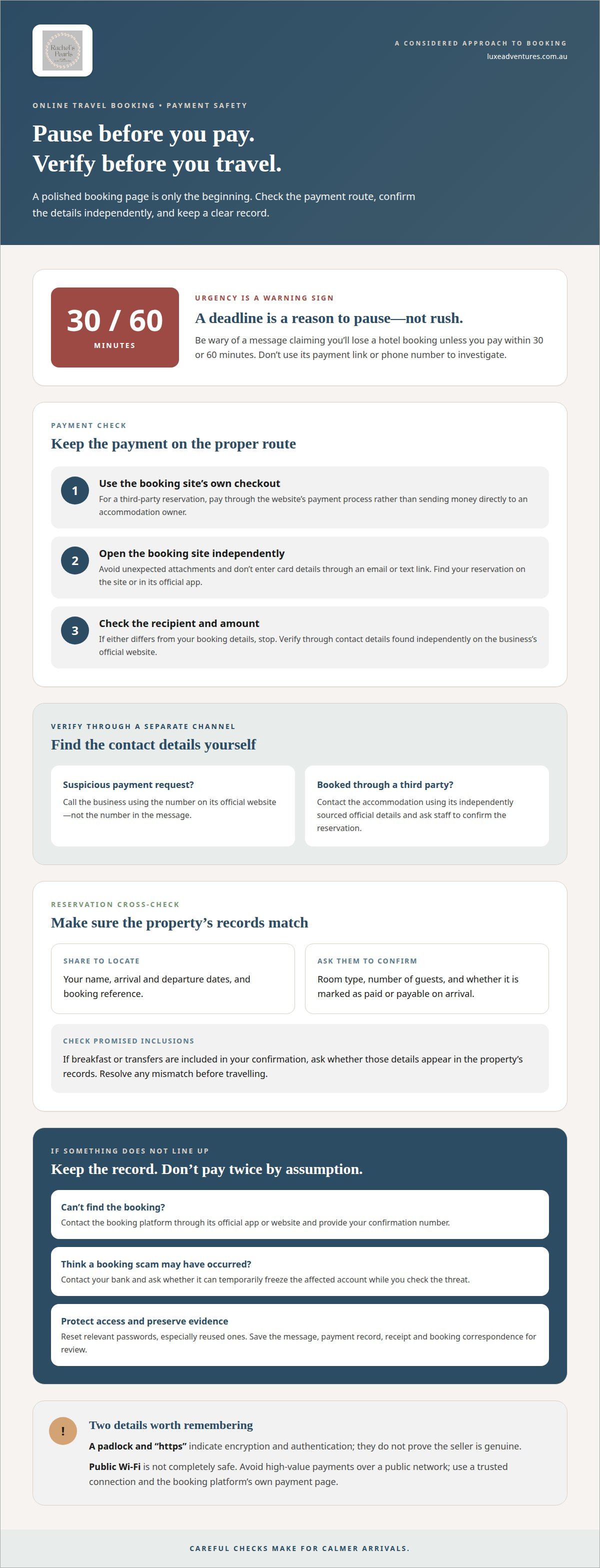
To ease the fear of booking an expensive trip online, use the booking website’s own payment process rather than sending money directly to an accommodation owner. If a payment request seems unusual, contact the business using the phone number on its official website, not the number in the message. For a third-party booking, contact the accommodation directly to confirm the reservation.
It’s sensible to pause before committing a substantial amount to a trip you’ve only seen on a screen. A polished website can inspire confidence, but the details behind the offer deserve as much attention as the photographs.
This guide explains how to assess a booking site, spot suspicious payment requests and confirm a reservation with the accommodation provider. Follow these steps before paying so you can make a considered decision rather than one driven by pressure.
Key Takeaways
- Pause on unexpected payment requests and verify them through contact details you find independently, not those in the message.
- Assess a booking site beyond its polished design: check the web address, profile history, charges and booking terms before paying.
- For a third-party reservation, contact the accommodation directly and confirm the key details before you travel.
- Understand how Australian Consumer Law may apply to an online travel booking, and know the role of the ACCC if something goes wrong.
1. Avoiding suspicious links, attachments and payment requests
For a third-party travel booking, pay through the website’s own checkout rather than sending money directly to an accommodation owner. A message asking you to transfer funds separately changes the payment route and warrants a pause. Avoid opening unexpected attachments or entering card details through an email or text link. Instead, open the booking site independently and find your reservation there.
A deadline can make an ordinary payment request feel urgent. Be wary if a message says you’ll lose a hotel booking unless you pay within 30 or 60 minutes. Don’t use the phone number or payment link in that message to investigate. Find the business’s contact number on its official website, then call to ask whether the request is genuine.
Check the payment method before proceeding. Wire transfers may not offer the protections available for card payments, so don’t treat a bank transfer request as equivalent to a credit card checkout. Review the recipient name and amount on the payment screen. If either differs from your booking details, stop and verify using contact details sourced independently from the business.
Public Wi-Fi isn’t completely safe for travellers. Avoid making a high-value payment over a public network; use a trusted connection and the booking platform’s own payment page. Keep your confirmation and payment receipt so you can compare the details later.
If you think you’ve been caught by a booking scam, act quickly:
- Contact your bank and ask it to freeze the affected account temporarily while you check the threat.
- Reset passwords for your email, social media, financial institution and booking-service accounts, especially if you reused a password.
- Save the message, payment record and booking correspondence for your bank’s review.
These steps help protect access to your accounts while you work out what happened. Pausing before you pay is far less stressful than trying to resolve a suspicious transfer while travelling.
Checking online advertisements and booking websites
The fear of booking an expensive trip online often starts with a tempting offer and too many unknowns. Begin with the web address: a misspelling, awkward wording or incomplete profile deserves scrutiny. A single review gives little context, so search the company name alongside “review” and “scam”. Compare the results with the business details on its own website.
An “https” address and padlock indicate encryption and authentication, but don’t prove the seller is genuine. Be cautious with unusually cheap offers or pressure to pay before reading the terms. If the fear of booking an expensive trip online is holding you back, slow the decision down and check the business details, itinerary and final checkout screen side by side.
To compare flights, accommodation and package holidays—whether arranging mainstream travel or researching niche adventure packages on sites like bestofpng.com—write down the same dates, room type, baggage, meals, transfers and inclusions for each option. Add any charges shown before payment, then compare like with like. A low headline fare may not include the baggage or other essentials you need.
Credit card chargebacks and travel insurance don’t guarantee refunds. A chargeback depends on your card provider’s process and the circumstances; insurance depends on the policy wording, exclusions and reason for a claim. Read both before relying on either.
Separate flight and accommodation bookings can leave you coordinating with different suppliers if a flight change disrupts your hotel dates. Check connection times and each booking’s change terms. One reservation may not adjust when the other does.
Before confirming, compare the itinerary and total payable amount with the checkout screen. Read the cancellation, refund and change policies, noting deadlines, fees, exclusions and how to submit a request. Save the terms and confirmation with your payment record.
For a complex itinerary, discuss the trip’s moving parts with a travel adviser before paying.
Research by the American Hotel & Lodging Association found that millions of travellers have been victims of fraudulent websites in recent years. Spelling errors in a booking website’s URL or page are a warning sign that it may be fake. “https” and a padlock indicate encryption and authentication that help protect transactions, but don’t establish legitimacy.
High-pressure sites may advertise only a fraction of a hotel’s available rooms, and travellers may later find rooms by booking directly. Treat unusually cheap offers with caution because they may be scams. A booking profile with only one review and an incomplete profile may be fake.
3. Checking reservations directly with accommodation providers
A booking confirmation is useful, but checking the accommodation’s own reservation system offers another safeguard. If you booked through a third-party website, find the property’s official contact details independently. Call or email the accommodation and ask staff to confirm the booking under your name. Don’t rely on contact details copied from an unexpected message.
Share only the details needed to locate your reservation: your name, arrival and departure dates, and booking reference. Ask the property to confirm the room type, number of guests, and whether the reservation is marked as paid or payable on arrival. If your confirmation promises breakfast or transfers, ask whether those details appear in the property’s records. Resolve any mismatch before travelling.
If staff can’t find the booking, don’t assume paying again will solve the problem. Contact the booking platform through its official app or website and provide your confirmation number. Keep the accommodation’s response and the platform’s reply with your receipt. This record can help clarify which party holds the booking and payment.
Booking directly with accommodation can reduce the number of parties involved when that option suits your plans. Compare the property’s cancellation terms, payment schedule and room details with the third-party offer before deciding. A direct reservation still needs careful review: check that the dates, guest names and agreed inclusions appear correctly in writing.
If an online booking is fraudulent, contact your bank or card issuer promptly and keep the booking messages and receipts. If a supplier becomes insolvent, contact the accommodation and any other affected travel suppliers, then speak with your insurer about the relevant policy terms. Record each conversation, including the date, who you spoke with and any next steps.
Before departure, contact the accommodation again if the confirmation is unclear. A brief, direct exchange can establish whether the reservation is visible and what to expect at check-in.
4. What protections do Australian Consumer Law and the ACCC provide for online travel bookings?
Australian Consumer Law (ACL) is relevant when a travel service is sold to an Australian consumer. It doesn’t make every cancellation refundable or every disputed booking automatically compensable. Your position depends on what was promised, what the supplier delivered and the booking terms.
Keep the advertisement, itinerary, payment receipt, confirmation and cancellation policy together. If a hotel booking promises a particular room or included breakfast, save the wording shown before payment. These records help you explain the difference between the offer and the service received.
Start by writing to the business that sold or supplied the travel service. Include the booking reference, what happened, when it happened and the outcome you’re seeking. For example, explain that the accommodation provider can’t find a reservation despite a paid confirmation. Keep the response and relevant messages in the same file.
The ACCC administers and enforces Australian Consumer Law, but it doesn’t handle individual booking disputes. Its consumer guidance can help you understand your options and recognise conduct worth reporting. For an individual complaint, continue pursuing the issue with the business involved and keep a clear record of each exchange.
Different parts of a trip can involve separate businesses. A booking platform, airline and hotel may each have their own terms and records. Identify which business took payment and which promised the disputed service. This distinction matters when explaining the problem and seeking a response.
Before paying, save the terms for changes, cancellations and refunds. If the offer changes at checkout, pause and compare the final details with the original advertisement. Keeping a clear record gives you a stronger basis for raising a concern under the ACL.
If you’re planning a complex itinerary and want help bringing its details together, discuss your travel plans with an adviser before booking.
Many online travel agencies act as intermediaries, so travellers may need to deal with both the platform and supplier. Whether booking a hotel or comparing voyages through specialist platforms like CLICKnCRUISE, confirm what protections and cancellation policies apply to each segment. Check agent accreditation through AFTA or ATAS. Avoid wire transfers, which may lack the protections available for card payments.
Luxe Adventures: African Safaris
Luxe Adventures designs African safaris for travellers who want a considered journey rather than a string of disconnected bookings. If you’re weighing an expensive trip and would value a clearer view of how its elements fit together, Luxe Adventures’ bespoke luxury travel design can shape an itinerary around your priorities.
An African safari may involve several accommodation and travel arrangements, so it helps to understand what each booking covers, who provides it and how the details connect. A thoughtfully planned itinerary brings those decisions into focus before you commit, while leaving room for the landscapes, wildlife and local encounters that make the journey meaningful.
For a different kind of escape, Luxe Adventures also designs Fiji luxury resort stays, expedition cruises and Scandinavia holidays. The right next step depends on the experience you want and how much planning you’d like an adviser to handle.
Contact Luxe Adventures to discuss an African safari, or visit luxeadventures.com.au.
Make space for a more considered next step
The fear of booking an expensive trip online can make every decision feel like a test. Let the details guide you instead: choose the journey you want, decide what matters most and give yourself time to make a considered choice. Confidence doesn’t come from rushing to a payment screen. It comes from knowing the plan reflects your priorities.
If you’d prefer a personal conversation before planning your next journey, Luxe Adventures can help you explore the possibilities and consider how the pieces might fit together. You don’t need to have every detail settled. A clear sense of what you hope to experience is a thoughtful place to begin.
Contact Luxe Adventures to discuss your travel plans, and take the next step at your own pace.
Frequently Asked Questions
Why do people feel anxious about booking an expensive trip online?
People often feel anxious about making a large payment before experiencing the trip or speaking face to face with the people arranging it. Online, separate flights, accommodation and activities can make the overall plan harder to picture as one journey. Concerns about changing plans, unclear responsibilities or losing personal control can add to the hesitation. Taking time to understand each decision can make the commitment feel more considered.

Article by
Rachel Cleary
Rachel Cleary is the founder of Luxe Adventures and an endlessly curious explorer with a passion for meaningful, experience-led travel. Having visited every continent and travelled to more than 100 countries — and counting — she believes travel is one of the greatest educations for both children and adults alike.
Rachel is addicted to scuba diving and gets underwater at every opportunity. When she isn't in the office you'll find her exploring remote reefs in Fiji, drift diving in the Maldives, or scuba cruising Raja Ampat or French Polynesia.
Her second home is Fiji where she has explored all the island groups and has favourite boutique resorts she returns to every year, for the diving and the authentic Fijian hospitality.
Get her talking about kayaking in Antarctica or the Arctic, African safaris and where to find the highest density of big cats, underwater adventures, remote expedition destinations, or the science and magic behind the Northern Lights — including when and where they are most likely to dance — and you may be there a while.
Through Luxe Adventures, Rachel combines firsthand experience, global industry connections, and a deep appreciation for nature, culture, food, wildlife, and human connection to help curious travellers explore the world in a way that feels seamless, personal, and unforgettable.
Refined by experience. Defined by connection.
Disclaimer
The information in this article is intended as general travel inspiration and guidance only. Travel requirements, hotel standards, airline schedules, entry regulations, weather conditions, pricing, and experiences can change without notice.
While every effort is made to ensure accuracy at the time of publishing, Luxe Adventures recommends confirming all details relevant to your personal travel plans before booking or travelling.
Opinions, recommendations, and destination insights shared in this article are based on firsthand experience, industry knowledge, and research at the time of writing. Experiences may vary depending on season, supplier changes, local conditions, and individual travel preferences.
Some articles may reference luxury travel affiliations, preferred partner programs, or value-added amenities available through Luxe Adventures. Benefits and inclusions are always subject to availability and supplier terms at the time of booking.
Luxe Adventures strongly recommends comprehensive travel insurance for all international travel.
For personalised travel advice, tailored itinerary design, or the latest destination updates, please contact Luxe Adventures directly.


