

What if the most memorable wildlife encounter is the one where you give an animal room to carry on undisturbed? In the Galápagos, a little preparation makes a meaningful difference. The galapagos national park rules for tourists protect wildlife and habitats, but it’s easy to confuse expectations at visitor sites with the separate procedures for travelling to the islands.
If you’re wondering what to pack, how to photograph wildlife or what happens before your flight from mainland Ecuador, you’re not alone. This guide covers what to prepare before arrival and how to behave in protected areas, from staying on marked trails to listening to your naturalist guide. It also explains how arrival and biosecurity steps differ from the rules you’ll follow on the islands, and where to find official information before you travel. With the essentials clear, you can focus less on second-guessing and more on the privilege of observing Galápagos wildlife without disturbing it.
Key Takeaways
- Learn the practical habits behind the galapagos national park rules for tourists, and how they help protect wildlife and habitats.
- Know how to respond when wildlife approaches, and enjoy close encounters without encouraging interaction.
- Build a simple pre-departure routine for checking current biosecurity guidance and preparing your belongings.
- Separate park conduct from arrival procedures, which can change and should be checked through official sources before travel.
- Understand how a considered cruise itinerary can make site briefings and conservation-minded visits easier to follow.
Why Galápagos National Park rules shape every visitor experience
In the Galápagos, conservation is not a distant idea reserved for park staff. It is part of how visitors move through the islands: where they walk, how they observe wildlife and which instructions they follow. The galapagos national park rules for tourists are practical safeguards for animals, fragile habitats and visitor safety. They help keep encounters close without making them intrusive.
The Galápagos National Park Directorate (DPNG) manages the national park and sets guidance for visits to protected areas. Its instructions, together with site-specific briefings, shape what visitors can do on a particular landing or excursion. The Galápagos National Park has a wider history and conservation context. For planning, the useful distinction is simple: park conduct applies at protected sites, while Ecuador’s entry and travel procedures are a separate layer to prepare for.
Respectful visitor behaviour is conservation in action. Choices that leave wildlife and habitat undisturbed help preserve the conditions that make each encounter possible.
What the Galápagos protected-area rules are designed to protect
Protected-area rules guide visitors through places where wildlife and habitat are part of the experience, not scenery to rearrange. They apply at visitor sites on land and in marine areas, not only aboard expedition vessels. A landing, trail walk or water-based visit may have its own instructions, so don’t assume the rules for one outing automatically cover the next.
Treat signs and briefings as part of the visit. Following a marked route, for example, keeps foot traffic within designated areas rather than across fragile ground. It also means you can pay attention to the landscape instead of deciding where to go at every turn.
How guides and authorised operators fit into a park visit
Visits to protected areas require a park-certified naturalist guide, and visitors should use authorised operators and boats for activities in those areas. A guide does more than lead the way: they explain the setting, outline site-specific expectations and help the group move with care. Listen before setting out, then follow any updated instructions from guides and officials on site.
Even a small instruction can matter. A change to the route or timing may reflect conditions at that site, rather than a general rule for every island. Keep your group together, pause when asked and leave space for wildlife to move naturally. The aim is not to make every visit feel regimented. It is to let people experience the islands without placing the burden of that experience on the animals.
Keep the two kinds of preparation distinct. Park rules govern conduct within protected areas; Ecuador’s entry and travel procedures relate to reaching the islands and can change. Before departure, check current official information for the latter. Once on the islands, take your cue from the guide and the instructions for each site. A considered cruise itinerary can make those transitions easier to follow, but no itinerary replaces guidance on the ground.
Wildlife, trails and photography: the rules to follow at visitor sites
The best wildlife photographs often come from waiting, not edging closer. At visitor sites, stay on marked trails, read signs before moving on and follow your naturalist guide’s instructions. These habits make the galapagos national park rules for tourists straightforward to apply, even when an animal seems remarkably unbothered by your presence.
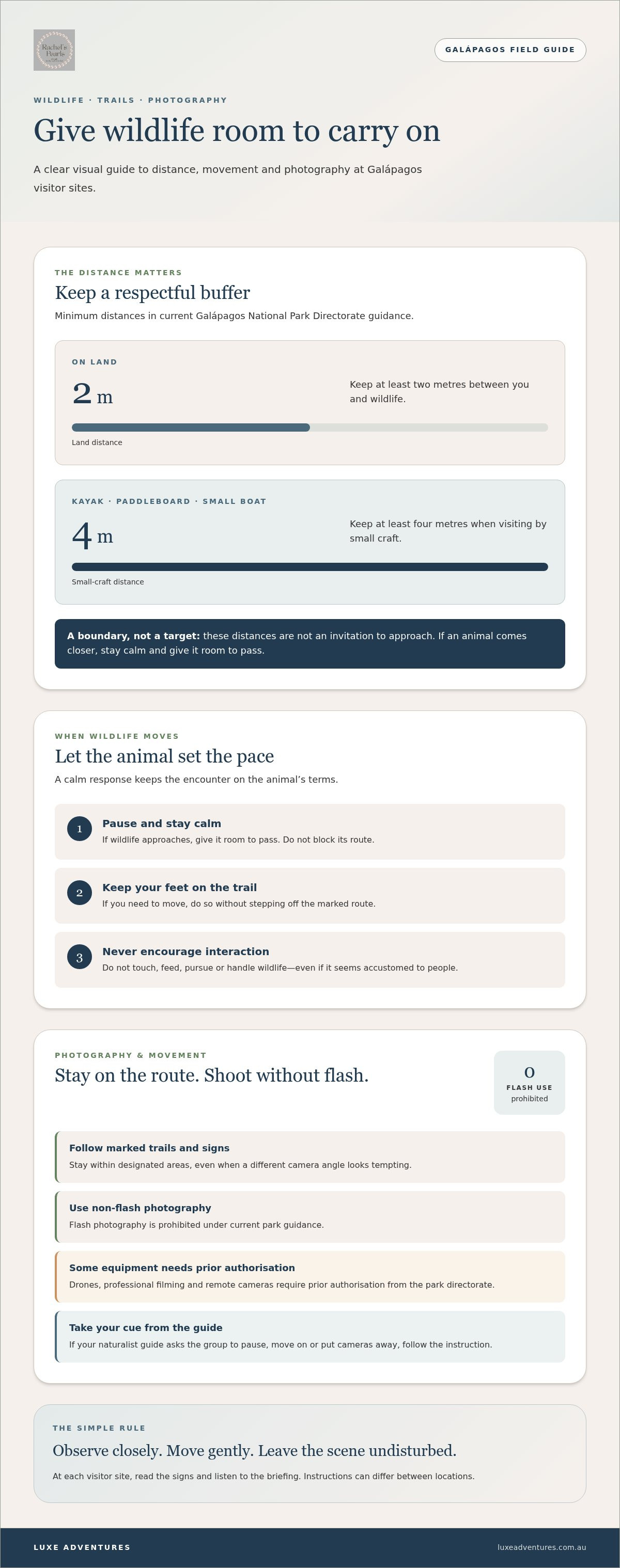
Current Galápagos National Park Directorate guidance sets a minimum distance of two metres from wildlife. For visitors in kayaks, on paddleboards or in small boats, the minimum is four metres. In practical terms: keep at least two metres from wildlife on land, and four metres when visiting by kayak, paddleboard or small boat. These distances are boundaries to respect, not an invitation to approach up to the line.
How to behave when wildlife approaches
If an animal moves closer, stay calm and give it room to pass. Don’t touch, feed, pursue or handle wildlife, even if it approaches your group or seems accustomed to people. Avoid blocking its route. If you need to move, do so without stepping off the marked trail. A natural encounter happens on the animal’s terms, and no one can promise how near it will come.
Photography, trails and guide instructions
Marked trails and signs keep visitors within designated areas and away from sensitive habitat. Flash photography is prohibited under current park guidance. Ordinary, non-flash photography is different from professional filming: drones, professional filming and remote cameras require prior authorisation from the park directorate. If your guide asks the group to pause, move on or put cameras away, follow that instruction.
For a useful reference before your visit, the Galápagos National Park rules outlined by Galápagos Conservancy cover wildlife interaction and other visitor conduct. At each site, notice the signs and listen to the briefing rather than relying on what applied at the previous landing. Conditions and instructions can differ between locations.
- Keep your distance: Maintain the applicable minimum, and step back if wildlife approaches.
- Stay on the route: Follow marked trails and site signs, even for a better camera angle.
- Let animals choose: Never feed, touch, chase or handle wildlife.
- Photograph without flash: Seek prior authorisation for drones, professional filming or remote cameras.
These small choices leave the scene intact for the next visitor and, more importantly, for the wildlife that lives there. If you’re considering a Galápagos cruise, you can explore a tailored itinerary.
Biosecurity, souvenirs and waste: what to prepare before visiting Galápagos
Biosecurity begins before you reach the islands. Seeds, fruit, plants and animals can carry organisms into an ecosystem where they don’t belong, so take care with what goes into your luggage and follow inspection instructions. The purpose is straightforward: avoid bringing potential biological risks across to the archipelago.
Park-conservation rules govern how you behave in protected areas; arrival paperwork covers the checks and declarations required to travel to the islands. Keep the two separate as you prepare. Under the current procedure described for 2026, visitors complete the digital Sworn Declaration of Goods before their flight to the islands, and officials check its QR code on arrival. Forms and processes can change, so confirm the current document name, purpose and completion steps through official Galápagos channels before departure.
Biosecurity checks and arrival paperwork
A useful pre-departure sequence is simple: check the latest official biosecurity instructions, review your packed items, then complete any required declaration by the stated deadline. If officials ask to inspect, declare or present an item, follow their direction rather than relying on an old checklist or a fellow traveller’s memory. Keep confirmation details accessible during the journey.
Pay particular attention to fresh produce, seeds, plants and animal-related items. Don’t assume an item is acceptable because it is sealed or seems harmless; follow the current official instructions for what may be brought and how it must be declared. Arrival checks are there to identify biosecurity risks, not to test your ability to guess the rules.
Souvenirs, rubbish and fire precautions
Choose keepsakes made by local makers rather than taking natural materials from a site. Park guidance prohibits removing natural items such as shells, rocks or sand. That attractive pebble is part of the place, not a complimentary extra. If you’re unsure whether a souvenir contains material taken from nature, leave it behind.
Carry rubbish with you until you can use a designated disposal or recycling point. In protected areas, smoking and campfires are prohibited under current park rules. The simplest approach is to leave no trace: take nothing from the landscape, leave nothing on the trail, and introduce no flame or smoke to the site.
Before you zip your suitcase, use this short check:
- Review the current official biosecurity instructions for your travel date.
- Check belongings for seeds, fresh fruit, plants or other items covered by those instructions.
- Complete the current digital declaration as directed and keep its confirmation accessible.
- Plan to pack out rubbish and leave natural materials where you find them.
These are small preparations with a clear purpose. The galapagos national park rules for tourists extend beyond the shoreline: careful choices before departure help protect the islands before your first visit even begins.
Before departure and during your Galápagos cruise: a practical compliance plan
A little organisation keeps conservation guidance from becoming a last-minute paperwork puzzle. Separate what you’ll do inside protected areas from the administrative steps involved in reaching the islands. The galapagos national park rules for tourists govern conduct at visitor sites; arrival requirements and travel documents are handled through relevant Ecuadorian authorities and may change.
For current park guidance, use information from the Galápagos National Park Directorate (DPNG). For travel formalities, check the official Ecuadorian authorities responsible for those procedures, including the Governing Council of Galápagos where relevant. A saved checklist is useful, but an old screenshot is not an authority.
A calm pre-trip checklist for park visits
Review official instructions before packing, then check them again shortly before departure. This second look matters because document names, forms and processes can be updated. Keep travel documents and required confirmations accessible, and follow directions from authorised officials at the airport or on arrival. Treat older articles as background, not proof that a past requirement still applies.
- Check current park and site guidance through the DPNG.
- Review the latest arrival and biosecurity procedures with the relevant Ecuadorian authorities.
- Prepare belongings and complete any current forms as instructed, keeping confirmations easy to retrieve.
- At each protected site, set aside the checklist and listen to the guide’s briefing.
This order is deliberate: verify, prepare, then respond to the instructions in front of you. It helps avoid confusing a change to an arrival process with a change to conduct on a trail.
What to expect from a guided visitor-site landing
Before stepping ashore or setting out, listen to the naturalist guide’s briefing. Note the route, signs and any site-specific directions, then stay with the group and on the marked path. If wildlife is nearby, give it space and allow it to move freely. The pace may be unhurried, which is often part of seeing more without turning the visit into a chase.
Instructions can vary between sites, so don’t assume yesterday’s route or advice will apply today. Ask your guide if you’re unsure, rather than improvising around a sign or leaving the trail for a photograph. The rhythm of expedition cruising is closely tied to guided, place-led exploration, where flexibility and attention are part of the experience.
A thoughtfully designed cruise itinerary can make the transitions between travel formalities and guided visits clearer, while leaving room to follow site instructions as they arise. You can view Galápagos journey planning options with conservation-minded exploration in mind.
Plan a Galápagos cruise that respects the park and rewards close attention
A considered Galápagos cruise is shaped as much by how you visit as by where you go. Thoughtful planning makes room for practical preparation, clear briefings and the unhurried pace that wildlife observation asks of us. It doesn’t create exceptions to park rules or guarantee particular landings. It helps you arrive ready to follow the guidance that applies on the day.
What considered Galápagos cruise planning can contribute
Before choosing an itinerary, consider how its pace and sequence will work for you. Allow time to understand the travel arrangements, prepare belongings and absorb site guidance without treating each transition as an inconvenience to rush through. A naturalist-led visit may involve different instructions from one location to another; a flexible mindset matters more than a rigid expectation of exactly what you’ll see.
At Luxe Adventures, founder and Travel Designer Rachel Cleary shapes bespoke journeys around personally vetted partners and a traveller’s priorities. That care can bring comfort and conservation-minded exploration together, while leaving site decisions where they belong: with park guidance, authorised operators and conditions at the time. No itinerary can promise wildlife sightings or access to a particular site, and a thoughtful one won’t pretend otherwise.
For context on the experience and the role of naturalist-led exploration, our Galápagos luxury cruise guide offers a useful starting point as you compare ways to explore the islands.
Continue planning with a travel designer
A travel designer can bring the moving parts into focus: the cruise, the broader itinerary and the practical preparations around each protected-area visit. That doesn’t replace official information or a guide’s instructions. It gives those details a considered place in the journey, so you’re less likely to be thinking about logistics when your attention could be on the landscape.
Rachel’s approach is personal and tailored, with high-touch support shaped around the journey being designed. For Australian travellers, that means planning the route from home with the island visit in mind from the outset, rather than treating the cruise as a booking detached from everything around it. The galapagos national park rules for tourists remain the same whichever itinerary you choose; good planning helps you understand and follow them.
In the Galápagos, restraint is not a limit on the experience. It is part of what makes observation meaningful: time to notice the details, space for wildlife to move freely and the good sense to leave a place as you found it. If you’re considering a Galápagos journey, discuss your travel plans with Luxe Adventures.
Carry a lighter footprint into your Galápagos journey
The most rewarding preparation is more than a checklist. It is a way of arriving ready to notice: the stillness of a visitor site, the movement of wildlife and the small choices that let the islands remain on their own terms. Keep the galapagos national park rules for tourists in mind as a guide to travelling with care, not a barrier between you and the experience.
For Australian travellers, a thoughtfully shaped itinerary can bring practical planning and a sense of purpose together. Rachel Cleary is an experienced luxury travel advisor and CLIA Ambassador, bringing an informed perspective to Galápagos journeys. The aim is considered travel, with the details shaped around your interests and respect for the place.
To begin planning a Galápagos journey with Luxe Adventures, discuss your travel plans with us. Arrive with curiosity, leave room for the unexpected, and let care for the islands deepen the experience.
Frequently Asked Questions
Are tourists required to have a naturalist guide in Galápagos National Park?
Yes. Visits to protected areas require a naturalist guide certified by the Galápagos National Park Directorate. This applies to visits in protected sites, not simply being aboard a cruise. Check that your itinerary makes clear which excursions are guided, and follow the guide’s instructions if the route or plan changes on the day. They’re the best source for interpreting site-specific directions.
How close can tourists get to wildlife in the Galápagos Islands?
Park guidance sets a minimum of two metres on land and four metres for visitors in kayaks, on paddleboards or in small boats. For vessels, the stated minimum is 100 metres from whales and 50 metres from dolphins. These are separate settings with different distances, so don’t apply the land guideline from a boat. Follow your guide’s directions if they call for more space.
Can visitors feed or touch animals in Galápagos?
No. Feeding and touching wildlife are prohibited, as are pursuing or handling animals. Keep snacks packed away during an encounter rather than using food to attract an animal or hold its attention. If one approaches, don’t reach out or try to redirect it for a photograph. Let the animal move freely, and take your cue from the guide if the group needs to reposition.
Can you use flash photography in Galápagos National Park?
No. Flash photography isn’t allowed under current park guidance. Before an outing, check your camera or phone settings so flash won’t activate unexpectedly in low light. This restriction is distinct from authorisation requirements for drones, professional filming and remote cameras. If you’re travelling with specialist equipment, establish whether your intended use needs prior authorisation before arriving at a visitor site.
What items are restricted when travelling to the Galápagos Islands?
Items that may introduce plants or animals, including seeds, fruit, plants and animals, are subject to biosecurity controls. Current official instructions determine what you can bring and how it must be declared, so use those rather than a general packing list. Single-use plastics are also banned in protected areas. Keep any relevant confirmation accessible and follow officials’ directions during inspection.
Do tourists need a permit to camp in the Galápagos Islands?
Camping isn’t something to assume is allowed wherever you choose. Park guidance identifies authorised camping areas and advance permission as relevant, so check directly with the Galápagos National Park Directorate before making plans. Confirm that your intended location and dates are covered by current instructions. If your itinerary depends on camping, settle that question before departure rather than relying on informal advice.
What paperwork do tourists need before travelling to Galápagos in 2026?
For 2026, the stated island-entry steps include a Transit Control Card and a digital Sworn Declaration of Goods completed before the flight to the islands. Travellers should also have a return ticket and proof of authorised accommodation or a resident host invitation. International visitors are required to have health insurance. Check current instructions with the relevant Ecuadorian authorities, as paperwork and processes can change.

Article by
Rachel Cleary
Rachel Cleary is the founder of Luxe Adventures and an endlessly curious explorer with a passion for meaningful, experience-led travel. Having visited every continent and travelled to more than 100 countries — and counting — she believes travel is one of the greatest educations for both children and adults alike.
Rachel is addicted to scuba diving and gets underwater at every opportunity. When she isn't in the office you'll find her exploring remote reefs in Fiji, drift diving in the Maldives, or scuba cruising Raja Ampat or French Polynesia.
Her second home is Fiji where she has explored all the island groups and has favourite boutique resorts she returns to every year, for the diving and the authentic Fijian hospitality.
Get her talking about kayaking in Antarctica or the Arctic, African safaris and where to find the highest density of big cats, underwater adventures, remote expedition destinations, or the science and magic behind the Northern Lights — including when and where they are most likely to dance — and you may be there a while.
Through Luxe Adventures, Rachel combines firsthand experience, global industry connections, and a deep appreciation for nature, culture, food, wildlife, and human connection to help curious travellers explore the world in a way that feels seamless, personal, and unforgettable.
Refined by experience. Defined by connection.
Disclaimer
The information in this article is intended as general travel inspiration and guidance only. Travel requirements, hotel standards, airline schedules, entry regulations, weather conditions, pricing, and experiences can change without notice.
While every effort is made to ensure accuracy at the time of publishing, Luxe Adventures recommends confirming all details relevant to your personal travel plans before booking or travelling.
Opinions, recommendations, and destination insights shared in this article are based on firsthand experience, industry knowledge, and research at the time of writing. Experiences may vary depending on season, supplier changes, local conditions, and individual travel preferences.
Some articles may reference luxury travel affiliations, preferred partner programs, or value-added amenities available through Luxe Adventures. Benefits and inclusions are always subject to availability and supplier terms at the time of booking.
Luxe Adventures strongly recommends comprehensive travel insurance for all international travel.
For personalised travel advice, tailored itinerary design, or the latest destination updates, please contact Luxe Adventures directly.


