

The ship with the strongest icebreaking ability isn’t automatically the best choice for a polar journey. When comparing an icebreaker ship vs expedition vessel, the distinction matters, but so do the route, season and kind of experience you want once you reach the ice.
It’s easy to assume that a vessel called an icebreaker can go further and must therefore be better. In some conditions, its specialised hull and power can help it move through heavier ice. An ice-strengthened expedition ship, meanwhile, may suit a classic Antarctic Peninsula or Svalbard itinerary, balancing ice capability with comfort in open water. Impressive specifications are useful only when they fit the voyage.
This guide explains what icebreaker and ice-strengthened mean, how vessel ratings relate to real-world access, and why a ship’s design can shape your time at sea as well as your time exploring. Use the comparisons and checklist to weigh technical capability against comfort, expedition activities and itinerary, so your choice reflects the journey you actually want, not just the boldest label in the brochure.
Key Takeaways
- In the icebreaker ship vs expedition vessel comparison, distinguish a ship’s icebreaking purpose from its role as an exploratory vessel. The terms can overlap.
- Read ice-class ratings alongside the specific ship and voyage, rather than treating a rating or label as a complete measure of capability.
- Compare vessels across ice capability, itinerary, expedition activities and onboard atmosphere to understand how each may shape your time in the polar regions.
- Start with the destination and route, then weigh the experiences you value most, from wildlife encounters to onboard comfort and active exploration.
- Firsthand-informed itinerary planning can connect a vessel’s specifications with your preferred pace and interests.
Icebreaker ship vs expedition vessel: why the distinction matters
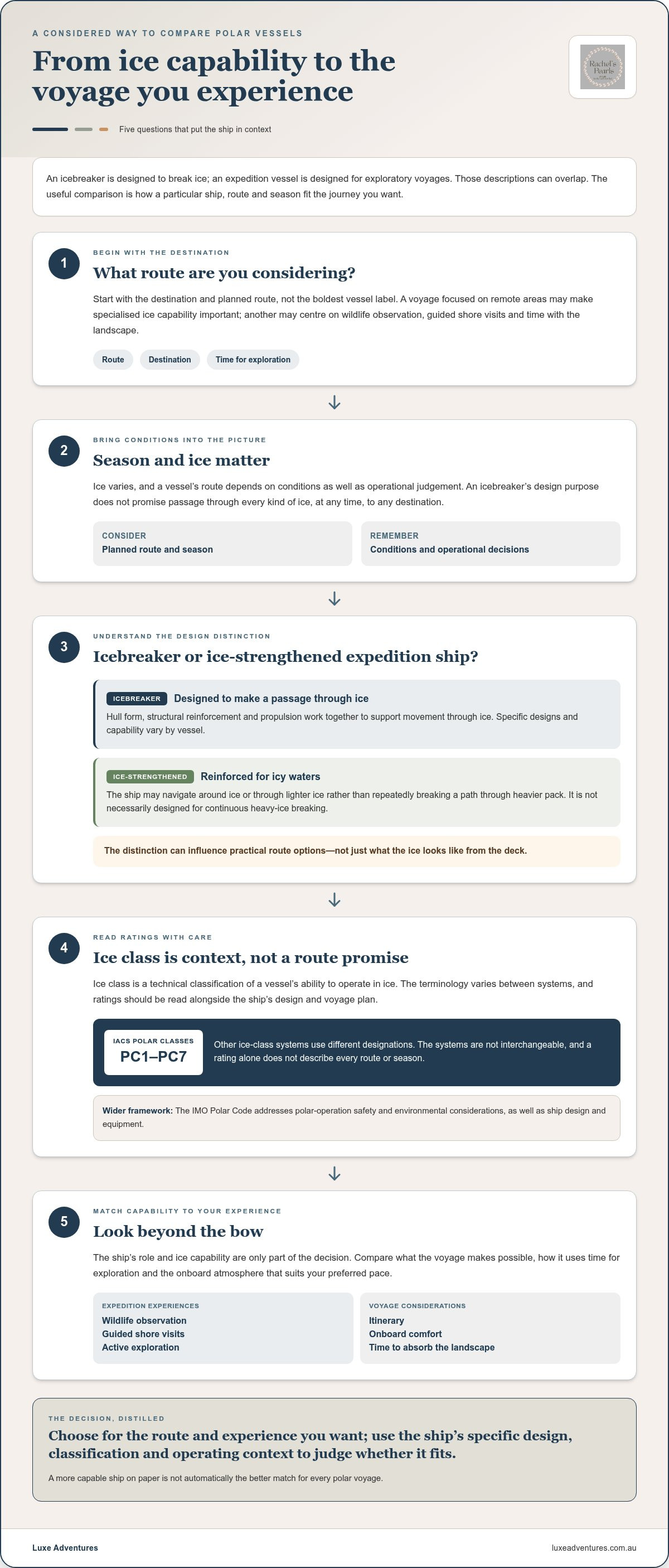
An icebreaker is designed to break ice; an expedition vessel is designed for exploratory voyages. These descriptions answer different questions, so they aren’t automatically opposites. A ship can be an expedition vessel with icebreaking capability, while another expedition ship may be built to navigate only in more limited ice conditions.
A useful distinction: icebreaking describes what a vessel is designed to do against ice; expedition vessel describes the purpose of its voyage. The label alone won’t tell you whether a ship’s capabilities suit a particular route, season or style of exploration. You’re choosing both a means of travelling through a polar environment and the kind of experience the ship is set up to deliver.
Consider two very different itineraries. One may focus on remote areas where ice conditions make specialised capability important. Another may prioritise wildlife observation, guided shore visits and time to absorb the landscape. The most capable ship on paper isn’t automatically the best match for both. Route planning, prevailing conditions and operational decisions all shape where a voyage can go and how it unfolds.
What makes a ship an icebreaker?
An icebreaker’s design supports movement through ice. Its hull form helps it interact with the ice, its structure is built to withstand the demands of that environment, and its propulsion provides power to manoeuvre. The precise combination varies by vessel. The word “icebreaker” doesn’t mean every ship has identical construction or capability. An overview of icebreaker design and function offers useful background, but an individual ship’s specifications and operating context still matter.
Even a purpose-built icebreaker doesn’t make conditions irrelevant. Ice varies, and a vessel’s route depends on conditions as well as operational judgement. Icebreaking describes a design purpose, not a promise that a ship can travel through every kind of ice, at any time, to any destination.
What does expedition vessel mean?
An expedition vessel is defined by its role: carrying travellers to remote destinations for exploration. Icebreaking may be part of its capability, but expedition suitability also depends on how the voyage is designed and how the ship supports activities beyond the open-water passage. The route, time available for exploration and onboard operations all shape the experience.
That’s why the comparison shouldn’t stop at the bow. A vessel’s ice capability is one part of a wider picture that includes the itinerary and what you hope to do ashore or at sea. For a broader explanation of the format, the guide What is Expedition Cruising? explores how expedition voyages differ from conventional cruising.
In practice, the icebreaker ship vs expedition vessel question is less about choosing a winning label and more about matching design to purpose. Start with the destination and the experience you want, then interpret the ship’s ice capability in that context. This keeps technical language useful, rather than letting it make the decision for you.
How icebreaker design differs from an ice-strengthened expedition ship
The difference is not simply “strong ship” versus “stronger ship”. Purpose-built icebreakers are designed to make a passage through ice. Ice-strengthened expedition ships have reinforced structures to operate in icy waters, but aren’t necessarily designed to break heavy ice continuously. That distinction can affect which routes are practical, yet capability depends on the vessel’s design, classification, conditions and operational decisions, not a dramatic description in a brochure.
Hull, propulsion and movement through ice
An icebreaker’s hull is shaped to interact with ice. Some designs can ride onto it so the vessel’s weight helps fracture it. Structural reinforcement helps the ship withstand the forces involved, while propulsion supports the manoeuvring needed to make progress. Power alone doesn’t determine what a vessel can safely do. Hull form, structure, machinery and operating procedures work together.
An ice-strengthened ship takes a different approach. Its reinforced hull supports operation in icy conditions, while the bridge team may navigate around ice or through lighter ice rather than repeatedly breaking a path through heavier pack. These distinctions matter to travellers because they can influence route options, not just the spectacle visible from the deck. A ship’s ice capability cannot be inferred from its label alone; it depends on its specific design, classification and the conditions of the planned voyage.
Ice class and vessel claims: what travellers should understand
Ice class is a technical classification of a vessel’s ability to operate in ice, assigned under a classification system. The terminology isn’t uniform: IACS Polar Classes, for example, run from PC1 to PC7, while other ice-class systems use different designations. These systems aren’t interchangeable, and a rating shouldn’t be read as a simple promise about every route or season. The ship’s actual design and the voyage plan give the rating its meaning.
The IMO Polar Code provides a broader framework for polar operations, addressing safety and environmental considerations as well as ship design and equipment. It’s useful context, but it doesn’t turn a vessel’s marketing label into a complete description of its capability. Treat the class as one technical reference, then consider how it relates to the intended itinerary.
Older articles sometimes use individual ships and their specifications to illustrate the difference between an icebreaker and an ice-strengthened vessel. Those examples can clarify a particular design, but they aren’t universal benchmarks for today’s expedition fleet. Ships vary, and the same class doesn’t mean identical hulls, onboard operations or route choices.
For a traveller, the practical question is what the design makes possible on the voyage being considered. Greater icebreaking capability may matter for an itinerary that aims to enter heavier ice; it may be less central on a route planned around other conditions and experiences. To bring those trade-offs back to the journey you want, discuss your polar expedition priorities.
Which vessel suits your polar cruise: compare the whole experience
The right choice depends on the voyage you want, not the most impressive-sounding ship description. An icebreaker’s capability can matter on routes where expected ice conditions shape access, but it’s only one part of the decision. Consider the itinerary, expedition programme, ship’s scale and how you want to spend your time on board. A stronger icebreaking design isn’t automatically a better match for every traveller.
This comparison offers a starting point, not a promise about any individual ship. Vessels differ, and activities depend on the ship, itinerary and conditions.
| Vessel consideration | Ice capability | Itinerary | Expedition activities | Onboard atmosphere |
|---|---|---|---|---|
| Purpose-built icebreaker | Designed for icebreaking; actual capability varies by vessel and conditions. | May suit routes where heavier ice is a central consideration. | Activities depend on the itinerary and onboard programme. | Design priorities may differ from those of a ship optimised mainly for open-water comfort. |
| Ice-strengthened expedition ship | Reinforced for icy waters, with limits that vary by ship. | May suit routes planned around lighter ice conditions. | Shore visits or other activities are vessel- and itinerary-specific. | Compare the ship’s scale, facilities and pace with your preferences. |
| Expedition experience | Capability matters in relation to the route, rather than as a stand-alone ranking. | Destination, season and planned route shape the voyage. | Look at the programme as a whole, including what is planned ashore and at sea. | Consider whether you prefer a more active rhythm or more time to observe and unwind. |
When icebreaking capability may matter most
Start with the route and the ice conditions it’s designed around. In the Arctic, itineraries span distinct regions, each with its own geography and conditions. Antarctic voyages also vary in route and season; the Peninsula and more remote areas shouldn’t be treated as interchangeable. Greater ice capability may be relevant to a particular plan, but it doesn’t guarantee access to a named location or make conditions predictable.
When expedition design and onboard experience lead
If your priority is wildlife observation, time ashore, a considered onboard programme or a quieter pace between excursions, expedition design deserves as much attention as ice class. Landing opportunities, small-boat outings and other activities are specific to the vessel and itinerary, and conditions can influence how a day unfolds. Comfort matters, too. Consider how you want to spend the hours at sea, not only where the ship may travel.
For Australian travellers weighing an Antarctic route, Antarctica Cruises from Australia offers a destination-specific point of reference alongside this broader comparison. The central question in the icebreaker ship vs expedition vessel decision is which combination of route, capability and onboard life best fits your priorities. Match the ship to the journey, and the specifications become more useful than a label.
A practical checklist for choosing an icebreaker or expedition vessel
Begin with the journey you want to take, not the ship label. A clear order of decisions makes technical descriptions easier to interpret and keeps the comparison centred on what matters: the destination, the conditions the route is designed for, and the experience you hope to have along the way.
Start with destination, season and itinerary
First decide which region draws you and what you want the voyage to include. The Arctic and Antarctic are distinct destinations, and routes within each vary. Season and expected conditions shape what a vessel may need to do, so consider the specific itinerary rather than assuming every polar voyage presents the same demands.
- Name the destination. Decide whether you’re considering the Arctic or Antarctic, then narrow your interest to the type of route and landscape you want to experience.
- Read the itinerary closely. Look at where the voyage is planned to travel and how it balances time at sea with exploration. A route’s aims are more useful than a broad promise of “remote access”.
- Compare the vessel’s stated capability. Review its ice classification and relevant design information alongside the planned route. Treat a label such as “icebreaker” as a starting point for comparison, not a complete specification.
- Match the expedition programme to your interests. Consider whether wildlife, remote landscapes, time ashore or active exploration matters most. Activities such as landings or small-boat outings depend on the vessel, itinerary and conditions.
- Picture life between excursions. Compare ship scale, facilities and onboard atmosphere. Think about whether you value a lively programme, space to observe quietly, or a particular balance of comfort and activity.
- Weigh the trade-offs. Decide which features are essential and which are simply appealing. Greater ice capability may be relevant to one route, while another voyage may suit you better for its itinerary and onboard experience.
Match ship details to personal travel priorities
Published specifications describe a vessel; they don’t decide whether you’ll enjoy the voyage. Separate stated capabilities from assumptions prompted by polished marketing language, and compare ships using the same practical questions. If a rating or technical description is difficult to interpret, experienced itinerary advice can connect it to the route and conditions rather than leaving you with a collection of acronyms.
Decision rule: Choose for the planned journey first, then assess whether greater ice capability is relevant to it. That keeps the icebreaker ship vs expedition vessel comparison grounded in your priorities, not in the assumption that the most powerful-sounding ship must be the right one.
If you’re ready to shape those priorities into a polar voyage, discuss your expedition plans with Luxe Adventures.
Plan a polar expedition with Luxe Adventures’ firsthand-informed guidance
A ship’s specifications tell part of the story. The finer judgement is understanding how those details relate to a particular route, onboard experience and traveller. Rachel Cleary, Luxe Adventures’ founder and Travel Designer, personally researches Arctic and Antarctic destinations and cruise experiences, bringing that knowledge to comparisons of vessel descriptions and expedition options.
Why firsthand-informed ship selection matters
Research is most useful when it turns technical detail into practical perspective. An ice classification or vessel description can be considered alongside the route it is intended to support, the character of the voyage and the experience a traveller values. That doesn’t mean one ship type or cruise line will suit everyone. A traveller drawn to remote landscapes may weigh priorities differently from someone whose focus is wildlife, comfort or a more active programme.
Luxe Adventures’ cruise partners and itineraries are personally vetted. That gives travellers a considered basis for discussing the distinctions between ships, without treating a striking specification as a recommendation in itself. As an expert luxury travel advisor, Luxe Adventures brings that perspective to bespoke expedition cruise planning with quiet confidence. The aim is an informed fit, not a louder label.
Shape the journey around what matters to you
Before comparing options, consider what you hope the days will hold. Is the destination itself the draw, or are there particular wildlife interests and landscapes you want to encounter? How much time would you like for shore-based exploration, and what kind of comfort and atmosphere feels right between excursions? Your preferred pace matters, too. Some travellers want a full expedition programme; others value time to watch the light shift across the water.
Bespoke planning brings these preferences together with the route, vessel characteristics and expedition-cruise options. It makes the icebreaker ship vs expedition vessel comparison more personal: not a contest between labels, but a way to understand which ship and itinerary suit your priorities. Rachel’s CLIA Ambassador credential is another relevant mark of her cruise-industry knowledge, alongside her personal research into destinations and cruise experiences.
There’s no single right way to experience the polar regions. The most considered choice connects your curiosity with a voyage whose pace, setting and ship feel aligned. If you’re beginning to imagine an Arctic or Antarctic journey, explore a personally tailored expedition cruise with Luxe Adventures.
Let your priorities shape the journey ahead
A polar voyage begins to take shape when you picture more than the ship: the silence of a wide, ice-framed horizon, the anticipation of wildlife, or the pleasure of returning from a day of exploration to a calm, welcoming space. Those details can help clarify what you want from the journey before vessel specifications enter the conversation.
The question of icebreaker ship vs expedition vessel is most useful when it leads to a more personal one: what kind of experience do you hope to carry home? There’s no need to choose the most formidable-sounding option simply for its label. The right decision is the one that feels considered, connects with your interests and gives the voyage a sense of purpose.
When you’re ready to turn that early sense of possibility into a considered plan, let’s shape your polar expedition around the journey you want. A thoughtful beginning can make all the difference.
Frequently Asked Questions
Is an icebreaker ship always better for an Antarctic cruise?
No. “Better” depends on what you want to spend your days doing. If wildlife watching and guided excursions are your priority, focus on how the voyage allocates time to those experiences and what the onboard programme includes. If reaching more challenging areas is central to your plans, give ice capability greater weight. Decide which elements matter most before comparing ships, rather than letting one feature dominate.
Can an expedition vessel travel through sea ice?
Yes, some can. For a useful comparison, look for the named vessel’s classification and the operator’s description of its intended operation, rather than relying on broad phrases such as “polar capable”. Also distinguish a planned route through ice from a claim that a vessel will break a passage through it. Those details make ship descriptions more informative when you’re comparing voyages.
What is the difference between an icebreaker and an ice-strengthened ship?
An icebreaker is built to break ice; an ice-strengthened ship has reinforced structure for icy-water operations. For a particular cruise, note the vessel’s exact classification and compare it with the operator’s description of the voyage. Avoid turning a general category into a personal guarantee about what you’ll see or where the ship will travel.
Do all icebreaker ships have helicopters?
No. A helicopter isn’t inherent to the icebreaker category. If an aerial experience appeals to you, look for it as a clearly stated feature of the specific voyage, not an assumption based on the ship’s name. A helicopter being listed as part of a vessel’s equipment also doesn’t, by itself, establish that guest flights or landings are planned.
Does a higher ice class mean a more comfortable expedition cruise?
No. To judge comfort, compare the details that affect your own routine: cabin options, shared spaces, dining arrangements and how the daily programme balances excursions with time on board. Consider what helps you feel at ease after an active day or during a longer stretch at sea. Those practical preferences deserve their own place in your decision, separate from technical ratings.
How should I choose between an icebreaker and a small expedition ship?
Write down your non-negotiables first, then rank what would be welcome but isn’t essential. Compare each ship against that list, including its onboard atmosphere, programme and the kind of days the voyage is designed to offer. This can reveal whether a smaller ship’s character suits you or whether a particular icebreaking capability is central to your plans. Judge the actual options, not size alone.

Article by
Rachel Cleary
Rachel Cleary is the founder of Luxe Adventures and an endlessly curious explorer with a passion for meaningful, experience-led travel. Having visited every continent and travelled to more than 100 countries — and counting — she believes travel is one of the greatest educations for both children and adults alike.
Rachel is addicted to scuba diving and gets underwater at every opportunity. When she isn't in the office you'll find her exploring remote reefs in Fiji, drift diving in the Maldives, or scuba cruising Raja Ampat or French Polynesia.
Her second home is Fiji where she has explored all the island groups and has favourite boutique resorts she returns to every year, for the diving and the authentic Fijian hospitality.
Get her talking about kayaking in Antarctica or the Arctic, African safaris and where to find the highest density of big cats, underwater adventures, remote expedition destinations, or the science and magic behind the Northern Lights — including when and where they are most likely to dance — and you may be there a while.
Through Luxe Adventures, Rachel combines firsthand experience, global industry connections, and a deep appreciation for nature, culture, food, wildlife, and human connection to help curious travellers explore the world in a way that feels seamless, personal, and unforgettable.
Refined by experience. Defined by connection.
Disclaimer
The information in this article is intended as general travel inspiration and guidance only. Travel requirements, hotel standards, airline schedules, entry regulations, weather conditions, pricing, and experiences can change without notice.
While every effort is made to ensure accuracy at the time of publishing, Luxe Adventures recommends confirming all details relevant to your personal travel plans before booking or travelling.
Opinions, recommendations, and destination insights shared in this article are based on firsthand experience, industry knowledge, and research at the time of writing. Experiences may vary depending on season, supplier changes, local conditions, and individual travel preferences.
Some articles may reference luxury travel affiliations, preferred partner programs, or value-added amenities available through Luxe Adventures. Benefits and inclusions are always subject to availability and supplier terms at the time of booking.
Luxe Adventures strongly recommends comprehensive travel insurance for all international travel.
For personalised travel advice, tailored itinerary design, or the latest destination updates, please contact Luxe Adventures directly.


