

A few days away may offer relief, but meaningful recovery from leadership burnout typically calls for 5 to 7 days of immersive retreat experience. Executive burnout recovery retreats can be paced in stages: 1 to 2 initial days for decompression, 2 to 3 days of active restoration, then 1 to 2 days for integration and transition planning.
For an executive used to making decisions at speed, stepping back can feel unfamiliar. Yet a retreat isn’t simply a change of scenery or a packed schedule of wellness activities. Its value lies in making room to slow down, notice how burnout is affecting sleep, energy and focus, and consider what needs to change on your return.
This guide explains what an executive burnout retreat can involve, how duration and daily pacing shape the experience, and which symptoms may call for medical advice rather than a retreat alone. You’ll also learn how a recovery plan can connect time away with realistic support and workplace adjustments, so the return is considered as carefully as the retreat itself.
Key Takeaways
- Allow 5 to 7 days for an immersive retreat, with time to decompress, restore and plan the transition home.
- Use sleep, movement and mindfulness practices as gentle supports, not as substitutes for medical advice when symptoms persist.
- Notice changes in energy, mood, sleep and decision-making; patterns can help clarify what kind of support may be useful.
- Shape recovery around the executive’s symptoms, work pressures and home life, then build practical changes into the return-to-work plan.
- Think beyond the retreat itself: sustained recovery may call for ongoing support and adjustments after time away.
Sleep, lifestyle, movement and mindfulness support
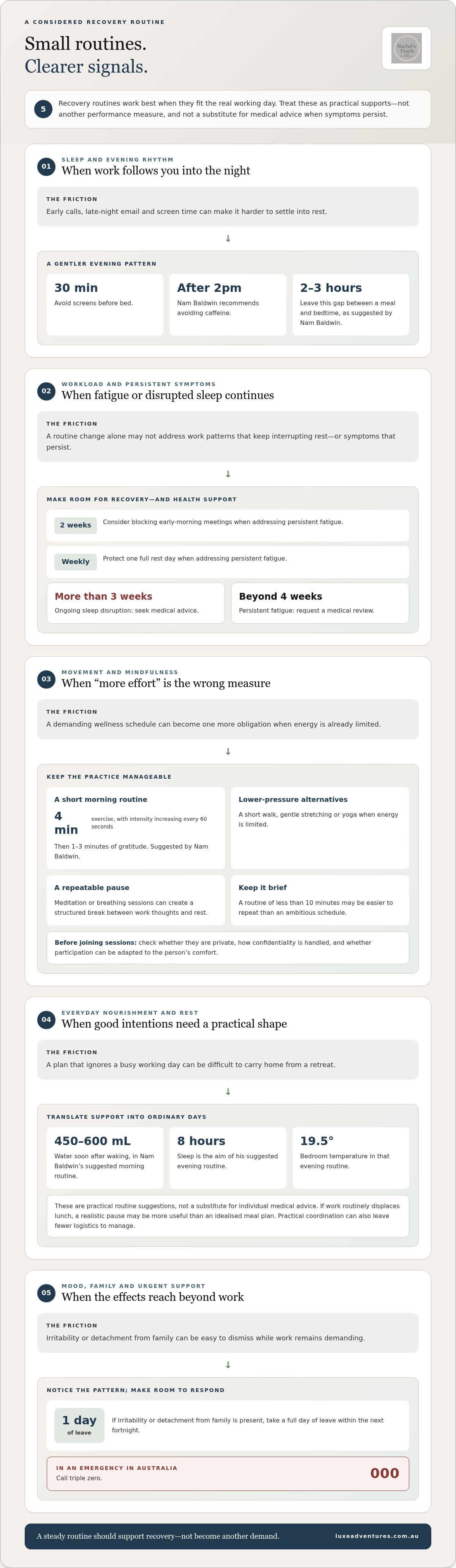
Recovery routines work best when they fit the executive’s actual working day, not an idealised schedule. Sleep, movement, nutrition and practical support can help identify small changes to carry into everyday life.
Sleep and Lifestyle Changes
Start with one repeatable evening step: avoid screens for 30 minutes before bed, then keep the bedroom routine calm. Nam Baldwin recommends avoiding caffeine after 2pm and eating a meal two to three hours before bed. A retreat can also help executives identify work patterns that disrupt rest, such as early calls or late-night email.
For workplace adjustments, consider blocking early-morning meetings for two weeks and protecting one full rest day per week when addressing persistent fatigue. If sleep disruption continues for more than three weeks, seek medical advice; request a medical review if fatigue persists beyond four weeks. These are reasons to involve health support, not simply add another wellness task.
Movement and Mindfulness Practices
Movement should feel manageable rather than like another performance measure. Nam Baldwin’s suggested morning routine includes four minutes of exercise, with intensity increasing every 60 seconds, followed by one to three minutes of gratitude. A short walk, gentle stretching or yoga can offer a lower-pressure alternative when energy is limited.
Meditation and breathing sessions can give executives a structured pause between work thoughts and rest. Look at whether sessions are private, how confidentiality is handled, and whether participation can be adapted to the person’s comfort. A routine of less than 10 minutes can be easier to repeat than an ambitious schedule that quickly becomes another obligation.
Nutrition and Wellness Support
Nutrition support is most useful when it translates into simple choices for ordinary working days. Nam Baldwin’s suggested morning routine includes drinking 450 to 600 millilitres of water soon after waking. His evening routine aims to support eight hours of sleep, with the bedroom temperature set to 19.5 degrees. Treat these as practical routine suggestions, not a substitute for individual medical advice.
Look for wellness support that connects meals, movement and rest to the executive’s actual pressures. For example, if work routinely displaces lunch, a plan might establish a realistic pause. A retreat concierge can coordinate schedules and practical details, leaving fewer logistics to manage. For anxiety or disrupted sleep, private sessions may provide space to discuss concerns and consider appropriate next steps.
Notice changes in feeling, mood and connection with family as well as sleep. If irritability or detachment from family is present, take a full day of leave within the next fortnight. In an emergency in Australia, call triple zero (000), according to the Australian Government.
What is an Executive Burnout Retreat?
An executive burnout retreat creates space away from workplace demands to examine exhaustion and plan recovery. Everyday stress may last days to weeks, while burnout may persist for months or longer. In a study of senior managers and C-suite executives, 75% of respondents said their senior managers were burned out.
Leadership pressure can make strain harder to spot. A director might continue chairing meetings and meeting targets while feeling depleted, detached or unable to switch off. High-functioning anxiety can show up as constant preparation, checking and control; outward performance doesn’t reveal the full mental toll. Noticing impatience, withdrawing from colleagues or struggling to listen can help leaders recognise changes in how they communicate.
Unlike therapy, which supports mental health through ongoing professional sessions, a retreat centres on time away and structured reflection. Medical leave creates distance from work, while a workplace wellness programme may support routines without removing daily pressures. These approaches can complement each other; a retreat isn’t a substitute for clinical care when that’s needed.
To choose a safe, suitable retreat, check its scope, staff qualifications, confidentiality practices and process for responding to distress. Ask whether the programme focuses on wellness or includes clinical mental health support, and whether activities can be adapted. A suitable option should account for symptoms, current treatment and the executive’s capacity, rather than treating an ambitious schedule as a recovery plan.
Australian options include wellness retreats, residential treatment and programmes combining restoration with structured support. Their purpose and clinical depth vary, so compare what each provides: private sessions, group activities, coaching or access to mental health professionals. The label “burnout retreat” alone doesn’t tell you what to expect.
Retreats are available in Australia, but the setting should serve the recovery plan. A quieter environment may create distance from work routines; practical access and continuity of support matter just as much. Consider travel demands, privacy and how easily follow-up support can continue after you return home.
Australian retreats may include accommodation, guided movement, mindfulness, meals, coaching or therapeutic sessions. Before choosing, clarify the daily structure and whether support is individual or group-based. Evidence-based mental health support should be clearly described. Look for programmes that specify clinician involvement and approaches such as CBT, rather than relying on wellness language alone.
Before a retreat, define what you want to change and note pressures such as decision fatigue or difficult team conversations. During the stay, expect time for reflection alongside planned activities. Afterward, turn insights into sustainable work boundaries and communication habits. Leadership coaching can help you practise a specific conversation, while mindfulness sessions can support a pause before reacting.
If a change of setting forms part of your recovery plan, consider a restorative Australian wellness escape that leaves room for reflection as well as activity.
Emotional, physical and performance-related burnout symptoms
Burnout can affect mood, the body and work performance at the same time. An executive may feel persistently drained, react sharply to routine questions, then struggle to recover after rest. Pay attention when these changes differ from the person’s usual baseline or begin affecting decisions, relationships and daily responsibilities. A demanding week alone doesn’t establish burnout; the pattern and its impact matter.
Emotional signs can include cynicism, irritability, detachment and a reduced sense of accomplishment. For example, a leader who once welcomed discussion may now avoid colleagues or feel unusually indifferent to outcomes. Physical signs may include fatigue, headaches, muscle tension or disrupted sleep. These experiences can have different causes, so a symptom list is a prompt for reflection, not a diagnosis.
Performance changes are often subtle at first. A leader might reread the same report without absorbing it, postpone decisions that once felt straightforward or miss details in a familiar process. Look for a cluster of changes, not just one difficult meeting. A simple record can help: note the situation, the emotional or physical response, and its effect on work or home life.
- Emotional: increased irritability, detachment or loss of motivation.
- Physical: persistent tiredness, tension or changes in sleep.
- Performance: difficulty concentrating, slower decisions or avoidable errors.
Organisations may feel the effects through strained team communication, delayed decisions and reduced continuity when a senior leader is struggling. A leader who stops delegating, for instance, may unintentionally create bottlenecks and leave colleagues uncertain about priorities. The expectation to remain composed can also conceal strain. Notice whether the team’s working patterns change alongside the executive’s wellbeing.
To recognise a developing pattern, compare recent behaviour with the executive’s usual way of working. Has energy stayed low despite opportunities to rest? Are emotional reactions more intense, or are routine tasks taking more effort? Has feedback from trusted colleagues changed? Specific examples make a discussion with a health professional more useful than a broad label such as “I’m not coping”.
Burnout symptoms can overlap with other health concerns, so assessment matters when changes persist or interfere with daily life. A structured next step is to record examples, discuss them with a GP and consider workplace pressures that may contribute. Retreats may provide distance and reflection, but symptom severity and clinical needs should guide whether one is suitable alongside other support.
Physical removal from the work environment can decrease cortisol levels within 48-72 hours. During Weeks 3-6 of burnout recovery, sleep may improve and emotional regulation may stabilise. These changes can be considered alongside the ongoing pattern of symptoms and functioning, rather than treated as standalone proof that recovery is complete.
Replacing a burned-out executive can cost an organization 200-300 percent of the executive's annual salary. Organizational costs associated with an executive burnout case can reach hundreds of thousands of dollars. These costs make it important to notice sustained changes in wellbeing and performance, as well as their effects on the organization.
Retreat duration, pacing, and activity sequencing
Meaningful recovery from leadership burnout typically requires 5 to 7 days of immersive retreat experience. That stay gives the programme room to move from decompression to restoration, then practical planning. How long do executive burnout recovery retreats last? Retreat options range from 2-3 days to 15 days or more, while a 5-to-7-day stay offers time for distinct recovery stages.
The opening 1 to 2 days can focus on decompression. Rather than filling every hour, the schedule can create space to arrive, rest, and become present without workplace demands. A brief assessment of energy, sleep and current pressures can help shape what follows. Someone arriving after a demanding quarter may need quiet before group discussion or structured activities.
Active restoration can take 2 to 3 days within a 5-to-7-day retreat. Activities might include guided movement, mindfulness, coaching or individual sessions, sequenced with pauses between them. The aim is a considered rhythm, not a timetable that reproduces the pressure of a working week. For example, a morning session followed by unstructured time allows reflection to settle before another activity.
The final 1 to 2 days can focus on integration and transition planning. Executives can identify which practices support wellbeing, then decide how to carry them into work and home routines. A practical plan might address meeting boundaries, delegation or recovery time after travel. Without this step, returning to a full diary can crowd out the restoration the stay was designed to support.
Stay duration should reflect the purpose of the programme and the person’s needs. Listed retreat options include 2-3 days, 4-5 days, 6-7 days, 8-14 days, and 15 days or more. A shorter stay may suit focused reflection, while an immersive experience needs enough time for arrival, active restoration and a deliberate departure from retreat routines.
Retreats differ from residential treatment and intensive outpatient care. Residential burnout treatment involves living in a rehab centre for 28 or more days. Intensive outpatient care involves meeting three to five times a week for several hours at a time. These formats serve different needs, so consider whether the priority is a restorative stay, ongoing clinical treatment, or a combination of support.
Prices depend on the case and are given after a quote request; duration, accommodation, support level and included sessions shape the cost. Compare what each stay includes, how activities are paced, and whether the final days allow time to transition. The best schedule leaves room for rest as well as purposeful work on recovery.
Effective executive retreat experiences can improve sleep quality and duration by 15 to 25 percent. That potential benefit can be considered alongside the programme’s pacing: protected rest, appropriately spaced activities and time to plan a return to work. A schedule can reflect the participant’s capacity, rather than treating a packed agenda as a measure of value.
Customised recovery plans for executive burnout
A customised plan connects time away with the pressures waiting at home and work. It begins by identifying what the executive is experiencing, then setting priorities around rest, support and practical change. For one leader, the first priority might be sleep; for another, workload, anxiety or difficulty switching off.
Start with a clear assessment. Record the main concerns, the situations that intensify them and the changes that would make daily life more manageable. A leader who feels overwhelmed by constant decisions, for example, might identify delegation and protected thinking time as priorities. Persistent or chronic symptoms also call for discussion with a health professional, rather than relying on a retreat alone.
A useful plan turns broad intentions into actions you can review:
- Recovery focus: Choose one priority, such as reducing evening work or restoring regular meals.
- Retreat setting: Select an environment and pace that support the person’s needs, with room for quiet as well as guided sessions.
- Support: Match the plan to the help required, such as clinical care, leadership coaching or time for reflection.
- Return plan: Identify a work boundary and a person who can help maintain it, such as a delegated meeting lead.
During the retreat, meditation or reflective writing can help executives notice patterns in their responses. The point isn’t to add another performance target. It’s to explore what happens before, during and after a stressful work situation, then consider a different response. A specific example, such as pausing before answering a difficult email, gives the plan something practical to build on.
Recovery continues after departure. The plan should translate insights into everyday routines: a realistic start to the workday, a boundary around after-hours messages or a conversation about responsibilities. Review what’s working and revise what isn’t. Prevention means addressing the conditions that contributed to exhaustion, not simply expecting the executive to tolerate them more gracefully.
Severe burnout may require 3-12 months of sustained intervention. That longer horizon can include appropriate professional support and gradual workplace changes, with retreat time serving as one part of a broader plan. Seeking help early can also make it easier to describe needs clearly and involve trusted colleagues without sharing more personal detail than necessary.
If you’re considering a restorative stay as one part of a recovery plan, discuss your travel plans and the setting that may best support time away.
Luxe Adventures: African Safaris
Luxe Adventures can help plan an African safari for leaders seeking considered time away from work. A change of pace, landscapes and daily surroundings may offer room for reflection, but travel isn’t a substitute for clinical care or a tailored recovery plan.
For an executive whose health needs are being supported separately, a safari can form part of a broader period of rest. The experience might centre on wildlife, thoughtful lodging and unhurried time in nature, with the itinerary designed around personal travel preferences. The same considered approach can shape Fiji luxury resorts, expedition cruises or Scandinavia holidays when another setting feels more fitting.
Choose travel for the experience it offers, not as a promise to resolve burnout. For a thoughtful conversation about planning an African safari, contact Luxe Adventures.
Make space for a considered next step
Recovery can begin with a decision to protect space for change, then give that decision practical shape. Executive burnout recovery retreats may offer distance from familiar demands, but travel is best considered alongside the support and workplace adjustments that suit your circumstances. A journey can create room to pause; it shouldn’t be mistaken for clinical treatment.
If time away feels useful, consider what kind of setting would genuinely restore your attention. Luxe Adventures can plan African Safaris, Fiji luxury resorts and Expedition Cruises, each offering a distinct pace and sense of place. The right choice starts with what you need from the experience, not simply how far you travel.
Let the next step be a thoughtful conversation about travel that may complement your wider recovery plan. Contact Luxe Adventures to discuss your travel plans. A quieter pace can make room for clearer choices, one considered step at a time.
Frequently Asked Questions
Is It Possible to Experience a Recurrence of Burnout?
Yes, burnout can recur, so recovery is better treated as an ongoing practice than a finish line. Before returning to work, write a brief contingency plan: identify the first sign that demands are again becoming unmanageable, name a trusted person to involve, and decide what immediate adjustment would help. A scheduled check-in with that person can make the plan easier to use during a demanding period.
What are the risks or limitations of burnout recovery retreats?
A retreat may create an expectation of a swift return to peak performance, putting pressure on someone who needs a gradual transition. Time away can also leave important decisions waiting, especially if responsibilities haven’t been handed over. Before departure, document essential tasks, delegate decision-making where possible and agree how urgent matters will be handled. A retreat is time away, not a guarantee that workplace demands will have changed when you return.

Article by
Rachel Cleary
Rachel Cleary is the founder of Luxe Adventures and an endlessly curious explorer with a passion for meaningful, experience-led travel. Having visited every continent and travelled to more than 100 countries — and counting — she believes travel is one of the greatest educations for both children and adults alike.
Rachel is addicted to scuba diving and gets underwater at every opportunity. When she isn't in the office you'll find her exploring remote reefs in Fiji, drift diving in the Maldives, or scuba cruising Raja Ampat or French Polynesia.
Her second home is Fiji where she has explored all the island groups and has favourite boutique resorts she returns to every year, for the diving and the authentic Fijian hospitality.
Get her talking about kayaking in Antarctica or the Arctic, African safaris and where to find the highest density of big cats, underwater adventures, remote expedition destinations, or the science and magic behind the Northern Lights — including when and where they are most likely to dance — and you may be there a while.
Through Luxe Adventures, Rachel combines firsthand experience, global industry connections, and a deep appreciation for nature, culture, food, wildlife, and human connection to help curious travellers explore the world in a way that feels seamless, personal, and unforgettable.
Refined by experience. Defined by connection.
Disclaimer
The information in this article is intended as general travel inspiration and guidance only. Travel requirements, hotel standards, airline schedules, entry regulations, weather conditions, pricing, and experiences can change without notice.
While every effort is made to ensure accuracy at the time of publishing, Luxe Adventures recommends confirming all details relevant to your personal travel plans before booking or travelling.
Opinions, recommendations, and destination insights shared in this article are based on firsthand experience, industry knowledge, and research at the time of writing. Experiences may vary depending on season, supplier changes, local conditions, and individual travel preferences.
Some articles may reference luxury travel affiliations, preferred partner programs, or value-added amenities available through Luxe Adventures. Benefits and inclusions are always subject to availability and supplier terms at the time of booking.
Luxe Adventures strongly recommends comprehensive travel insurance for all international travel.
For personalised travel advice, tailored itinerary design, or the latest destination updates, please contact Luxe Adventures directly.


