Why do two camps, both draped in hand-stitched canvas and boasting private plunge pools, sit at such wildly different price points? It's a question that often leaves even the most discerning travellers feeling a sense of hesitation. Understanding the cost of luxury african safari travel in 2026 requires looking far beyond the thread count of your sheets or the label on the gin bottle. It demands an appreciation for the invisible logistics of intimacy and the value of genuine, exclusive access.
We understand the frustration of trying to decode complex itineraries or the fear of accidentally booking a commercialised experience that feels more like a tour than a transformation. You want your investment to reflect the raw beauty and depth of the wilderness. This guide will clarify exactly what a luxury budget buys, from the quiet authority of a master tracker to the stewardship of private conservancies. We'll examine the nuances of seasonal shifts and the logistical precision required to create a seamless journey. By the end, you'll have the confidence to set a realistic budget for a 2026 departure that is defined by connection and refined by expert travel design.
Key Takeaways
- Understand why the cost of luxury african safari travel varies so significantly between regions, contrasting Botswana's high-value exclusivity with South Africa’s accessible, high-end infrastructure.
- Learn to look beyond the aesthetics of a lodge to the true drivers of value, specifically the ratio of private concession acreage per guest and the calibre of the guiding team.
- Discover the strategic advantage of the "Green Season," a period that offers exceptional value and vibrant landscapes for those who prefer intimacy over the peak season crowds.
- Deconstruct the all-inclusive model to see how your investment directly supports critical conservation efforts and the invisible logistics that ensure a seamless journey.
- Realise the long-term benefit of professional curation, where personally vetted lodges and on-the-ground relationships protect you from commercialised experiences.
Beyond the Price Tag: Defining the Investment of a Luxury Safari
To understand the history and evolution of the safari is to realise that the word itself simply means "journey" in Swahili. Yet, for the modern traveller, a journey into the African bush has become a complex calculation of price versus expectation. When we discuss the cost of luxury african safari travel, we aren't talking about the price of a hotel room. We're talking about the price of a wilderness. Luxury in this context is a spatial metric. It's measured by the hectares of private concession available to each guest. A lodge with ten suites on a 30,000-hectare private reserve offers a level of silence that a 50-room hotel in a public park simply cannot match.
The gap between a $1,000 and $3,000 nightly rate often comes down to the person sitting in the front of your Land Cruiser. A master guide isn't just a driver. They are a scientist, a storyteller, and a local guardian. Their expertise determines whether you merely see a lion or if you understand the complex social dynamics of the pride. This is where the investment shifts from a transaction to a transformation. You're paying for the absence of other vehicles and the presence of undisturbed wildlife. It's about the texture of the experience, the smell of the rain on the dust, and the profound intimacy of being the only humans for miles.
The Three Pillars of Safari Value
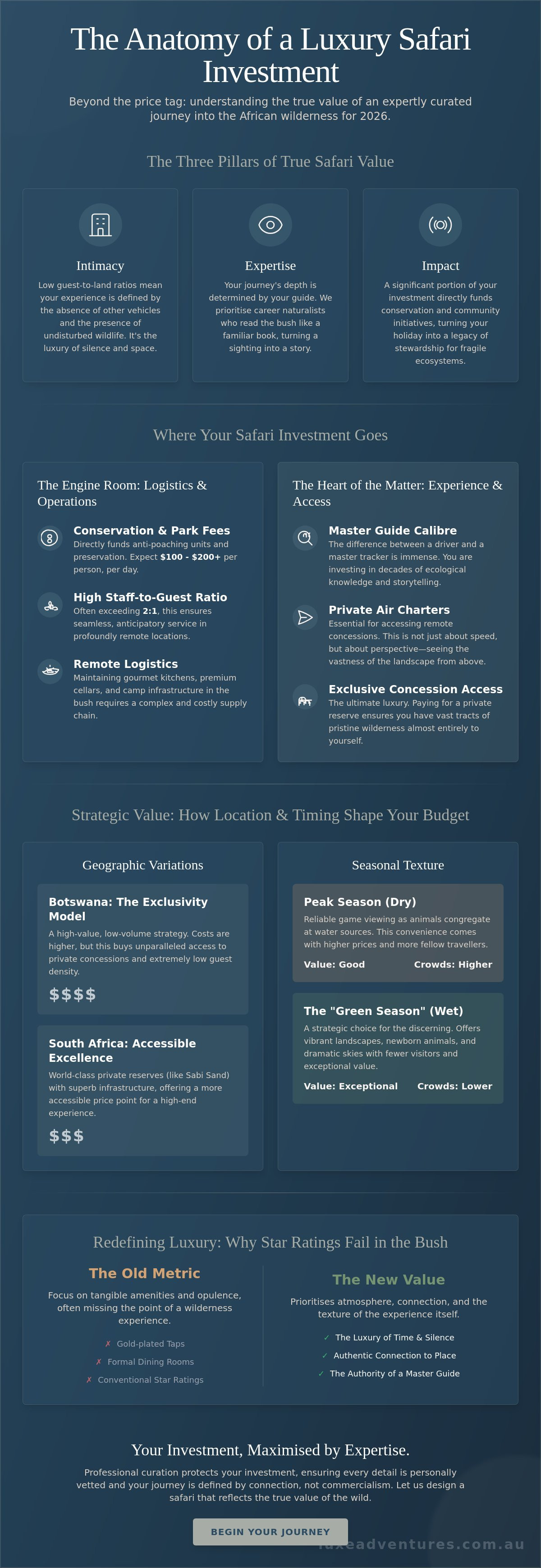
True value rests on three foundational elements. First is Intimacy. This means low guest-to-land ratios and the freedom of private vehicles, ensuring your observations are never rushed by a queue of other travellers. Second is Expertise. We prioritise guides who are career naturalists and can read the bush like a familiar book. Third is Impact. A significant portion of your nightly rate funds anti-poaching units and community health clinics. Your stay is a direct investment in the stewardship of these fragile ecosystems, turning your holiday into a legacy of conservation.
Why Star Ratings Fail the Modern Explorer
A gold-plated tap in a crowded national park is a poor substitute for a canvas tent in a private wilderness. The "Quiet Luxury" movement has shifted the focus from opulence to atmosphere. It prioritises the texture of the air, the sound of the dawn chorus, and the luxury of time. This is why luxury african safari packages are priced on access rather than amenities. You aren't buying a room; you're buying a front-row seat to the natural world. We look for lodges that value substance over style, where the architecture serves to connect you to the land rather than insulate you from it.
The Anatomy of Cost: Where Your Safari Investment Goes
The cost of luxury african safari travel is often shrouded in the vague "all-inclusive" label. To the uninitiated, this implies a simple bundle of bed and board. In reality, it represents a complex logistical feat. Your investment covers far more than the physical space of a suite. It accounts for the daily conservation and park fees which, in 2026, often range from $100 to over $200 per person. These fees are the lifeblood of the wilderness, directly funding the protection of the very landscapes and species you've come to witness.
Then there's the human element. A truly high-end lodge operates on a staff-to-guest ratio that often exceeds two-to-one. This ensures that your preferences are anticipated before they're spoken. Whether it's a specific vintage for your sundowner or a personalised menu that caters to dietary nuances in the middle of the Okavango, the cost reflects the immense effort of maintaining world-class hospitality in remote environments. Maintaining gourmet dining programmes and premium wine cellars in the bush requires a supply chain that is both delicate and remarkably expensive.
Invisible Logistics: The Private Air Charter
The backbone of any discerning itinerary is the light aircraft transfer. While some might balk at the price of these hops, the alternative is spending six hours in a dust-filled 4WD on corrugated roads. Flying isn't just about speed; it's about perspective. Seeing the delta or the plains from above provides a geographical context that ground travel cannot match. You'll need to embrace the "safari duffel" though, as these small planes have strict weight limits. If you're unsure how to pack for these technical transitions, our luxury travel design experts can refine your packing list.
Guiding: The Difference Between a Driver and a Naturalist
A driver follows a road. A naturalist follows a story. The investment in a high-calibre guide is perhaps the most critical component of the daily cost of luxury african safari experiences. These professionals spend years training to read the subtle signs of the bush. For photographers, a private vehicle is the ultimate luxury, allowing you to stay at a sighting for hours without compromise. A great guide doesn't just find animals. They translate the language of the wilderness, turning a simple sighting into a profound understanding.
Geographic Variations: Regional Pricing from the Okavango to the Serengeti
Africa is a continent of vast contrasts, and the cost of luxury african safari travel reflects this diversity. The price of your journey is often dictated by the specific logistical challenges and tourism models of the country you choose. While one region might prioritise high-volume access, another may deliberately limit visitor numbers to preserve the raw integrity of the landscape. This geographic nuance is why a seven-day itinerary in one corner of the continent can look entirely different, financially and experientially, from another just a few hours' flight away.
Botswana: The High-Value, Low-Impact Model
Botswana is widely regarded as the gold standard for exclusivity. The government’s "high-value, low-volume" tourism policy is a masterclass in conservation through pricing. By limiting the number of beds available in massive private concessions, they ensure that the guest experience remains intimate and the environmental footprint stays light. In the Okavango Delta, the necessity of flying between camps in light aircraft adds to the investment, but it rewards you with views of the labyrinthine waterways that define this region. It's home to some of the most luxury safari camps in the world, where the nightly rate is a direct reflection of the absolute privacy you enjoy.
South Africa: Sophistication and Ease
In contrast, South Africa offers exceptional value for money without sacrificing refinement. The infrastructure here is sophisticated, allowing for direct access to premier reserves like the Sabi Sands and Timbavati. Because many of these lodges can be reached by road or short hops from major hubs, you often save on the heavy logistical costs found in more remote regions. This ease of movement makes it a preferred choice for a luxury safari honeymoon, where you can seamlessly combine a world-class wildlife experience with the culinary and cultural textures of the Cape Winelands.
East Africa presents its own set of variables, particularly in Kenya and Tanzania. Here, the cost of luxury african safari travel is often tied to the Great Migration. Being in the right place at the right time requires precise planning and often carries a premium during peak months. If your journey extends to Rwanda or Uganda for gorilla trekking, be prepared for a specific fixed investment. Gorilla permits in Rwanda currently sit at $1,500 USD per person, a non-negotiable cost that goes directly toward the protection of these endangered primates. Each region offers a different emotional payoff, and understanding these regional drivers helps you allocate your budget where it matters most to you.
Timing and Texture: How Seasonality Influences Value
The cost of luxury african safari travel is inextricably linked to the rhythm of the rains and the movement of the herds. While many travellers default to the dry winter months of July to October, this peak period carries the highest premium. For those with a more discerning eye, the calendar offers opportunities to maximise value without compromising on the calibre of the experience. Timing isn't just about the weather. It's about the financial and sensory texture of the trip.
For 2026, we're seeing a distinct trend toward booking earlier than ever. The most sought-after lodges in the Okavango and Serengeti are already filling their calendars for the prime months. If you're aiming for a specific window, such as the dry season in Southern Africa or the river crossings in East Africa, a lead time of 12 to 18 months is now the standard for securing top-tier guides and the most intimate camps.
The Allure of the Green Season
The "Green Season," typically running from December to March in Southern Africa, is often dismissed by those following generic advice. This is a mistake. For the discerning traveller, it's a well-kept secret. Landscapes turn a vibrant emerald, the air is crisp after afternoon thunderstorms, and the plains are filled with baby animals. From a value perspective, the nightly rates in regions like Botswana can drop by as much as 40% compared to the peak dry season. You get the same level of service and the same expert tracking, but with far more space and a significantly lower cost of luxury african safari investment.
- Photography: Dramatic skies and dust-free air provide the perfect light for capturing the wilderness.
- Exclusivity: With fewer vehicles in the concessions, your sightings feel even more private and unhurried.
- Birdlife: Migratory species arrive in their thousands, adding a different layer of colour and sound to the bush.
Planning for the Great Migration
If your heart is set on the Great Migration in the Maasai Mara or the Serengeti, be prepared for peak pricing. The logistics of positioning camps near the river crossings during the height of the action are immense. These areas command a premium because you're paying for the privilege of being in exactly the right place at exactly the right time. To navigate this complexity and ensure you aren't caught in a "tourist trap" of crowded sightings, consulting a bespoke travel designer is essential. They have the relationships to secure the camps that prioritise quiet access over volume.
If you're ready to secure your 2026 dates and want to ensure every dollar of your investment is placed with intention, connect with us to begin your journey.
The ROI of Curation: Maximising Value Through Expertise
The allure of a discount code or a "best price guarantee" on a generic booking site is a siren song for the unwary. When calculating the cost of luxury african safari travel, the most expensive mistake you can make is choosing the cheapest option. A low headline rate often masks a lack of on-the-ground support, subpar guiding, or rooms positioned near the noisy service areas of a camp. We believe that true value is found in the ROI of curation. This is the return on investment that comes from having a visionary architect design your journey rather than a computer algorithm.
My approach is built on personal validation. I don't just recommend lodges; I research them. I've walked the trails, met the trackers, and sat at the communal tables. This firsthand expertise allows me to navigate the invisible logistics that make or break a trip. It's the difference between a frantic connection in a crowded terminal and a seamless transition to a waiting private charter. By leveraging on-the-ground relationships, we ensure your investment is placed where it will yield the greatest emotional return.
Virtuoso and Preferred Partner Advantages
As a Virtuoso member, I provide access to a world of benefits that simply aren't available to the general public. This isn't just about perks; it's about your status as a VIP guest. When you book through a preferred partner, you aren't just a confirmation number in a database. You are a valued traveller whose arrival is anticipated. These advantages add tangible value to the cost of luxury african safari itineraries through:
- Room upgrades upon arrival, subject to availability, which can represent thousands of dollars in added value.
- Daily breakfast for two and bespoke VIP amenities.
- Hotel or resort credits, often $100 USD or more, for spa treatments or private bush dinners.
- Early check-in and late check-out to align with light aircraft schedules.
The Masterclass in Safari Planning
We believe that planning a luxury safari in 2026 requires a specialist who understands the delicate interplay between seasonal movements and lodge availability. With the complexities of multi-country logistics, having 24/7 support and local knowledge isn't a luxury; it's a necessity. It provides the peace of mind that allows you to remain fully present in the moment, rather than managing flight delays or permit issues yourself. Ultimately, a safari is an investment in awe. It should be refined by experience and defined by connection, ensuring that when you look back, you remember the silence of the dawn and the depth of the wild.
Designing Your Legacy in the Wild
A safari is far more than a simple getaway; it's a deliberate investment in a specific kind of silence and stewardship. We've explored how the cost of luxury african safari travel is driven by the invisible logistics of private concessions and the high calibre of guiding expertise. Whether you choose the strategic value of the Green Season or the high-demand window of the Great Migration, the true return on your investment is found in the depth of connection you feel with the land. It's about the texture of the experience and the certainty that your presence supports vital conservation efforts.
As a Virtuoso Member and CLIA Master Specialist, I personally vet every destination and lodge to ensure they align with our philosophy of quiet luxury. My research is conducted firsthand, ensuring the relationships we hold on the ground translate into VIP benefits and seamless transitions for you. Africa has a profound way of reshaping your perspective, and we're here to ensure the logistics never distract from the awe. Begin your curated journey with a bespoke safari consultation today and let's design a 2026 itinerary that is as meaningful as it is refined.
Refining Your Perspective: Frequently Asked Questions
What is the average nightly cost for a luxury safari in 2026?
A luxury safari in 2026 typically starts from $1,000 per person per night, with ultra-luxury experiences often exceeding $3,500. These rates reflect the high-value, low-impact model of top-tier camps. The cost of luxury african safari travel is an investment in exclusive access to private concessions and world-class guiding, ensuring your sightings remain intimate and undisturbed by the crowds found in public parks.
Are all-inclusive safari rates truly inclusive of everything?
Most luxury rates cover accommodation, all meals, scheduled game drives, and laundry services. However, the definition of "inclusive" varies between lodges. While house wines and local spirits are usually part of the package, vintage champagnes or rare whiskies might incur a surcharge. It is essential to verify if internal light aircraft transfers and park fees are bundled into the nightly rate or listed as separate line items.
Why is Botswana significantly more expensive than South Africa?
Botswana’s higher price point is a direct result of its "high-value, low-volume" tourism policy. By limiting bed numbers in vast private concessions, the government ensures a more exclusive and environmentally sustainable experience. South Africa often provides excellent value because of its superior road infrastructure and established logistics, which reduce the need for expensive light aircraft transfers between remote camps.
Is it cheaper to book a safari directly with the lodges?
Booking directly with a lodge rarely results in a lower price and often costs you valuable benefits. As a Virtuoso member, we access exclusive rates and value-added perks like room upgrades and resort credits that aren't available on public sites. More importantly, a specialist manages the complex multi-country logistics, providing a level of protection and coordination that a single lodge cannot offer.
What additional costs should I budget for outside of the lodge rate?
You should budget for international flights, visa fees, and specialised travel insurance. Optional activities like hot air balloon safaris over the Serengeti or private helicopter transfers are typically additional. While many lodges include drinks, specific premium labels may be extra. It is also wise to set aside funds for local community visits or boutique purchases that support regional craftsmanship and conservation.
How much should I budget for tipping on a luxury safari?
Tipping is a customary way to acknowledge the exceptional service of your camp team. A general guideline is to budget approximately $10 to $20 per guest per day for your lead guide and a similar amount for the general lodge staff. Most luxury camps provide a communal tip box or allow you to add gratuities to your final account via credit card for convenience.
Does the time of year really change the price that much?
Seasonality significantly impacts the cost of luxury african safari travel, with price fluctuations of up to 40%. The "Green Season" offers substantial savings and lush scenery, while the peak dry season commands a premium due to high demand and easier wildlife viewing. Choosing the shoulder season can provide a balanced sweet spot, offering temperate weather and more competitive nightly rates than the mid-winter rush.
Is travel insurance a necessary part of the safari budget?
Comprehensive travel insurance is an essential, and often mandatory, component of your safari budget. It protects your investment against unforeseen flight cancellations, medical emergencies, or the need for emergency evacuations from remote areas. Given the technical nature of light aircraft travel and the remoteness of the camps, we always recommend a policy that specifically covers these unique wilderness variables.
Article by
Rachel Cleary
Rachel Cleary is the founder of Luxe Adventures and an endlessly curious explorer with a passion for meaningful, experience-led travel. Having visited every continent and travelled to more than 100 countries — and counting — she believes travel is one of the greatest educations for both children and adults alike.
Rachel is addicted to scuba diving and gets underwater at every opportunity. When she isn't in the office you'll find her exploring remote reefs in Fiji, drift diving in the Maldives, or scuba cruising Raja Ampat or French Polynesia.
Her second home is Fiji where she has explored all the island groups and has favourite boutique resorts she returns to every year, for the diving and the authentic Fijian hospitality.
Get her talking about kayaking in Antarctica or the Arctic, African safaris and where to find the highest density of big cats, underwater adventures, remote expedition destinations, or the science and magic behind the Northern Lights — including when and where they are most likely to dance — and you may be there a while.
Through Luxe Adventures, Rachel combines firsthand experience, global industry connections, and a deep appreciation for nature, culture, food, wildlife, and human connection to help curious travellers explore the world in a way that feels seamless, personal, and unforgettable.
Refined by experience. Defined by connection.
Disclaimer
The information in this article is intended as general travel inspiration and guidance only. Travel requirements, hotel standards, airline schedules, entry regulations, weather conditions, pricing, and experiences can change without notice.
While every effort is made to ensure accuracy at the time of publishing, Luxe Adventures recommends confirming all details relevant to your personal travel plans before booking or travelling.
Opinions, recommendations, and destination insights shared in this article are based on firsthand experience, industry knowledge, and research at the time of writing. Experiences may vary depending on season, supplier changes, local conditions, and individual travel preferences.
Some articles may reference luxury travel affiliations, preferred partner programs, or value-added amenities available through Luxe Adventures. Benefits and inclusions are always subject to availability and supplier terms at the time of booking.
Luxe Adventures strongly recommends comprehensive travel insurance for all international travel.
For personalised travel advice, tailored itinerary design, or the latest destination updates, please contact Luxe Adventures directly.


