
If you think planning a trip to Antarctica is simply a matter of picking a date and a cabin, you’re likely preparing for the wrong expedition. The White Continent doesn't offer a one-size-fits-all experience; instead, it offers a mirror to your own priorities. It’s understandable to feel buried under a mountain of brochures, especially when you realise how many gloss over the reality of 500-passenger queues or the stomach-churning uncertainty of the Drake Passage. You want the silence of a remote bay, not the chatter of a crowded tourist boat.
This masterclass will strip away the marketing noise to help you decipher the nuances of vessel size, seasonal wildlife rhythms, and the logistical precision required for a truly intimate encounter with the ice. We’ll show you how to match your personal sense of adventure to the right ship and the perfect window of time. From understanding when the penguin chicks emerge to deciding whether to fly or sail the crossing, we provide the clarity needed to ensure your 2026 journey is as seamless as it is transformative.
Key Takeaways
- Understand why planning a trip to Antarctica requires a curated approach that prioritises intentional design and personal connection over simple cabin booking.
- Learn how the three-week wildlife cycles dictate your experience, from the pristine ice and penguin courtship of November to the active whale sightings of late summer.
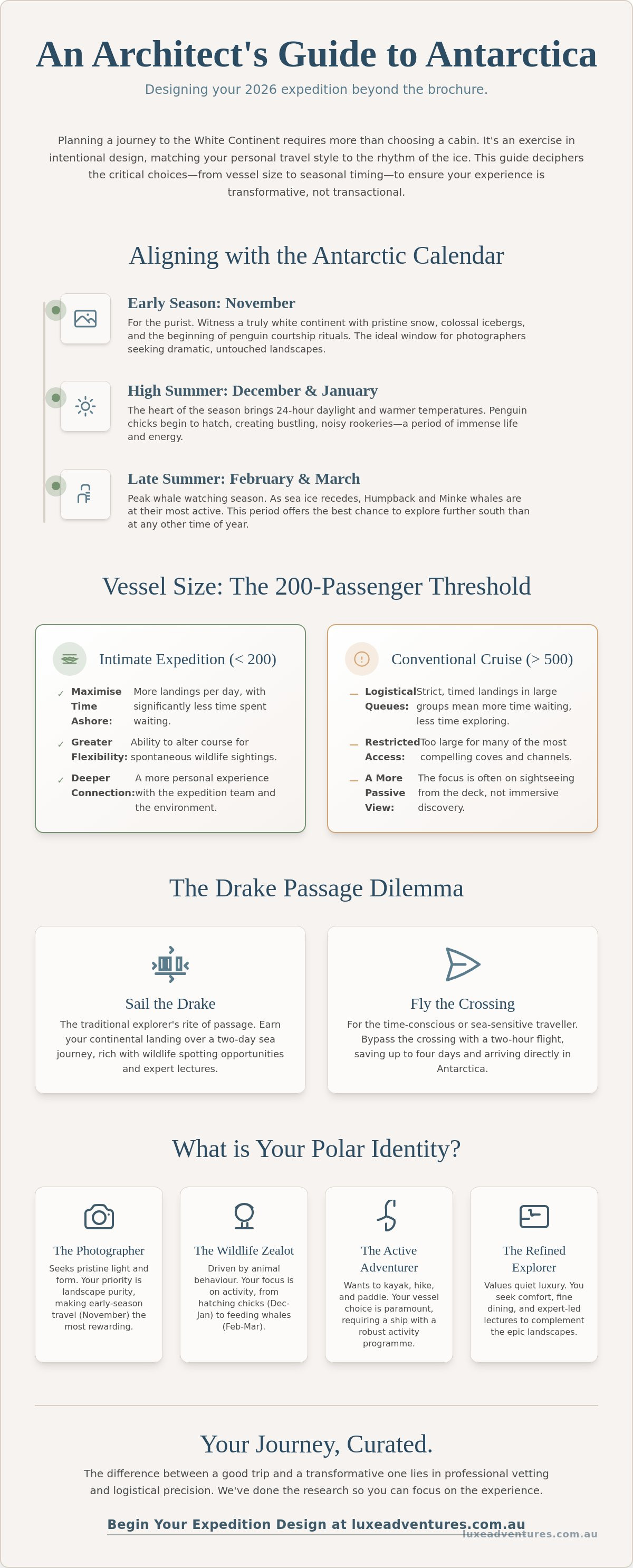
- Discover the 200-passenger threshold and why choosing a smaller vessel is the most critical factor for maximising your actual time spent exploring off the ship.
- Navigate the logistical choice between sailing the Drake Passage for a traditional explorer’s entry or opting for a fly-cruise to save time and avoid the crossing.
- Identify the value of professional vetting and expert guidance to ensure your chosen expedition vessel and itinerary align with your specific polar identity.
The Architecture of Planning a Trip to Antarctica: Why Curation Trumps Booking
Booking a cabin is a transaction; designing an expedition is an architectural project. When you’re planning a trip to Antarctica for the 2026 season, the sheer volume of options can feel like a whiteout. It’s a crowded marketplace where every brochure promises the same pristine silence. However, with over 118,000 visitors recorded in the 2024-2025 season, the reality of Tourism in Antarctica has changed. It’s no longer enough to just "get there." You need a strategy to avoid the crowds and find the soul of the continent.
Most travellers approach this as a box-ticking exercise, but intentional design focuses on the texture of the experience. A vetted advisor acts as your polar compass, filtering out the noise of generic "tourist" boats to find the vessel that matches your specific rhythm. We move beyond the "what" to focus on the "why," ensuring your journey isn't just a cruise, but a curated soft adventure tailored to your personal sense of discovery.
Defining Your Polar Goals
Every traveller has what I call a "Polar Identity." Some are driven by the quest for specific wildlife, perhaps seeking the rare sight of an Emperor Penguin or the dramatic breach of Humpback whales in late summer. Others prioritise the atmosphere, wanting to feel the isolation of the ice from a quiet, heated observatory. You must decide if your ideal day involves the physical grit of kayaking through brash ice or the refined comfort of viewing the landscape with a glass of wine in hand. These aren't just preferences; they're the pillars of your itinerary.
Soft Adventure vs. Technical Expedition
The 2026 season offers more "soft adventure" options than ever before, blurring the lines between sightseeing and immersive exploration. It’s essential to clarify where you sit on this spectrum.
- Sightseeing: Focussed on the visual grandeur from the ship’s deck with occasional, well-managed landings.
- Immersive Exploration: Involves multiple daily landings, citizen science programmes, and active participation in the environment.
Success in planning a trip to Antarctica lies in this initial curation. By matching your expectations to the right operational style, we ensure the logistics remain invisible, leaving you free to connect with the raw beauty of the south. We've done the research and vetted the ships, so you don't have to guess which deck plan leads to the most intimate experience.
Aligning the Antarctic Calendar with Your Personal Expedition Goals
Planning a trip to Antarctica isn't about finding a gap in your diary; it’s about aligning your journey with the continent’s biological clock. The travel season spans a mere five months, yet the landscape and inhabitants undergo a total metamorphosis every few weeks. Choosing your window is the difference between witnessing the silent drama of shifting sea ice and the chaotic, endearing energy of a penguin rookery. Success in this environment requires an understanding of these subtle shifts in rhythm.
The Early Season: Pristine Beauty and Ice
November is for the purists. This is the "White Continent" in its most literal sense, before the sun has had time to soften the snow or the footprints of the season’s visitors have marked the bays. You’ll witness the arrival of the first Adélie and Gentoo penguins as they begin their intricate courtship rituals. It’s a period of giant icebergs and pristine textures, making it the preferred window for serious photographers. While you're checking the U.S. Department of State Antarctica travel information for entry requirements, remember that early season ice can still be stubborn, often limiting how far south a vessel can push.
The Peak Summer: Life in Abundance
By December and January, the sun barely touches the horizon. This is High Summer, characterised by 24-hour daylight and the arrival of fluffy penguin chicks. The energy is palpable. It’s the busiest time for antarctica wildlife viewing, as seal pups appear on the floes and the rookeries become a cacophony of life. If your goal is to maximise shore time and soak in the sheer abundance of the Southern Ocean, this is your window. The weather is at its most stable, allowing for longer explorations and more frequent landings.
The Late Season: Whale Watching and Deep Exploration
February and March bring a different kind of sophistication. As the sea ice retreats to its minimum, ships can often push through the Lemaire Channel and beyond the Antarctic Circle. For those who prioritise marine life, planning a trip to Antarctica in the late season is the most rewarding choice. This is the undisputed peak for whale watching; Humpbacks and Minke whales are frequent companions as they feast on krill before their northern migration. The light shifts here, too, offering the first true sunsets of the season, casting deep ochres and violets across the glaciers.
If you're unsure which month resonates with your vision, you might find it helpful to discuss your priorities with a polar specialist who can match your interests to the seasonal calendar. Every week on the ice tells a different story, and the right curation ensures you're there for the chapter that matters most to you.
Selecting Your Vessel: The Critical Balance of Intimacy and Capability
The vessel you select is the single most impactful variable when planning a trip to Antarctica. It is your sanctuary, your laboratory, and your primary vantage point. While it’s tempting to be swayed by the grandeur of larger ships, the reality of polar exploration is governed by strict regulations that favour the small. In the Antarctic, size is the ultimate arbiter of access.
IAATO guidelines dictate that only 100 passengers may be ashore at any given time from a single vessel. If you choose a ship carrying 400 guests, you are effectively scheduling your day around waiting for your turn. This is why we prioritise small ship expedition cruises. On a smaller vessel, the transition from the mudroom to the Zodiac is seamless, allowing for multiple landings and spontaneous detours when a pod of Orcas appears on the horizon.
The 100-200 Passenger Sweet Spot
Operating within the 100 to 200 passenger range offers a perfect equilibrium. It provides enough scale for refined onboard amenities while maintaining the agility required for efficient Zodiac operations. There is a profound sense of shared discovery in these smaller groups; you aren't just a face in a crowd but part of a focused expedition team. This intimacy fosters deeper connections with the expert naturalists who guide your journey. When reviewing the U.S. Department of State Antarctica Travel Advisory, you'll note the emphasis on safety and professional guidance. A smaller ship ensures that guidance is personal, frequent, and expertly managed.
Luxury vs. Expedition-First Ships
Choosing between ultra-luxury and expedition-first vessels requires an honest assessment of your priorities. Ultra-luxury ships, such as those from Seabourn, offer an uncompromising level of suite-based comfort and fine dining that rivals the world’s best hotels. Conversely, specialists like Ponant or Swan Hellenic strike a sophisticated balance, providing high-end design alongside a rigorous focus on the landing experience.
- Guide-to-Guest Ratio: We look for a 1:20 ratio or better, which became a formal IAATO requirement in 2025. This ensures expert insights are always within reach.
- Technical Capability: High ice-class ratings allow ships to navigate deeper into the pack ice with confidence.
- Onboard Space: Luxury in the wild is defined by the volume of space per guest, ensuring you always have a quiet corner to reflect.
Mastering Polar Logistics: From the Drake Passage to the Antarctic Wardrobe
Logistics are the invisible threads that hold an expedition together. When planning a trip to Antarctica, the technicalities can seem daunting, yet they're the very elements that define the texture of your journey. Success in the high latitudes isn't just about showing up; it’s about arriving prepared, insured, and appropriately equipped for one of the most volatile environments on Earth. We treat these details with the same level of curation as the itinerary itself, ensuring the transition from the civilised world to the wild is as smooth as possible.
Navigating the Drake Passage
The Drake Passage is the world’s most famous gatekeeper. For many, the two-day crossing from Ushuaia is a rite of passage, a 800-kilometre stretch of open ocean that allows the mind to slow down and prepare for the silence of the ice. Modern expedition vessels are equipped with sophisticated stabilisers that significantly mitigate the "Drake Shake," often turning it into a "Drake Lake." However, if your time is limited or your tolerance for the open sea is low, the fly-cruise model is a compelling alternative. By flying from Punta Arenas to King George Island, you bypass the crossing entirely, saving roughly four days of transit and landing directly in the heart of the South Shetland Islands.
The Refined Packing List
The secret to polar comfort isn't a single heavy coat; it’s a sophisticated layering system. The goal is to manage moisture and trap heat without restricting movement. Most luxury lines provide high-quality, expedition-grade parkas and waterproof boots, so your focus should remain on what sits closest to your skin.
- Base Layers: Merino wool is the gold standard for its warmth and breathability.
- Mid Layers: Lightweight down vests or fleece jackets that can be easily added or removed as the weather shifts.
- Sensory Gear: Invest in high-quality binoculars (8x42 is the preferred specification) and professional-grade skin protection to combat the intense Antarctic sun.
The Non-Negotiable Admin
In 2026, medical and insurance requirements are stricter than ever. Most operators now mandate a minimum of $100,000 in emergency medical evacuation coverage. This isn't just a formality; it’s a necessary precaution given the remote nature of the continent. You'll also need to complete a detailed medical questionnaire, which we recommend doing well in advance to ensure there are no surprises before you depart. If you're feeling overwhelmed by the paperwork, it’s often best to organise a consultation to review your logistical options with a specialist who understands the nuances of polar travel insurance and medical clearances.
The Vetted Advantage: Why a Luxury Travel Designer is Your Polar Compass
Planning a trip to Antarctica is a significant investment of both time and emotional energy. It’s a journey that deserves more than a standard booking engine or a generic brochure. In a region where the margin for error is as thin as the sea ice, having a visionary architect for your expedition isn't a luxury; it’s a necessity. We act as your polar compass, ensuring every decision, from the choice of hull to the specific week of departure, is made with intentionality and purpose.
The value of a bespoke travel designer lies in the depth of their vetting process. We aren't simply relaying information from a cruise line’s sales department. We have been there, walked the decks, and tested the Zodiac operations ourselves. This firsthand validation allows us to filter out the mass-market noise and protect you from the "tourist" pitfalls that can dilute the raw power of the Antarctic experience. Our role is to bridge the gap between raw, untamed adventure and the refined comfort you expect.
Beyond the Itinerary
A truly curated journey is defined by the unseen logistics that happen long before you reach the white continent. We manage the complexities that often cause anxiety, such as securing the specific $100,000 emergency evacuation insurance required for polar travel or coordinating private transfers in Ushuaia. Through our Virtuoso affiliations, we often secure value-added benefits that enhance the journey, such as room upgrades at your pre-expedition hotel or VIP access that makes the transition through South America feel effortless. We also look at the texture of the entire trip, often suggesting pre- or post-expedition stays in the Atacama Desert or the vineyards of Mendoza to add a sensory counterpoint to the monochromatic beauty of the ice.
Personalised Vetting and Expertise
The difference between a travel agent and a luxury travel designer is the commitment to research. At Luxe Adventures, our founder, Rachel Cleary, personally researches the vessels and regions we recommend. This ensures that when we suggest a ship for 2026, it’s because we know the expedition leader’s style and the specific guide-to-guest ratio will deliver the intimacy you seek. We don't guess; we know.
If you’re ready to move beyond the surface and design an expedition that resonates with your personal sense of adventure, we invite you to begin the curation process. Whether you are looking for an antarctica cruise from australia or a classic departure from the tip of South America, we provide the clarity and expertise needed to make 2026 the year you truly connect with the silent frontier. Planning a trip to Antarctica is the art of the possible, and we are here to ensure your vision becomes a reality.
Defining Your Polar Legacy for 2026
The 2026 season offers a rare opportunity to engage with the White Continent on your own terms. By focusing on the 200-passenger threshold and aligning your journey with the specific biological rhythms of the Antarctic calendar, you move beyond mere sightseeing into the territory of true exploration. Planning a trip to Antarctica is a significant undertaking; it requires a balance of logistical precision and emotional resonance that only firsthand expertise can provide. Success is found in the details that brochures often overlook.
As a CLIA Master Specialist and Virtuoso member, Luxe Adventures offers more than just a booking. We offer a relationship built on personally vetted expeditions and a commitment to quiet luxury that prioritises substance over noise. We handle the invisible details, from Virtuoso-exclusive benefits to the nuances of polar insurance, leaving you free to connect with the raw beauty of the south. You aren't just visiting a destination; you're participating in a carefully architected experience that respects the fragility of the environment.
The ice is shifting, and the most profound experiences are reserved for those who choose curation over convenience. Start your journey with a bespoke Antarctica consultation today. Let's design a journey that is as singular as the landscape itself.
Frequently Asked Questions
When is the best month to plan a trip to Antarctica for wildlife?
December and January are the most active months for wildlife, featuring the hatching of penguin chicks and the arrival of seal pups on the ice. If your heart is set on whale watching, February and March are the peak times to see Humpbacks and Minke whales as they feast on krill. Every window in the short season offers a distinct biological spectacle, so the "best" month depends on your specific interests.
How far in advance should I book an Antarctic expedition for 2026?
You should ideally begin planning a trip to Antarctica 12 to 18 months before your intended departure. The 2026 season is already seeing significant demand for small-ship expeditions with fewer than 200 passengers, which are the first to sell out. Booking early ensures you secure your preferred suite category and allows ample time to manage the necessary medical clearances and specialised insurance requirements.
Do I need to be physically fit for an Antarctic cruise?
You don't need to be an athlete, but a reasonable level of mobility is essential for safely boarding and disembarking Zodiacs in shifting sea conditions. Most landings involve walking over uneven, snowy, or rocky terrain, sometimes with a slight incline. If you can manage a flight of stairs comfortably and walk a few kilometres on a beach, you'll find the vast majority of activities perfectly accessible.
Is the Drake Passage really as rough as people say?
The Drake Passage is unpredictable, but modern stabilisers on luxury expedition vessels have transformed the crossing into a manageable experience for most travellers. While the "Drake Shake" does occur with significant swells, many departures enjoy the "Drake Lake," where the water is surprisingly calm. We always suggest consulting with your doctor about motion sickness preventatives to ensure you remain comfortable regardless of the sea state.
What is the difference between a fly-cruise and a traditional sailing?
A fly-cruise allows you to skip the two-day Drake Passage crossing by flying from Punta Arenas directly to King George Island. This is an efficient choice for those with limited time or a low tolerance for open-ocean sailing. Traditional sailing, departing from Ushuaia, offers a slower, more contemplative entry into the Antarctic environment and is often viewed as a quintessential part of the explorer's journey.
What kind of boots and gear do I need to bring?
Most luxury operators provide the heavy waterproof boots and insulated parkas required for landings, so you should focus on your internal layering system. Essential items include moisture-wicking merino wool base layers, a breathable mid-layer fleece, and waterproof trousers. Don't overlook high-quality polarised sunglasses and sunscreen, as the Antarctic sun is exceptionally intense when reflected off the snow and ice.
Are there age restrictions for Antarctic travel?
Most expedition ships have a minimum age requirement, typically ranging from 8 to 12 years old, to ensure safety during Zodiac operations and shore landings. While there is no formal upper age limit, travellers must be in good health and capable of navigating the ship’s gangways and stairs. We frequently review the specific medical requirements of each vessel with our clients to ensure a comfortable fit for their mobility.
Why should I use a travel designer instead of booking directly with a cruise line?
A luxury travel designer provides independent vetting and advocacy that a single cruise line cannot offer. When planning a trip to Antarctica, we compare multiple operators to find the vessel that matches your personal rhythm rather than just filling a cabin. You also benefit from Virtuoso perks like shipboard credits or private transfers, alongside a single point of contact to manage the complex logistical and medical paperwork.

Article by
Rachel Cleary
Rachel Cleary is the founder of Luxe Adventures and an endlessly curious explorer with a passion for meaningful, experience-led travel. Having visited every continent and travelled to more than 100 countries — and counting — she believes travel is one of the greatest educations for both children and adults alike.
Rachel is addicted to scuba diving and gets underwater at every opportunity. When she isn't in the office you'll find her exploring remote reefs in Fiji, drift diving in the Maldives, or scuba cruising Raja Ampat or French Polynesia.
Her second home is Fiji where she has explored all the island groups and has favourite boutique resorts she returns to every year, for the diving and the authentic Fijian hospitality.
Get her talking about kayaking in Antarctica or the Arctic, African safaris and where to find the highest density of big cats, underwater adventures, remote expedition destinations, or the science and magic behind the Northern Lights — including when and where they are most likely to dance — and you may be there a while.
Through Luxe Adventures, Rachel combines firsthand experience, global industry connections, and a deep appreciation for nature, culture, food, wildlife, and human connection to help curious travellers explore the world in a way that feels seamless, personal, and unforgettable.
Refined by experience. Defined by connection.
Disclaimer
The information in this article is intended as general travel inspiration and guidance only. Travel requirements, hotel standards, airline schedules, entry regulations, weather conditions, pricing, and experiences can change without notice.
While every effort is made to ensure accuracy at the time of publishing, Luxe Adventures recommends confirming all details relevant to your personal travel plans before booking or travelling.
Opinions, recommendations, and destination insights shared in this article are based on firsthand experience, industry knowledge, and research at the time of writing. Experiences may vary depending on season, supplier changes, local conditions, and individual travel preferences.
Some articles may reference luxury travel affiliations, preferred partner programs, or value-added amenities available through Luxe Adventures. Benefits and inclusions are always subject to availability and supplier terms at the time of booking.
Luxe Adventures strongly recommends comprehensive travel insurance for all international travel.
For personalised travel advice, tailored itinerary design, or the latest destination updates, please contact Luxe Adventures directly.


