
The most restorative retreat may be the one with the least on its schedule. A packed programme can look persuasive on a polished website, but the best luxury wellness retreats are chosen for the kind of rest you actually need, not the number of treatments listed.
It’s understandable to want a clear answer. Retreat descriptions often blur together relaxation, wellbeing and mental health support, making it hard to tell whether a place offers quiet time, structured practices or clinical care. A restorative holiday can create space to pause and reconnect, but it isn’t a substitute for support from a qualified mental health professional.
This guide will help you compare retreat styles by setting, pace and intended experience, then choose an escape that feels personal rather than prescriptive. We’ll look at what distinguishes a slow, nature-led stay from a more structured wellness experience, and how thoughtful travel design can bring the details into line with your priorities. Genuine renewal rarely needs a timetable full of promises. Sometimes it starts with room to breathe.
Key Takeaways
- Match your retreat style to the restoration you’re seeking, whether that means a spa-led pause, time in nature, gentle activity or an unhurried resort stay.
- Compare the real shape of each stay: its setting, daily pace and level of structure, rather than relying on broad wellness promises.
- Choose your escape in sequence: clarify your intention, decide how much structure you want, then select a setting that supports it.
- Consider how luxury wellness retreats can sit within a broader holiday, or form a quieter, more focused pause on their own.
- Thoughtful travel design can bring your priorities, preferred pace and personally researched stays together in one considered itinerary.
What makes a luxury wellness retreat restorative rather than simply relaxing?
A retreat is travel shaped around rest, space and personal wellbeing. It gives the days a different centre of gravity: less rushing between obligations, more room to notice what restores you. A spa break may offer welcome relief through treatments and facilities, but a restorative stay considers the experience as a whole, from its setting and daily rhythm to how much structure feels comfortable.
A luxury wellness retreat is a thoughtfully designed stay that gives personal wellbeing room to shape the pace, setting and experiences of a journey.
The distinction isn’t about whether a treatment menu is extensive or a resort looks serene in photographs. It’s about fit. Some travellers value gentle movement and time outdoors; others want unplanned hours, a quiet room and meals that aren’t squeezed between activities. Wellness itself is broad, as the Wellness Tourism Overview illustrates. The useful question isn’t whether a retreat promises everything, but which parts of the experience matter to you.
Wellness travel, relaxation and mental health support are not interchangeable
A holiday can create space to rest, change scenery and step away from familiar demands. It isn’t mental health treatment, and a retreat shouldn’t be expected to resolve a health condition or guarantee an emotional outcome. If you need clinical mental health support, seek care from an appropriately qualified professional. A restorative trip may sit alongside that care, but it doesn’t replace it.
This distinction matters because polished language can make a leisure experience sound more clinical than it is. Look at what the stay involves: time for rest, activities you choose and a pace that leaves room to opt out. You don’t need to turn a holiday into another assignment.
What luxury can add beyond polished surroundings
Luxury has real value when comfort supports the experience rather than competing with it. Consider thoughtful pacing, privacy, attentive service and a setting that feels suited to you. Natural light, a quiet moment between plans or an unhurried meal can matter more than an itinerary that fills every available hour.
Some structure can be welcome, especially when it removes the effort of planning each day. But a packed schedule of classes, treatments and activities may leave little space to simply be. A considered retreat makes room for choice: join in, slow down or let the morning unfold without a timetable insisting it has ideas.
For a practical test, imagine an ordinary day there. Is there breathing room between planned experiences? Does the setting invite the kind of pause you want, or is the appeal mostly a list of facilities? Luxury wellness retreats are most restorative when their details work together to create an experience that feels calm, comfortable and genuinely your own.
Which luxury wellness retreat style suits the kind of restoration you want?
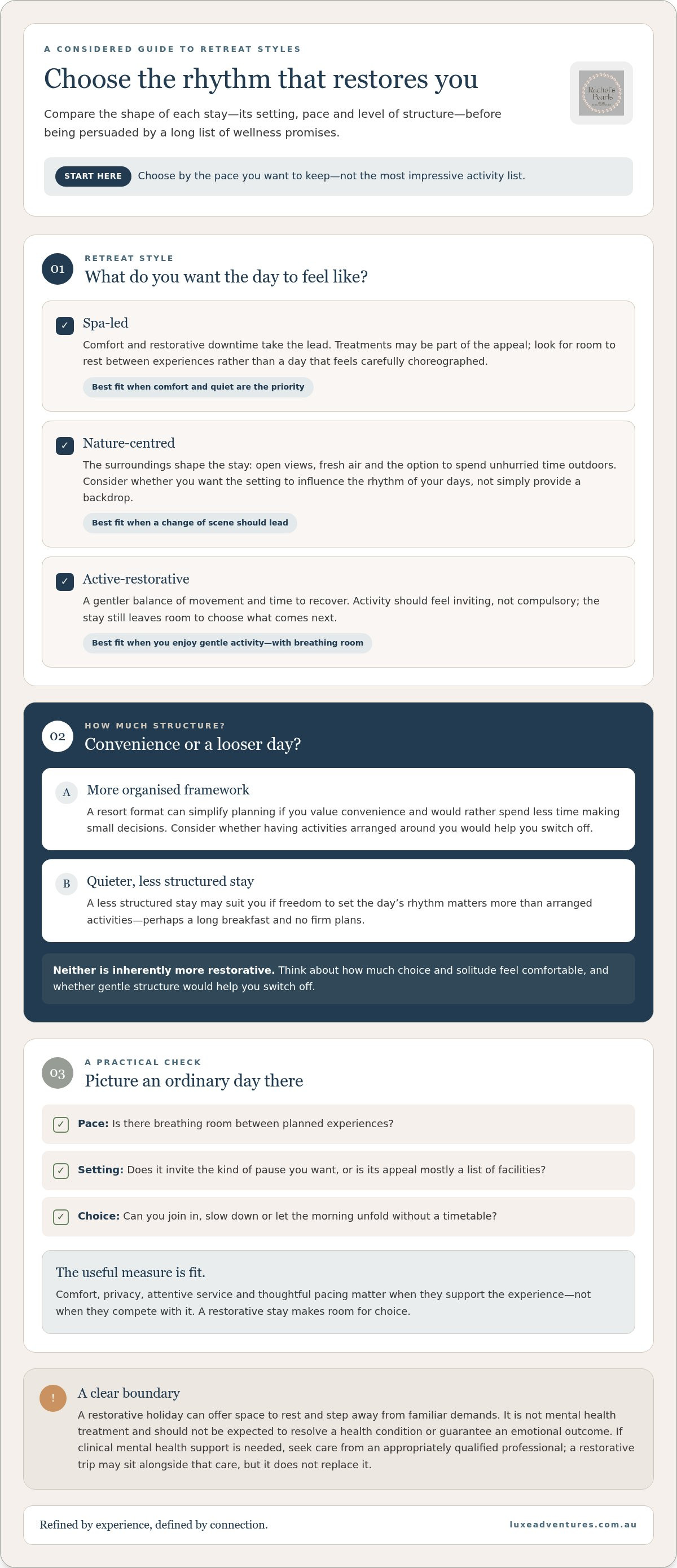
The right style depends less on a label than on how you want your days to feel. Some travellers are restored by comfort and quiet; others need open landscapes, gentle movement or the ease of having fewer practical decisions to make. Choose a retreat style by the pace you want to keep, not by the most impressive list of activities.
These planning lenses can help you compare stays, even when a retreat blends several styles. Identifying its dominant character helps you picture the experience beyond the photographs. The Global Wellness Tourism Trends 2026 offers a wider industry perspective. For your own plans, the more personal question is whether you want stillness, scenery, movement or convenience to take the lead.
Spa-led, nature-centred or active-restorative: how do they differ?
A spa-led stay puts comfort and restorative downtime at the centre. Treatments may be part of its appeal, but consider the broader rhythm too: is there space to rest between experiences, or does the day feel carefully choreographed?
Nature-centred stays take their character from the surroundings. Think open views, fresh air and the option to spend unhurried time outdoors, an approach exemplified by destinations such as Bawaria Wellness Retreat. The setting matters most when you want a change of scene to shape the days, rather than simply provide a backdrop.
Active-restorative travel offers a gentler balance: movement for those who enjoy being engaged, paired with unstructured time to recover and choose what comes next. It needn’t mean turning a holiday into a fitness schedule. A useful test is whether activity feels inviting, not compulsory.
When an all-inclusive resort or a quieter stay may suit better
A resort format can simplify planning for travellers who value convenience and a more organised framework. That ease can be appealing if you’d rather spend less time making small decisions. A quieter, less structured stay may suit you better if freedom to set the day’s rhythm matters more than having activities arranged around you.
Neither is inherently more restorative. Consider how much choice you want at your destination, how much solitude feels comfortable and whether gentle structure would help you switch off. Some people relax when the day is taken care of; others prefer a long breakfast and no firm plans. Both are entirely respectable holiday strategies.
Luxe Adventures designs luxury travel that includes stays associated with Six Senses, Anantara and Club Med. Each offers a different possibility to consider, rather than a single retreat template. The value lies in matching the setting and style to your priorities, without assuming that a brand name alone tells you how the experience will feel.
If you’re weighing up which rhythm and setting would suit you, share your wellness travel priorities as a starting point for a more considered journey.
How to compare luxury wellness retreats without relying on wellness promises
Descriptions such as “reconnect”, “reset” and “restore” can sound compelling while revealing very little about the stay itself. A more useful comparison looks at the practical shape of each experience: where you’ll spend time, how the days are paced, how much is guided and what kind of environment you’ll return to between activities. The framework below compares broad retreat styles.
Nature-centred stay
Setting: Open landscapes or natural surroundings. Pace: Often shaped around time outdoors. Structure: Can leave room to explore at your own rhythm. Could suit: Travellers drawn to scenery, fresh air and a change of environment.
Spa-led stay
Setting: A comfortable base with a focus on downtime. Pace: May centre on rest between chosen experiences. Structure: Consider how much of the day is arranged. Could suit: Travellers who value comfort and a slower tempo.
Active-restorative stay
Setting: A place that supports gentle movement. Pace: Alternates activity with unplanned breathing space. Structure: More engaging, without needing to fill every hour. Could suit: Travellers who feel at ease with movement and downtime in balance.
Resort-based stay
Setting: A resort environment with its own daily character. Pace: Can feel more organised or more self-directed. Structure: Varies with the stay and its arrangements. Could suit: Travellers who prioritise convenience or want a comfortable base from which to choose.
Four questions that reveal whether a retreat fits
Use these questions to move from attractive language to a clearer picture of your time away:
- Would you prefer solitude, shared experiences or a balance of both?
- Do you enjoy a guided daily rhythm, or do you want substantial time left unplanned?
- Which matters most to you: nature, comfort, cultural connection or movement?
- What should the setting make easy: quiet reflection, being outdoors or simply switching off?
Your answers needn’t point to one pure category. Luxury wellness retreats can combine different qualities; the aim is to identify which should lead and which are welcome extras.
How to read wellness language with clear expectations
Separate details you can picture from promises that are difficult to assess. A description of the landscape, the daily format and the balance between guided experiences and free time gives you something concrete to compare. Broad claims about transformation don’t tell you exactly what a stay involves, and wellness branding alone doesn’t establish clinical credentials or treatment outcomes.
The same care applies to stewardship. Give weight to specific information about how a property respects its surroundings and local culture, rather than assuming that a nature-led setting automatically reflects responsible practice. A well-matched retreat is easier to recognise when its actual character aligns with the experience you want.
How to choose a luxury wellness retreat that fits your life
A considered retreat begins with a simple question: what would you like the journey to make room for? Not a sweeping promise of transformation, just a clear sense of what would feel valuable now. That might be quiet, reconnection, gentle activity or a change of scene. From there, let intention guide the practical choices.
- Clarify your intention. Name the feeling or experience you want more of, such as unhurried mornings, time outdoors or space to reconnect with someone you care about.
- Choose your pace. Decide whether you want a lightly guided rhythm, a few planned experiences or plenty of open time. Be honest about whether a full schedule would energise you or feel suspiciously like work.
- Select your setting. Consider what supports that pace: a resort with a considered structure, a nature-led escape or a comfortable base that leaves room to explore.
- Shape the journey. Look at the travel days and transitions as well as the stay itself. The experience begins before check-in, and a complicated itinerary can make a supposedly restful break feel busy.
Start with the feeling you want the journey to make room for
Translate your intention into choices you can picture. If quiet is the priority, consider how much privacy and unplanned time you’d like. If reconnection matters, think about whether you want shared experiences or simply time together without competing demands. For a change of scene, ask what kind of landscape or cultural setting would feel meaningfully different from home. There’s no prescribed answer; the best starting point is the one that sounds like you.
Keep expectations kind and realistic. A holiday can offer distance from routine and a welcome pause, but it can’t guarantee a particular mood or outcome. Feeling tired doesn’t need to become a project, either. Sometimes the most useful plan is simply fewer commitments and enough time to enjoy them.
Shape the journey around pace, travel style and personal priorities
For Australian travellers, the time and energy involved in reaching a destination can influence how restorative the stay feels. Think about arrival timing, connections, transfers—such as arranging premium chauffeured transport with LuxPro® USA to ease airport and city transitions—and whether you’d prefer to settle in one place or combine a resort stay with other meaningful experiences. A longer journey may call for a gentler start; a shorter break may work best when the logistics are simple.
Bespoke design can bring those decisions together, balancing resort time with experiences that reflect your interests without turning every day into an itinerary. Luxe Adventures founder Rachel Cleary personally researches destinations and stays, bringing an experience-led perspective to how the pieces fit. The aim is a journey shaped around your priorities, not a template with wellness added as decoration.
For a considered approach to planning a restorative escape, explore your next restorative journey.
How Luxe Adventures can design a personally curated wellness escape
The most useful starting point isn’t a resort name. It’s your sense of what time away should feel like: quietly restorative, gently active, connected to nature or part of a broader holiday. Luxe Adventures uses those priorities to shape a considered itinerary, bringing together a suitable setting, a comfortable pace and the practical details that help the journey feel coherent.
That personal fit matters. A beautifully presented property may still be wrong for a traveller who wants privacy and unplanned time, while another may appreciate a more structured resort stay. The aim is not to prescribe a version of wellbeing, but to make the options easier to understand and choose between.
The value of personal research and considered curation
Founder Rachel Cleary personally researches destinations, hotels and expedition cruises. That firsthand perspective informs details that can be hard to read from a property description alone: the character of a setting, how it might suit a particular travel style and whether it fits the kind of journey someone has in mind. Curation helps narrow the field without turning planning into a second job.
A bespoke travel designer can also consider the journey as a whole, rather than treating accommodation as the only decision. Travel days, connections, time to settle in and the possibility of adding other experiences all influence how an escape feels. For a closer look at the value of that planning relationship, see our guide to why a bespoke travel designer matters.
Luxe Adventures holds professional industry accreditations, including CLIA Master status. These affiliations reflect travel-industry expertise; they don’t indicate clinical wellness credentials or promise a particular personal outcome.
A restorative journey shaped around the individual
Personal planning begins with a conversation about what you value: a calm setting, flexibility, cultural connection, time outdoors or the ease of a resort-based stay. From there, those preferences can guide the shape of the itinerary, including how much time to leave open and whether wellness travel should be the focus or one element of a wider luxury holiday.
Luxe Adventures designs wellness luxury travel and works with stays associated with Six Senses, Anantara and Club Med. These are starting points within a broader range of travel possibilities, not shorthand for a particular programme or guaranteed experience. The right choice depends on the traveller and the details of the stay.
A considered escape doesn’t need to promise reinvention. It can simply offer a setting and rhythm that make room for what matters to you, with experienced advice to bring the pieces together. If you’re ready to explore the possibilities, start a conversation about a personally curated wellness escape.
Make space for the kind of rest you want
The most considered escape doesn’t need to become a project in self-improvement. It can begin with a quieter question: what would you like more room for when you step away from your usual routine? The answer may change with the season of life you’re in. Let that be a useful guide, not another standard to meet.
For luxury wellness retreats, the details matter because they shape how the days feel: the balance of open time and planned experiences, the atmosphere of the setting, and how the journey fits around your life. Thoughtful planning can bring those pieces into focus without asking a holiday to promise more than it can deliver.
Ready to explore an escape shaped around your priorities? Share what you’d like from time away with Luxe Adventures. A good journey starts with a conversation, and there’s no need to have every detail decided before it begins.
Frequently Asked Questions
What is a luxury wellness retreat?
It’s a stay where comfort and the guest experience make space for wellbeing. To understand what that means in practice, consider what a typical day includes, which activities are optional and how much free time is available.
Are wellness retreats the same as mental health retreats?
No. A wellness label doesn’t indicate that a stay provides mental health services. If you need clinical support, speak with a qualified professional and treat any retreat activities as travel experiences, not therapy.
How do I choose a luxury wellness retreat?
Compare practical details such as travel connections, transfers, accommodation style and activity flexibility. If you’re travelling with someone, agree on expectations around shared plans and independent time before booking.
Can a wellness retreat help with stress or burnout?
A break may offer time away from everyday pressures, but no retreat can promise to resolve stress or burnout. If either is affecting your health or daily life, seek guidance from a qualified health professional.
What is the difference between a spa holiday and a wellness retreat?
The labels can overlap. Compare the actual stay: what activities are available, how optional they are and what a typical day looks like. This gives you a clearer sense of whether it matches your expectations.
Are luxury wellness retreats worth it?
That depends on how much you value the setting, service, convenience and overall fit. Consider what you’ll genuinely use and enjoy; an elaborate stay isn’t automatically the best choice for you.
Can I combine a wellness retreat with other travel experiences?
Yes. You could pair a resort stay with cultural experiences or another destination, while leaving enough time for transfers and rest. Decide which part of the journey should set the pace before adding plans.

Article by
Rachel Cleary
Rachel Cleary is the founder of Luxe Adventures and an endlessly curious explorer with a passion for meaningful, experience-led travel. Having visited every continent and travelled to more than 100 countries — and counting — she believes travel is one of the greatest educations for both children and adults alike.
Rachel is addicted to scuba diving and gets underwater at every opportunity. When she isn't in the office you'll find her exploring remote reefs in Fiji, drift diving in the Maldives, or scuba cruising Raja Ampat or French Polynesia.
Her second home is Fiji where she has explored all the island groups and has favourite boutique resorts she returns to every year, for the diving and the authentic Fijian hospitality.
Get her talking about kayaking in Antarctica or the Arctic, African safaris and where to find the highest density of big cats, underwater adventures, remote expedition destinations, or the science and magic behind the Northern Lights — including when and where they are most likely to dance — and you may be there a while.
Through Luxe Adventures, Rachel combines firsthand experience, global industry connections, and a deep appreciation for nature, culture, food, wildlife, and human connection to help curious travellers explore the world in a way that feels seamless, personal, and unforgettable.
Refined by experience. Defined by connection.
Disclaimer
The information in this article is intended as general travel inspiration and guidance only. Travel requirements, hotel standards, airline schedules, entry regulations, weather conditions, pricing, and experiences can change without notice.
While every effort is made to ensure accuracy at the time of publishing, Luxe Adventures recommends confirming all details relevant to your personal travel plans before booking or travelling.
Opinions, recommendations, and destination insights shared in this article are based on firsthand experience, industry knowledge, and research at the time of writing. Experiences may vary depending on season, supplier changes, local conditions, and individual travel preferences.
Some articles may reference luxury travel affiliations, preferred partner programs, or value-added amenities available through Luxe Adventures. Benefits and inclusions are always subject to availability and supplier terms at the time of booking.
Luxe Adventures strongly recommends comprehensive travel insurance for all international travel.
For personalised travel advice, tailored itinerary design, or the latest destination updates, please contact Luxe Adventures directly.


