
What if the most memorable part of a luxury journey isn’t the hotel, the suite or the number of places you visit, but how naturally the days fit you? That’s the thinking behind luxury travel design: shaping each choice around your interests, your pace and what you want to take home from the experience.
Finding polished options is easy. Making them feel personal, then bringing destinations, stays and experiences together without turning the itinerary into a relay race, takes more thought. A considered journey reflects your priorities, not a familiar template with a few upgrades added.
In this article, you’ll discover what goes into a cohesive, bespoke itinerary and which preferences are worth sharing from the outset, from the kind of cultural connection you enjoy to how much breathing room you want between experiences. We’ll also look at how firsthand knowledge can help bring a safari, expedition cruise or resort stay into one well-judged plan. The aim is simple: travel that feels unmistakably yours, with the details thoughtfully considered.
Key Takeaways
- Luxury travel design is about considered comfort, atmosphere and connection, not simply adding more five-star touches.
- Build a cohesive itinerary by giving destinations, stays and experiences a shared purpose.
- Choose a ready-made itinerary when its structure already suits you; consider bespoke design when you want greater flexibility or a more individual fit.
- Before planning, describe the experiences that draw you in and the pace that helps you enjoy them.
- Firsthand knowledge across safaris, cruises and resorts can help shape a personally vetted journey.
What Does Luxury Travel Design Mean Beyond Five-Star Stays?
Luxury travel design is the craft of shaping a journey around a traveller’s interests, preferred pace and purpose, so each destination, stay and experience feels part of a considered whole. The destination matters, of course. But the address alone can’t tell you whether a journey will feel right.
Comfort is part of the picture, but it needn’t announce itself. It might mean an arrival without avoidable complications, a stay whose character suits its setting, or enough space in the day to linger over breakfast rather than race to the next appointment. These choices may not look dramatic on an itinerary. Their effect is felt in how the journey flows.
Good design begins with the traveller, not a catalogue of upgrades. Someone drawn to wildlife and conservation may value expert interpretation and time to observe. Another traveller may be seeking a restorative break, with fewer transitions and a setting that invites them to slow down. The shape of the trip changes with the reason for taking it.
That personal context helps guide practical decisions, too:
- Interests: What do you return to in conversation: food, design, nature, history or the life of a place?
- Pace: Do you enjoy full days, unstructured afternoons or a balance of both?
- Purpose: Is this time for discovery, reconnection, celebration or rest?
There’s no ideal set of answers. The point is to let them guide the choices, rather than assume that more activity, more formality or more amenities will automatically make a holiday better. Even thoughtful restraint is a design decision.
How is luxury travel design different from choosing a luxury holiday?
A ready-made luxury holiday can be an excellent fit when its itinerary already reflects what you want. Bespoke design takes a different route: it starts with your priorities, then considers how each stay, experience and transition can support them. A preference for cultural encounters, for instance, may influence what you do, where you stay and how much unscheduled time you leave around it. Not every traveller needs that degree of tailoring.
What does quiet luxury feel like in a journey?
Quiet luxury is less a checklist than a sense of ease. It could be a calm arrival, a thoughtful room in a setting with a strong sense of place, and an itinerary with enough breathing room for an unplanned conversation or a second cup of tea. The measure isn’t how many amenities can be named; it’s whether the details make space for deeper attention and a more genuine connection to the journey.
How Luxury Travel Design Turns Ideas Into a Cohesive Journey
A coherent itinerary connects each destination, stay and experience to a shared purpose, while allowing the journey to unfold at a pace that suits the traveller. That doesn’t happen by stacking impressive places together. It takes a clear understanding of what matters to you, followed by careful choices and considered refinement.
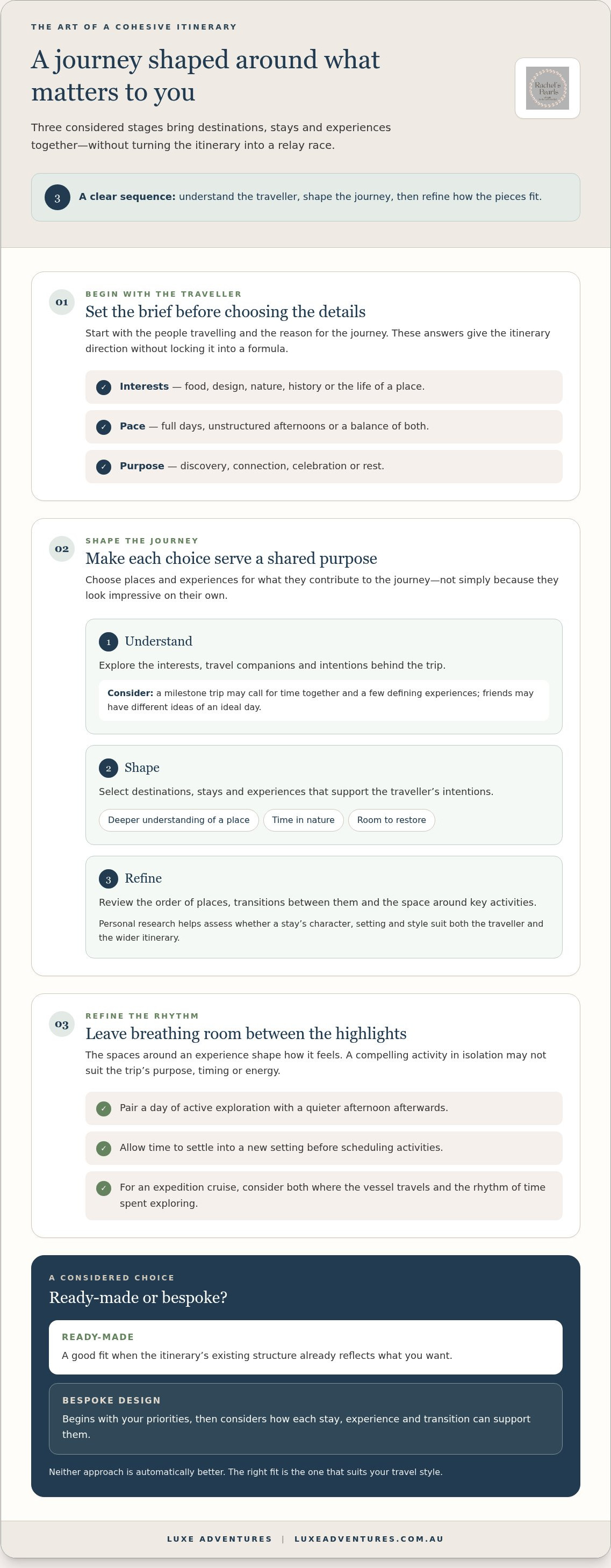
In practice, luxury travel design moves through three stages:
- Understand the traveller. Explore the interests, travel companions and intentions behind the journey. A couple marking a milestone may want time together and a few defining experiences; friends travelling together may have different ideas of an ideal day.
- Shape the journey. Choose destinations, stays and experiences that serve those intentions. Each element should contribute something, whether that’s a deeper understanding of a place, time in nature or room to restore.
- Refine the details. Review how the pieces fit: the order of places, the transitions between them and the amount of space around key activities. Small decisions often determine whether a plan feels fluid or overworked.
Research and firsthand judgement matter at every stage. A property’s description can tell you what it offers; personal research helps assess whether its character, setting and style suit the traveller and the wider itinerary. The same care applies to experiences: a compelling activity in isolation may not suit the trip’s purpose, timing or energy.
Start with the reason for travelling
Begin with a useful question: what would you like this journey to leave you feeling? Consider who’s travelling, what you’re curious about and whether you’re seeking discovery, connection or genuine rest. A safari might centre on wildlife and time in the landscape; an expedition cruise may appeal to travellers drawn to remote environments and exploration; a restorative stay might call for fewer movements and more unhurried hours. Motivation gives the itinerary direction without locking it into a formula.
Build rhythm between places and experiences
Headline experiences deserve attention, but so do the spaces around them. A day of active exploration may feel richer with a quieter afternoon afterwards. A change of setting can also benefit from time to settle in rather than an immediate schedule of activities. Expedition cruising offers a useful example: the experience is shaped not only by where a vessel travels, but by the changing landscape and the rhythm of time spent exploring. This guide to expedition cruising explains that style of travel in more detail.
If you’re beginning to turn a travel idea into a considered plan, you can share what you have in mind. A clear sense of purpose is a useful starting point, even if the destination is still taking shape.
Bespoke Design or Ready-Made Package: Which Better Fits Your Travel Style?
Neither approach is automatically the more considered choice. The right fit depends on how closely an existing itinerary matches your priorities and how much you want to shape the journey yourself. A ready-made package can offer a clear route and fewer decisions; bespoke design allows more room to tailor the route, experiences and pace to individual preferences.
The key difference is that a ready-made itinerary starts with a set plan, while a bespoke journey starts with the traveller and builds a plan around their needs. That distinction is about the planning approach, not a guarantee that one format is more comfortable or rewarding than the other.
| Consideration | Ready-made package | Bespoke design |
|---|---|---|
| Personalisation | Choose from an established itinerary. | Shape choices around individual interests and priorities. |
| Flexibility | The route and structure are defined. | The journey can be tailored to preferred pacing and experiences. |
| Planning effort | Fewer decisions may be needed before departure. | Your input helps guide the design process. |
| Itinerary coherence | Follow the structure already provided. | Connect each choice to a specific purpose or preference. |
Luxury travel design isn’t simply a matter of selecting more expensive accommodation. A beautiful hotel can still feel like the wrong choice if its atmosphere or setting doesn’t suit the traveller, or if the wider itinerary leaves little room to enjoy it. The value lies in fit: choosing places and experiences that make sense together, rather than treating price or prestige as a substitute for thought.
When can a ready-made itinerary be the right choice?
A defined route may suit travellers who know what they want to see, prefer fewer planning decisions or find an existing structure appealing. A packaged format can still include engaging experiences and comfortable stays. If its shape already suits your interests and preferred pace, there may be little reason to customise for the sake of it. Simplicity can be a pleasure in its own right.
When does a bespoke journey add more value?
Bespoke planning can be useful when your interests are particularly specific, your preferred pace differs from a standard route, or you want a mix of experiences that don’t naturally sit together in a ready-made plan. For instance, you might want active exploration followed by time to unwind, with transitions arranged to make the combination feel natural. The aim is considered curation, not change for its own sake.
A simple way to decide is to ask whether an existing itinerary already reflects what you value. If it does, its clear structure may be exactly right. If you find yourself wanting to adjust the rhythm, replace experiences or connect distinct interests, a more individual approach may be a better fit. Share your travel ideas to begin shaping a journey around what matters to you.
How to Prepare for a Luxury Travel Design Conversation
You don’t need a polished itinerary or a list of destinations before you begin. A useful conversation starts with the things that help a journey feel right to you: what you’re curious about, who’s travelling, how you like to spend a day and what you’d rather avoid. Honest preferences are far more helpful than trying to make the trip sound impressive.
Think of these prompts as a starting point, not homework:
- What draws you in? Consider wildlife, culture, food, history, time on the water or simply the chance to spend time together.
- What pace feels enjoyable? Would you prefer active days, long pauses or a mix, with room to change gears?
- Who’s coming? Note the needs and interests of your travel companions, especially where they differ from yours.
- What makes you comfortable? Share preferences around accommodation, travel transitions and the balance between structure and free time.
- What’s non-negotiable? Name the few elements that matter most, along with anything you know you don’t want.
Specific memories can be useful clues. Perhaps you loved having a knowledgeable guide but didn’t enjoy moving accommodation every few days. Maybe an unplanned afternoon became the highlight of a previous holiday. Those details reveal more about your travel style than a string of hotel categories ever could.
Which preferences help shape a more personal itinerary?
Describe the balance you enjoy between activity and rest, cultural encounters and quiet time, or being outdoors and retreating somewhere comfortable. Share experiences you’ve enjoyed, and be just as candid about what you’d rather avoid. If a packed schedule leaves you weary, say so; if you’re happiest with a full day of discovery, that matters too. There’s no prize for being the most adventurous person in the room.
How can travellers describe the experience they want?
Try describing the atmosphere or feeling you hope for, not only naming a destination. “A closer understanding of wildlife” or “space to reconnect” gives a designer a useful sense of what should guide the choices. Those interests can inform an African safari, a cruise or a resort stay in different ways. For a sense of how personal priorities can shape a safari, explore this guide to luxury African safari packages.
In luxury travel design, the best brief doesn’t need to be exhaustive. A few clear preferences, a sense of pace and an honest account of what matters can give the planning conversation direction, while leaving room for informed suggestions you may not have considered.
If you’re ready to put those ideas into words, start a conversation about your journey.
How Luxe Adventures Approaches Luxury Travel Design
Luxe Adventures is an Australian travel design studio creating bespoke, personally vetted experiences. Its approach begins with the traveller, not a preset list of upgrades. Interests, preferred pace and the purpose of a journey guide the choices, while firsthand research brings informed judgement to the places and experiences considered.
Rachel Cleary personally researches destinations, hotels and expedition cruises. That attention to detail matters because an appealing description is only one part of the picture. The character of a stay, the nature of an experience and how each fits the wider journey all deserve consideration. The aim is a plan that feels joined up, with choices made for a reason.
A considered range of journeys, curated around the traveller
Different interests call for different kinds of travel. A fascination with wildlife may point towards an African safari, where the appeal lies in time spent observing and understanding the natural world. Travellers drawn to remote environments may find an expedition cruise a more natural fit, while someone seeking a change of pace may prefer the restorative setting of a resort stay. The starting point is what the traveller hopes to experience, not a named package.
Luxe Adventures brings specialist knowledge across African safaris, luxury cruises, expedition cruising and resort stays. Personally vetting experiences helps put recommendations in context: a stay or activity should suit the traveller and contribute to the journey’s overall character. That is a more useful measure than choosing by headline amenity alone.
The studio’s advisors include CLIA Master expertise. This specialist knowledge supports an experience-led approach, while understanding each traveller’s priorities remains central to shaping a considered itinerary. Luxe Adventures also maintains exclusive global industry partnerships, bringing access to elite benefits and VIP treatment on eligible travel arrangements.
From an idea to a personal conversation
You don’t need to arrive with every detail decided. A destination in mind is helpful, but so is a broader thought: perhaps you’re keen to spend more time in nature, curious about life aboard an expedition vessel, or hoping for a quieter stretch at a resort. Share who’s travelling, what you enjoy, the pace that suits you and any practical preferences that should shape the plan.
Those first thoughts give the conversation somewhere meaningful to begin. From there, the planning can explore which experiences make sense together and how the details might support the purpose of your journey. Sometimes the clearest starting point is simply what you want more of, or less of, in your time away.
Travel can be more than a sequence of reservations. Thoughtful design gives it shape and intention, while leaving room for the moments that can’t be scheduled. If you’re ready to explore what your next journey could mean, Share the journey you have in mind.
Give Your Next Journey a Meaningful Starting Point
Before choosing where to go, consider what you’d like to notice, learn or make room for in the months ahead. It might be a different kind of time together, a deeper connection to the natural world, or simply the pleasure of being somewhere that shifts your perspective. That thought can become a quiet compass for the decisions that follow.
Luxury travel design is at its most compelling when it makes space for what matters to you, rather than filling every moment with something to do. The measure of a journey may be found in small things: a conversation that stays with you, an unhurried morning, or a new curiosity that follows you home. Those details are personal. So is the way you choose to travel.
You don’t need to have every answer before you begin. A first idea, a feeling or a question is enough to open up possibilities and give a journey its own direction.
Begin shaping your next journey with Luxe Adventures, and see where a thoughtful conversation might lead.
Frequently Asked Questions
What is luxury travel design?
It’s a way of making deliberate choices about a holiday, rather than treating the booking of individual components as the whole task. A useful test is to look at each proposed experience and ask what it contributes: does it deepen your understanding of a place, create time with someone important, or simply fill a gap in the schedule? If an element has no clear purpose, it may not need to be there.
Is luxury travel design only for long or complicated holidays?
No. It can be useful for a short stay if you’re weighing several appealing options or want to make limited time count. For a straightforward break, you may only need help with a few key decisions; a multi-stop itinerary may involve more moving parts. Think about where you’d most value experienced input, rather than assuming the length of your holiday determines how much planning support makes sense.
Can a luxury travel designer combine adventure with time to rest?
Yes. One practical way to assess the balance is to consider what happens after the most demanding parts of the trip. A long travel day or an intensive activity may call for a lighter stretch afterwards, while a quieter day can leave you ready for more exploration. The right sequence depends on your energy and comfort, not a rule that every day must alternate neatly between activity and rest.
How far ahead should I speak with a luxury travel designer?
There’s no universal lead time. The details of the journey and the dates you have in mind affect how much planning is involved. If your dates are tied to work leave, a celebration or other fixed commitments, mention those early so they can guide the conversation. If your plans are still open, that’s useful context too. Rather than wait for certainty, share what you know and what remains undecided.
What should I tell a travel designer about my preferences?
Give examples that reveal how you make decisions. You might say that you’d rather spend longer in one place than add another stop, or that a guided experience appeals more than a tightly scheduled day. Mention any past travel choice you’d make differently, too. That can highlight a useful constraint before plans take shape. You don’t need polished answers; candid, ordinary details are often the most revealing.
Can luxury travel design include both a safari and a cruise?
Yes, provided the combination makes sense for your interests and the practical shape of the journey. Consider how the settings relate, how you’ll move between them and whether the overall pace still feels enjoyable. A safari and a cruise shouldn’t be treated as two separate highlights simply placed side by side. Their transitions and timing matter just as much as the experiences themselves.
Does using a travel designer mean giving up control of my holiday?
No. You remain the person deciding what feels right. It can help to distinguish between decisions you feel strongly about and choices where you’d welcome a recommendation. For example, you might have firm views on the overall pace but be open to suggestions about how to spend a free afternoon. That gives the planning conversation useful boundaries while leaving room for thoughtful ideas.

Article by
Rachel Cleary
Rachel Cleary is the founder of Luxe Adventures and an endlessly curious explorer with a passion for meaningful, experience-led travel. Having visited every continent and travelled to more than 100 countries — and counting — she believes travel is one of the greatest educations for both children and adults alike.
Rachel is addicted to scuba diving and gets underwater at every opportunity. When she isn't in the office you'll find her exploring remote reefs in Fiji, drift diving in the Maldives, or scuba cruising Raja Ampat or French Polynesia.
Her second home is Fiji where she has explored all the island groups and has favourite boutique resorts she returns to every year, for the diving and the authentic Fijian hospitality.
Get her talking about kayaking in Antarctica or the Arctic, African safaris and where to find the highest density of big cats, underwater adventures, remote expedition destinations, or the science and magic behind the Northern Lights — including when and where they are most likely to dance — and you may be there a while.
Through Luxe Adventures, Rachel combines firsthand experience, global industry connections, and a deep appreciation for nature, culture, food, wildlife, and human connection to help curious travellers explore the world in a way that feels seamless, personal, and unforgettable.
Refined by experience. Defined by connection.
Disclaimer
The information in this article is intended as general travel inspiration and guidance only. Travel requirements, hotel standards, airline schedules, entry regulations, weather conditions, pricing, and experiences can change without notice.
While every effort is made to ensure accuracy at the time of publishing, Luxe Adventures recommends confirming all details relevant to your personal travel plans before booking or travelling.
Opinions, recommendations, and destination insights shared in this article are based on firsthand experience, industry knowledge, and research at the time of writing. Experiences may vary depending on season, supplier changes, local conditions, and individual travel preferences.
Some articles may reference luxury travel affiliations, preferred partner programs, or value-added amenities available through Luxe Adventures. Benefits and inclusions are always subject to availability and supplier terms at the time of booking.
Luxe Adventures strongly recommends comprehensive travel insurance for all international travel.
For personalised travel advice, tailored itinerary design, or the latest destination updates, please contact Luxe Adventures directly.


