

What if the world’s most hostile environments were actually the ultimate setting for profound restoration? It's a question many discerning travellers ask when they weigh the desire for raw discovery against the very real fear of over-tourism or the anxiety of spending weeks on a vessel that feels more like a research station than a sanctuary. You want the edge of the map, but you don't want to sacrifice the quiet luxuries that make a journey feel like yours. We understand that the choice between a rugged mission and a refined holiday shouldn't be a compromise, especially when considering the current rise of luxury sea expeditions.
This guide explores the nuanced world of modern maritime travel; a space where scientific curiosity meets uncompromising elegance on the world’s furthest frontiers. You'll learn how to distinguish between soft adventure and hard expedition while discovering how modern technology allows for seamless access to the Kimberley, the Arctic, and the white silence of Antarctica. We are moving beyond the surface to explore how a well-curated voyage can offer a meaningful connection with nature and local cultures, ensuring your time at sea is defined by depth rather than noise.
Key Takeaways
- Understand how the "Safari at Sea" philosophy transforms a vessel into a mobile base camp, prioritising deep immersion over mere transit.
- Learn why the 200-guest threshold is the gold standard for securing landing rights and navigating the world’s most intimate, shallow-water estuaries.
- Discover how to evaluate luxury sea expeditions by the credentials of their expedition teams, ensuring you have access to geologists, historians, and naturalists.
- Identify the critical distinction between "soft adventure" and "hard expedition" to align your journey with your personal threshold for exploration and comfort.
- Recognise the value of personal vetting and bespoke travel design in creating a seamless, end-to-end experience on the world’s furthest frontiers.
The Evolution of Discovery: Defining Luxury Sea Expeditions
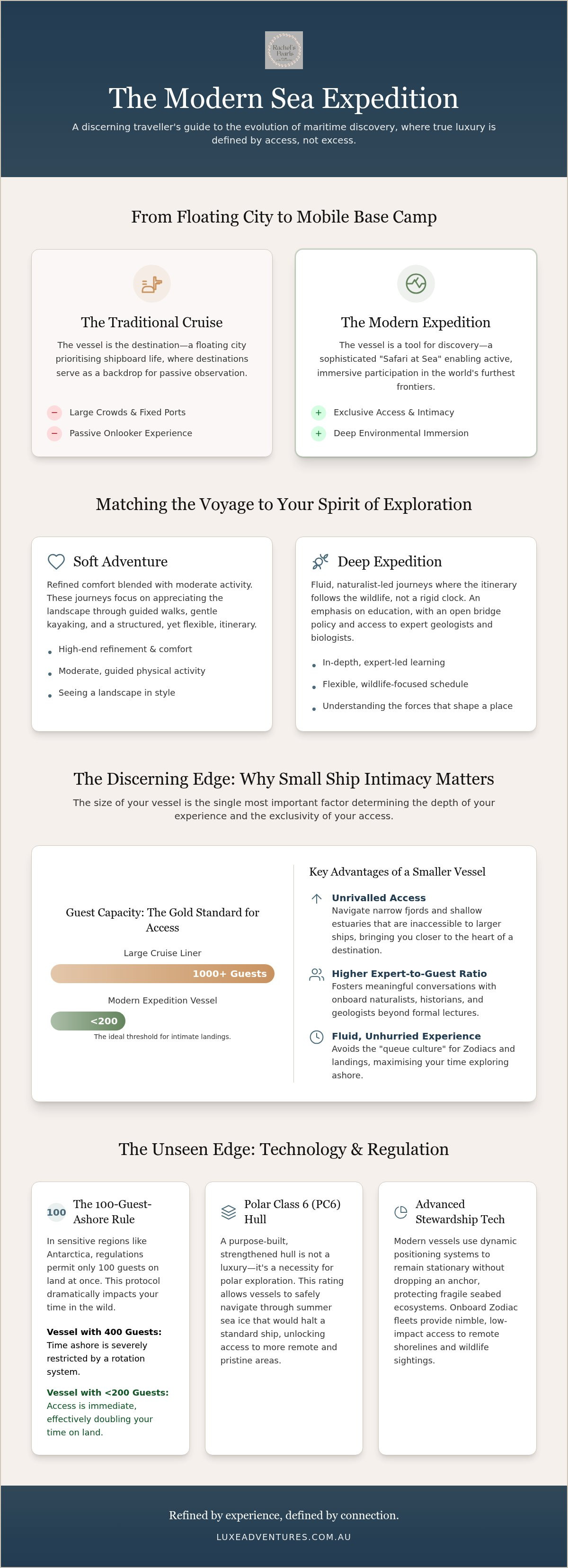
The traditional cruise liner is a floating city; the modern expedition vessel is a mobile base camp. This distinction is fundamental to understanding how luxury sea expeditions have evolved. For the discerning traveller, the shift is one of intent. We are moving away from passive observation, where the destination is merely a backdrop to shipboard life, toward active, immersive participation. In 2026, the true markers of luxury aren't gold-plated fixtures or midnight buffets. Instead, luxury is defined by the absence of crowds, the presence of profound silence, and the privilege of exclusive access to the world’s furthest frontiers.
The "Safari at Sea" philosophy treats the vessel as a sophisticated tool for discovery. It's a platform that allows you to wake up in a different, inaccessible fjord every morning without sacrificing the refined comforts of a world-class hotel. This approach prioritises the "why" behind the journey, ensuring that every nautical mile serves a purpose in connecting you with the raw reality of the environment. Whether it's the Kimberley's ancient sandstone or the Antarctic's shifting ice, the ship exists to put you exactly where the action is.
The Anatomy of an Expedition Vessel
Technical specifications might seem dry, but they dictate the depth of your experience. A vessel with a Polar Class 6 (PC6) rating, for example, possesses a strengthened hull capable of pushing through summer sea ice that would halt a standard ship. The interior architecture also reflects this purpose. The mudroom is the heart of the ship; a transition point where you swap your slippers for rugged boots. It’s here that you board the Zodiac fleet, those nimble workhorses essential for shoreline landings. The evolution of the expedition cruise ship from basic transport to a high-tech base camp illustrates this commitment to reaching the unreachable.
Soft Adventure vs. Deep Expedition
Choosing the right voyage requires an honest assessment of your personal threshold for exploration. Soft adventure typically offers high-end refinement with moderate physical activity, such as guided walks on stable terrain or gentle kayaking. Deep expeditions are more fluid and naturalist-led, often following the wildlife rather than a rigid clock. These journeys often feature an open bridge policy, allowing you to stand with the officers as they navigate. It’s the difference between simply seeing a landscape and having a geologist explain the tectonic forces that shaped it. One is a holiday; the other is a transformation.
The Discerning Edge: Why Small Ship Intimacy Matters
Small ship intimacy isn't just a marketing preference; it's a structural necessity for meaningful exploration. In the context of luxury sea expeditions, the size of your vessel is the single most important factor determining where you go and how much time you spend there. While a thousand-guest liner might offer a broad range of amenities, it remains tethered to deep-water ports and established docks. Small ships, conversely, are designed with a shallow draft and nimble proportions that allow them to slip into narrow fjords and shallow estuaries that larger ships simply cannot reach.
We often recommend ships with fewer than 250 guests to ensure a personalised experience. This intimacy avoids the "queue culture" that plagues larger vessels, where waiting for a Zodiac can consume half your morning. On a smaller ship, the transition from breakfast to the shoreline is fluid and unhurried. This scale also facilitates a higher ratio of experts to guests. When you're sharing a lounge with a marine biologist or a polar historian, the conversation doesn't end at the lecture hall; it continues over coffee or on the observation deck, providing a level of intellectual engagement that is impossible on a grander scale.
Regulatory Advantages of Small Ships
In regions like Antarctica and the Arctic, ship size is governed by strict environmental protocols from bodies like IAATO and AECO. One of the most critical regulations is the 100-guest-ashore rule. This means that regardless of how many people are on the ship, only 100 can be on land at any one time. If you are on a vessel with 400 guests, your time on the ground is severely restricted by a rotation system. On a ship with 100 or 200 guests, your access is immediate and your time in the wilderness is doubled. Smaller modern vessels also utilise advanced dynamic positioning systems, which allow the ship to remain stationary without dropping anchor, protecting fragile seabed ecosystems.
Intuitive Service on the High Seas
The luxury of a small ship extends into the social fabric of the journey. Dining is unhurried, often with open seating that encourages connection between like-minded explorers who share your curiosity for the unknown. Service is anticipatory rather than reactive; your suite steward learns your preferences by the second day, and the bartender remembers exactly how you take your evening drink. The Virtuoso edge in onboard service ensures that these personal touches are backed by a global standard of excellence, providing you with value-added benefits that enhance the journey without feeling transactional. If you’re ready to discuss which vessel best suits your appetite for discovery, you can connect with us here to begin tailoring your journey.
Global Frontiers: Navigating the Most Exquisite Sea Expeditions
Choosing a destination for luxury sea expeditions is a matter of aligning your specific curiosity with the planet's seasonal rhythms. While the polar regions remain the iconic choice for many, the world’s coastal and equatorial frontiers offer equally profound encounters. It isn't just about where you go, but when and how you engage with the environment. For a deeper look at the foundational concepts of these journeys, our guide on What is Expedition Cruising? provides the broader context needed to distinguish between a standard voyage and a true mission of discovery.
The Polar Majesty: Antarctica and the Arctic
Antarctica is the silent frontier, a place where the scale of nature humbles even the most seasoned traveller. Its season runs from November to March, and the timing of your visit dictates the texture of the experience. November offers pristine, untouched snow and the spectacle of penguins nesting. By February and March, the ice has receded, allowing ships to push further south, while the waters teem with whale activity. In the northern hemisphere, the High Arctic offers a different kind of majesty. Svalbard is the primary theatre for those seeking the polar bear, where expedition ships navigate the pack ice under the midnight sun. Our specialised guide on Antarctica Cruises from Australia details the specific logistics and vessel choices for those departing from our shores.
Equatorial and Coastal Wonders
The Galapagos Islands remain a masterclass in evolutionary biology. The lack of fear in local wildlife allows for intimate encounters that feel almost otherworldly. These volcanic outcrops are best explored on vessels that balance high-end hospitality with rigorous naturalist standards. Closer to home, the Kimberley region of Western Australia presents a rugged, ancient landscape defined by the world’s largest tidal shifts and prehistoric rock art. Navigating the horizontal falls by Zodiac is a visceral reminder of nature’s raw power. Further north, the pristine reefs of Indonesia and West Papua offer some of the planet's most biodiverse diving and snorkelling. These areas are accessible only by small-ship expeditions that can navigate the intricate archipelagos and shallow lagoons where larger ships cannot venture. Whether you are following the path of Darwin or the songlines of the Kimberley, these journeys are about depth rather than distance.
The Selection Framework: Crafting Your Maritime Journey
Selecting the right vessel for luxury sea expeditions is less about comparing star ratings and more about aligning with a specific philosophy of travel. Before looking at deck plans, you must identify your primary driver. Are you motivated by the visceral thrill of wildlife encounters, the intellectual depth of ancient cultures, or the meditative silence of a polar landscape? Each expedition line prioritises these elements differently. A journey through the Kimberley requires a different set of expertise than a voyage to the High Arctic, and the credentials of the onboard team should reflect this. Look for itineraries led by seasoned geologists, historians, and naturalists who offer lived experience rather than rehearsed scripts.
The onboard atmosphere is equally critical to your overall sense of restoration. You might prefer the formal elegance and butler service of a traditional luxury line, or perhaps you lean toward the understated "quiet luxury" found on newer, more minimalist vessels. Through our Virtuoso affiliation, we ensure these choices come with tangible value, such as shipboard credits or room upgrades, which enhance the experience without making it feel promotional. It's about finding the texture that fits your personal style.
Comparing the Leading Expedition Lines
While various leading lines offer different philosophies of maritime discovery, those seeking cultural depth in the South Pacific often find that specialized Adventure Cruise Packages provide a legendary freighter-passenger experience through the remote Marquesas and Tuamotu Islands. This approach prioritizes deep immersion and local connection, ensuring every nautical mile serves a purpose. Each expedition has a unique "hand-print" on the destinations they visit, reflecting a commitment to meaningful exploration.
Practical Logistics for the Australian Traveller
For Australians, the journey begins long before you reach the pier. Managing long-haul flights to remote embarkation points like Ushuaia or Longyearbyen requires careful planning. We strongly advise incorporating "buffer days" and curated pre-cruise stays to ensure you arrive rested and ready for the expedition. Specialist travel insurance is also non-negotiable; standard policies often lack the specific coverage required for remote maritime medical evacuations. If you're ready to design a journey that accounts for every detail, you can enquire about a bespoke expedition plan with our team today.
The Luxe Adventures Approach: Refined by Experience
The logistical map of luxury sea expeditions is often as intricate as the coastlines they explore. A bespoke travel designer acts as your most critical asset in this environment, translating high-level aspirations into a seamless reality. We don't just book cabins; we curate the entire arc of the journey. This process is rooted in a commitment to stewardship, ensuring we partner with expedition lines that respect the fragile frontiers they visit. Our recommendations aren't based on brochures. They're the result of personal vetting and a deep understanding of how each vessel operates in the wild.
The ultimate goal is an emotional payoff that transcends the journey itself. You should return from the Antarctic or the Amazon with a renewed perspective on the natural world, not just a collection of digital files. It’s about the quiet moments of connection that happen when the noise of the world is left behind. We focus on the "why" behind your travel, helping you shape a journey that reflects your values and your curiosity. This intentionality is what separates a standard holiday from a truly transformative experience.
The Value of Human Connection
Kerrie-Anne and the team act as your personal advocates, ensuring your specific needs are understood by the cruise lines before you even step on board. We spend our time deciphering the fine print of expedition contracts and inclusions so you don't have to. This level of detail ensures that your expectations for comfort and discovery are met with precision. Lived experience is the only currency that matters when planning a journey to the world's most remote environments. It allows us to offer insights that no algorithm can replicate, from the best suite for viewing wildlife to the nuances of local landing protocols.
Virtuoso Benefits and Exclusive Access
Our status as a Virtuoso member and CLIA Master provides more than just industry credentials. It offers tangible value through exclusive perks like shipboard credits, private receptions, and prioritised upgrades that enhance your time at sea. These relationships often provide the key to accessing "sold out" itineraries for the 2026 and 2027 seasons. Because we are deeply embedded in the industry, we can often secure space on vessels that appear unavailable to the general public. We invite you to begin the curation process with us, ensuring your next foray into the world’s furthest reaches is handled with the discernment it deserves.
Charting Your Course to the Far Frontiers
The world’s most remote coastlines don't reveal their secrets to the casual observer. They require a vessel that acts as a sophisticated base camp and a team that understands the rhythm of the wild. The true value of luxury sea expeditions lies in the intersection of scientific curiosity and uncompromising refinement. By prioritising ships with fewer than 250 guests, you ensure the intimate access and landing rights that larger liners simply cannot provide. Whether you're drawn to the white silence of Antarctica or the ancient sandstone of the Kimberley, the key is a journey defined by depth rather than noise.
At Luxe Adventures, we bring our boutique Queensland-based expertise and CLIA Master Specialist credentials to every itinerary we curate. We don't just plan trips; we advocate for your experience, backed by the tangible value of Virtuoso Member perks. If you're ready to move beyond the surface and explore the world's furthest frontiers with intentionality, we're here to guide you. It's time to shape a future defined by connection and profound discovery. Begin your journey with a curated consultation and let's discover what's possible on the high seas.
Frequently Asked Questions
What is the difference between a luxury cruise and a luxury sea expedition?
The primary difference lies in the intent of the journey. A luxury cruise prioritises the ship as the destination, focusing on onboard amenities and established ports of call. Conversely, luxury sea expeditions use the vessel as a sophisticated tool to access remote, often uninhabited environments. You swap Broadway-style theatre for lectures by glaciologists and replace traditional docks with Zodiac landings on rugged shorelines.
Are luxury sea expeditions suitable for people with limited mobility?
Suitability depends on the specific vessel and the nature of the landings. While newer ships offer elevators and accessible suites, boarding a Zodiac in ocean swells requires a degree of physical agility. We recommend discussing your specific needs with us so we can identify ships with specialised boarding platforms or itineraries that focus on ship-based viewing rather than strenuous shore excursions.
What should I pack for a luxury polar expedition?
Effective packing is about technical layers rather than heavy bulk. You'll need high-quality merino wool base layers, waterproof over-trousers, and moisture-wicking socks to stay dry. Most luxury expedition lines provide a specialised polar parka and insulated boots for the duration of the trip. Don't forget high-SPF sunscreen and polarised sunglasses; the glare from the ice is intense even on overcast days.
How far in advance should I book a luxury sea expedition?
You should ideally plan 12 to 18 months ahead of your intended departure. High demand for specific cabin categories and the short seasonal windows of the polar regions mean that the best vessels often sell out over a year in advance. Booking early also allows us to secure Virtuoso-exclusive benefits and ensure your preferred pre-cruise arrangements are perfectly aligned with the ship's schedule.
Is the Drake Passage really as rough as they say?
The Drake Passage is famously unpredictable, alternating between the "Drake Shake" and the "Drake Lake." Modern expedition ships are equipped with advanced stabilisers that significantly mitigate motion, but it remains a visceral maritime experience. For those truly concerned about sea sickness, we can explore fly-cruise options that bypass the passage entirely, landing you directly on the Antarctic Peninsula via a short flight.
Are all-inclusive expedition cruises truly all-inclusive?
Most luxury lines are genuinely all-inclusive, covering daily shore excursions, alcoholic beverages, and gratuities. However, you should check the details for specialised activities. Experiences like submersible dives, helicopter flightseeing, or scuba programmes often incur an additional fee. We help you navigate these inclusions during the planning phase so there are no unexpected costs once you are on board.
What kind of wildlife can I expect to see on a sea expedition?
Wildlife encounters are dictated by your destination and the timing of your visit. Antarctica offers vast colonies of Adélie and Gentoo penguins, while the Arctic is the primary theatre for spotting polar bears and walrus. Tropical luxury sea expeditions in the Galapagos or the Amazon reveal entirely different ecosystems, from giant tortoises to pink river dolphins. Every journey is a masterclass in the planet's biodiversity.
How does Luxe Adventures help me choose the right expedition line?
We use our firsthand knowledge and personal vetting to match you with a ship that suits your personal style. Beyond just selecting a destination, we evaluate the credentials of the expedition team and the specific atmosphere on board. As a CLIA Master Specialist, we advocate for your specific interests, ensuring you receive the Virtuoso perks and personalised service that define a Luxe Adventures journey.

Article by
Rachel Cleary
Rachel Cleary is the founder of Luxe Adventures and an endlessly curious explorer with a passion for meaningful, experience-led travel. Having visited every continent and travelled to more than 100 countries — and counting — she believes travel is one of the greatest educations for both children and adults alike.
Rachel is addicted to scuba diving and gets underwater at every opportunity. When she isn't in the office you'll find her exploring remote reefs in Fiji, drift diving in the Maldives, or scuba cruising Raja Ampat or French Polynesia.
Her second home is Fiji where she has explored all the island groups and has favourite boutique resorts she returns to every year, for the diving and the authentic Fijian hospitality.
Get her talking about kayaking in Antarctica or the Arctic, African safaris and where to find the highest density of big cats, underwater adventures, remote expedition destinations, or the science and magic behind the Northern Lights — including when and where they are most likely to dance — and you may be there a while.
Through Luxe Adventures, Rachel combines firsthand experience, global industry connections, and a deep appreciation for nature, culture, food, wildlife, and human connection to help curious travellers explore the world in a way that feels seamless, personal, and unforgettable.
Refined by experience. Defined by connection.
Disclaimer
The information in this article is intended as general travel inspiration and guidance only. Travel requirements, hotel standards, airline schedules, entry regulations, weather conditions, pricing, and experiences can change without notice.
While every effort is made to ensure accuracy at the time of publishing, Luxe Adventures recommends confirming all details relevant to your personal travel plans before booking or travelling.
Opinions, recommendations, and destination insights shared in this article are based on firsthand experience, industry knowledge, and research at the time of writing. Experiences may vary depending on season, supplier changes, local conditions, and individual travel preferences.
Some articles may reference luxury travel affiliations, preferred partner programs, or value-added amenities available through Luxe Adventures. Benefits and inclusions are always subject to availability and supplier terms at the time of booking.
Luxe Adventures strongly recommends comprehensive travel insurance for all international travel.
For personalised travel advice, tailored itinerary design, or the latest destination updates, please contact Luxe Adventures directly.


