

Choosing between the top and bottom of the world isn't a matter of geography; it's a reflection of what your soul currently craves. You've likely spent hours comparing itineraries, wondering if the legendary drama of the Drake Passage is a price worth paying or if the cultural tapestry of the High Arctic offers a more profound connection. The question of arctic vs antarctica cruise which is better often feels like choosing between two masterpieces, each with its own distinct rhythm and scale. One offers the raw, uninhabited silence of a frozen continent, while the other provides a window into ancient traditions and resilient wildlife.
I understand the hesitation that comes with such a significant investment. My promise is to move beyond the glossy brochures and provide the clarity you need to choose with confidence. We'll examine the nuances of polar bear sightings versus penguin colonies, the logistical realities of the journey, and how to select a vessel that offers refined luxury without the pretension. This guide will help you determine which expedition resonates with your spirit, ensuring your time in the ice is as transformative as the landscapes themselves.
Key Takeaways
- Distinguish between the "Big Five" of the North and South, ensuring you choose the destination that hosts the specific wildlife, from polar bears to emperor penguins, you most desire to see.
- Contrast the rich, 40,000-year human history and indigenous cultures of the Arctic with the profound, uninhabited silence and scientific legacy of the Antarctic continent.
- Gain a realistic perspective on the Drake Passage and learn how modern ship technology or fly-cruise alternatives can streamline your journey to the Southern Ocean.
- Evaluate the distinct atmospheres of each region to finally decide an arctic vs antarctica cruise which is better for your personal temperament and quest for connection.
- Understand the value of a personally vetted expedition, from selecting the right vessel to leveraging Virtuoso benefits that enhance your comfort in the most remote corners of the earth.
Polar Opposites: The Fundamental Divide Between North and South
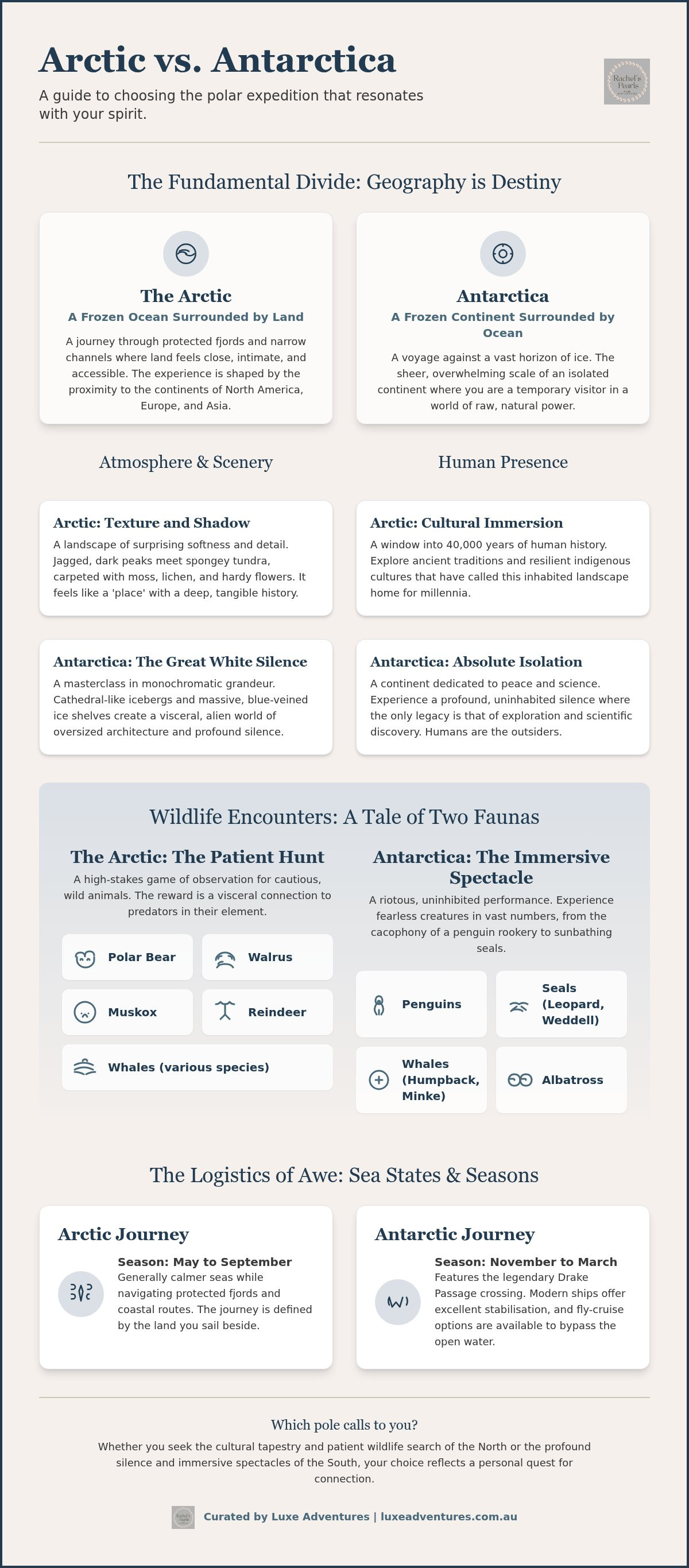
The most profound difference between the two poles is a matter of physical structure. The Arctic is essentially a frozen ocean almost entirely surrounded by the landmasses of Russia, Canada, Greenland, and Scandinavia. Antarctica, conversely, is a massive, isolated continent encircled by the wild, productive waters of the Southern Ocean. To understand the sheer complexity of Earth's polar regions, one must first appreciate how this geographic inversion shapes every moment of your journey. When clients ask me arctic vs antarctica cruise which is better, I always start with this distinction. Geography isn't just a background detail; it's the visionary architect of your daily rhythm.
In the North, you're often sailing through protected fjords and narrow channels, where the land feels close and accessible. In the South, you're a speck against a horizon of ice that stretches beyond human comprehension. This structural divide dictates how you explore. Arctic excursions often involve walking on ancient, spongey tundra or visiting small outposts, while Antarctic landings are a delicate dance with shifting ice and sea states. The question of arctic vs antarctica cruise which is better often comes down to whether you prefer the intimacy of an inhabited landscape or the raw, overwhelming scale of a continent where humans are the outsiders.
The Arctic Landscape: Tundra and Spire
The Arctic landscape is one of surprising texture and shadow. In places like Svalbard and Greenland, you'll find jagged, dark peaks that contrast sharply against the deep cerulean of the sea. Unlike the high south, the Arctic has a softness to it. Low-lying tundra provides a carpet of moss, lichen, and tiny hardy flowers that turn a brilliant gold in the late summer months. This presence of life makes the Arctic feel like a "place" with a deep history. It's a landscape of intricate details, where you can feel the connection between the land and the resilient cultures that have called it home for millennia.
The Antarctic Landscape: The Great White Silence
Antarctica is a masterclass in monochromatic grandeur. It's a world of oversized architecture, from the cathedral-like tabular icebergs to the massive, blue-veined ice shelves that dwarf even the most sophisticated expedition ships. The beauty here is visceral and alien. It's a study in every conceivable shade of white, silver, and electric blue. There's a profound silence in the Antarctic interior that you won't find anywhere else on the planet. It doesn't feel like a part of our world; it feels like an encounter with the primordial. It's a space that demands your full attention and rewards you with a sense of utter perspective.
Wildlife and Scenery: Charismatic Megafauna and Icy Architecture
The choice between the two poles often rests on the specific cast of characters you hope to encounter. In the North, wildlife viewing is an exercise in mindful patience, a quiet hunt for the "Big Five": polar bears, walrus, muskox, reindeer, and whales. Conversely, the South offers a riotous, uninhibited spectacle featuring penguins, seals such as the Leopard and Weddell, whales, and the majestic albatross. Deciding an arctic vs antarctica cruise which is better usually depends on whether you seek the thrill of the search or the immersion of a crowd.
The Hunt for the King of the North
Svalbard remains the gold standard for those seeking the polar bear. Here, the experience is defined by the "scanned horizon." You'll find yourself on the bridge with binoculars in hand, peering at distant ice floes for a smudge of cream-coloured fur. It's a high-stakes game of observation where the reward is a visceral connection to a predator in its element. Because Arctic animals have evolved alongside humans and bears, their behaviour is cautious and wild. This creates a sense of profound respect; you aren't just a tourist, you're a quiet witness to a fragile, northern survival.
The Penguin Pandemonium of the South
Antarctica offers a completely different sensory texture. Penguin colonies are a sensory assault in the best possible way. There's the constant, braying cacophony of thousands of birds and the unmistakable, earthy scent of a busy rookery. Because these creatures have no land-based predators, they're remarkably fearless. You might find a curious Gentoo pecking at your boot or a Weddell seal barely glancing up from its nap as you pass. It's an environment of absolute trust that feels remarkably intimate.
The Lemaire Channel provides perhaps the world's most dramatic backdrop for whale watching. Imagine the ship gliding through a mirror-still channel, the silence broken only by the explosive "pouf" of a humpback's blow. The scale of the icy architecture here, with mountains rising vertically from the sea, makes every encounter feel like a masterclass in natural design. If you're struggling to decide which ecosystem aligns with your vision, sharing your wildlife priorities with a specialist can help narrow the focus.
Humanity and History: Cultural Immersion vs. Absolute Isolation
The emotional resonance of your journey is often defined by the presence, or the profound absence, of human history. When weighing up arctic vs antarctica cruise which is better, you're essentially choosing between a living cultural landscape and a frozen archive of exploration. The North is a region of continuity. It's a place where people have thrived for over 40,000 years, adapting with grace to one of the world's most demanding environments. This history isn't just found in books; it's written in the very fabric of the coastal outposts you'll visit.
Antarctica, conversely, offers a starkly different emotional weight. There are no permanent residents here, only a rotating cast of scientists and the lingering ghosts of the Heroic Age. Visiting the South means acknowledging that you are a guest in a land that has never been tamed. The history here is one of grit and scientific curiosity, evidenced by the weathered timber of old huts and the rusted remains of whaling stations. It's a place of absolute isolation that invites deep introspection, a stark contrast to the communal warmth found in the Arctic.
The Indigenous Soul of the Arctic
In the Arctic, you'll encounter colourful outposts clinging to the rocky coastlines of Greenland or the northern reaches of Norway. These aren't just stops on an itinerary; they're vibrant communities where ancient traditions intersect with modern life. You might witness the intricate craftsmanship of Inuit carving or learn about the reindeer herding practices of the Sami. This human connection adds a layer of depth to the ice, making the journey feel like a shared experience with the land's rightful stewards. It's a destination that feels lived-in and resilient.
Echoes of the Heroic Age in Antarctica
The South is where the silence is most profound. The history is concentrated in specific, evocative sites like Shackleton’s hut or the Grytviken whaling station on South Georgia. These places feel frozen in time, preserved by the very cold that once challenged the explorers who built them. To better understand the nuances of these remote journeys, it's helpful to explore what is expedition cruising and how it differs from traditional travel. Ultimately, the question of arctic vs antarctica cruise which is better depends on whether you seek the intimacy of a cultural encounter or the transformative power of total solitude.
The Logistics of Awe: Sea States, Seasons, and Suitcases
The transition from the world we know to the world of ice is a ritual of passage. It requires patience. It demands intentionality. When asking arctic vs antarctica cruise which is better, the answer often hinges on your personal tolerance for the journey itself. Reaching the Arctic typically involves flying through European hubs like Oslo or Helsinki, leading to relatively calm coastal departures from places like Longyearbyen. Antarctica, however, requires a pilgrimage to the tip of South America, followed by a crossing of the legendary Drake Passage. For the Australian traveller, both represent a significant commitment of time, but the "feel" of the arrival differs immensely.
Navigating the "Drake Shake" or the "Drake Lake"
The Drake Passage has a reputation that precedes it, yet modern luxury vessels have quietly revolutionised this crossing. Advanced stabilisers and innovative X-bow technology now allow ships to pierce through waves rather than slamming into them, significantly smoothing the experience. The anxiety of the "Drake Shake" is often replaced by the serenity of the "Drake Lake." For those truly pressed for time or particularly sensitive to sea states, the "fly-cruise" option allows you to skip the crossing entirely by flying from Punta Arenas directly to King George Island. This choice is particularly relevant for those planning Antarctica cruises from Australia, where the total travel time is already substantial and every day in the ice is precious.
Seasons of the Poles
Timing is everything in the high latitudes. The Arctic season is a brief, intense window from June to August. This is the time of the Midnight Sun, where 24-hour daylight illuminates blooming tundra and receding sea ice. Antarctica's season is longer, stretching from November to March. Early visitors in November witness giant, pristine icebergs and the arrival of seals on the pack ice. By February, the landscape changes as fluffy penguin chicks begin to fledge and whale activity peaks in the warming waters. The "shoulder seasons," such as late November or early March, often provide the most evocative, low-angled lighting for photography, casting long shadows across the architectural ice and deepening the cerulean hues of the glaciers.
Packing for these regions is about layering for the experience, not just the cold. Most luxury expedition lines provide high-quality parkas, but your personal layers should focus on natural fibres like merino wool that breathe and insulate. If you're ready to map out the specifics of your polar transit, enquire about a bespoke expedition itinerary to ensure the logistics of your journey match your personal comfort levels.
Curation Over Catalogues: How to Choose Your Pole
Navigating the polar market requires more than a cursory glance at a brochure. It's about understanding the soul of a ship and the expertise of the team on the bridge. When debating arctic vs antarctica cruise which is better, you're also choosing a philosophy of travel. A sophisticated Ponant expedition offers a completely different atmosphere than the refined ultra-luxury of Seabourn or the intellectual, heritage-led exploration of Swan Hellenic. Matching your personal temperament to the vessel's personality is the difference between a standard holiday and a truly transformative journey.
As Virtuoso members and CLIA Masters, we don't just secure a cabin; we orchestrate an elevated experience. This "Virtuoso Edge" provides tangible benefits like room upgrades, breakfast, and VIP access, but its true value lies in the relationships we hold with the operators. It ensures you're treated as a discerning guest with specific needs rather than a booking number. In these remote corners of the world, having a visionary architect for your journey provides a layer of security and refinement that a generic booking engine simply cannot replicate.
The Vetted Perspective
I personally research these ships and itineraries to move beyond the glossy marketing. We evaluate the calibre of the naturalist teams, the ship's stability in high seas, and the authenticity of the shore excursions. Understanding why a bespoke travel designer is your most critical travel asset is vital when the stakes are this high. You need an advocate who knows which deck offers the best vantage point for photography or which expedition leader specializes in the specific history you crave. We ensure the reality on the ice matches the dream in your mind.
Your Decision Framework
The choice of arctic vs antarctica cruise which is better ultimately rests on what resonates with your spirit. If you crave cultural connection, the resilient history of indigenous peoples, and the thrill of tracking the polar bear through jagged fjords, the Arctic is your destination. If you seek the profound silence of an uninhabited continent, the overwhelming scale of tabular icebergs, and the uninhibited joy of a penguin colony, then head south. Both poles offer a sense of perspective that is increasingly rare in our modern world. My role is to ensure you select the one that speaks to your current chapter of exploration, refined by experience and defined by connection.
Mapping Your Polar Future
Deciding between the two ends of the earth isn't about finding a superior destination; it's about identifying the landscape that matches your internal compass. Whether you seek the resilient indigenous cultures and elusive polar bears of the North or the profound, echoing silence of the Antarctic continent, the experience will inevitably reshape your perspective. The question of arctic vs antarctica cruise which is better is ultimately answered by your own desire for either human connection or absolute isolation. The ice doesn't compromise.
As a CLIA Master Cruise Specialist and Virtuoso member, I personally vet every expedition to ensure the reality exceeds the brochure. By leveraging Virtuoso Preferred Partner Benefits, we secure the upgrades and VIP access that define quiet luxury. If you're ready to move beyond the catalogue and into the ice, let Luxe Adventures design your curated polar expedition. Your journey starts here.
Frequently Asked Questions
Is an Arctic or Antarctica cruise more expensive?
Antarctica typically commands a higher investment because of the significant logistical challenges and the sheer distance from major travel hubs. Reaching the Antarctic Peninsula involves specialised vessels and longer transit times through South American gateways like Ushuaia. Arctic expeditions often offer shorter itineraries departing from European ports, which can be more cost-effective. However, high-end luxury in either region requires a similar commitment to quality and craftsmanship to ensure a refined experience.
Which pole is better for seeing whales?
Antarctica is often considered the premier destination for consistent whale encounters, particularly humpbacks and minkes in the Lemaire Channel. The nutrient-rich waters of the Southern Ocean support massive populations during the austral summer. The Arctic offers a different variety, including rare species like the narwhal, beluga, and bowhead whale. Deciding an arctic vs antarctica cruise which is better for whale watching depends on whether you seek high-volume sightings or the search for rare, elusive species.
Will I get seasick on a polar expedition cruise?
Seasickness is a common concern, but modern ship technology has significantly mitigated the risk. Vessels equipped with advanced stabilisers and X-bow designs cut through swells with remarkable precision. While the Drake Passage is known for its potential turbulence, the Arctic's coastal fjords are generally much calmer. I always recommend consulting with your travel designer about ship selection, as certain hull designs are specifically engineered to provide a smoother, more comfortable transit for sensitive travellers.
Can I see the Northern Lights on an Arctic cruise?
Seeing the Aurora Borealis on a standard summer Arctic cruise is unlikely because of the 24-hour daylight of the Midnight Sun. The sky simply doesn't get dark enough for the lights to be visible between June and August. If the Northern Lights are a priority, you should consider late-season itineraries in September or land-based Scandinavia holidays during the winter months. We can curate specific journeys that align with these celestial events for the best viewing opportunities.
What is the best age for a polar cruise?
There is no single best age, though most of our clients are active professionals aged 40 and above who value intellectual depth and quiet luxury. The primary requirement is a reasonable level of mobility to safely navigate Zodiac transfers and uneven terrain during landings. Many modern expedition ships now feature elevators and accessible suites, making these remote regions more reachable for travellers who appreciate a refined pace without sacrificing the thrill of authentic exploration.
Do I need to be physically fit for an expedition cruise?
You don't need to be an athlete, but moderate physical fitness enhances the experience. The most demanding aspect is stepping in and out of Zodiacs, often in swaying water, and walking on unpaved ground or snow. Most landings offer varying levels of activity, from strenuous hikes to leisurely strolls along the shoreline. We help you select an expedition team that prioritises your safety and comfort, ensuring you can engage with the landscape at your own rhythm.
What is the difference between a luxury cruise and an expedition cruise?
A traditional luxury cruise focuses on the ship's amenities and ports of call, while an expedition cruise prioritises the destination, wildlife, and scientific insight. However, the new generation of vessels combines these worlds perfectly. You can spend your morning on a rugged ice landing and your afternoon enjoying a world-class spa or fine dining. This blend of raw exploration and refined comfort is what we call luxury without pretension, where the ship serves as a sophisticated basecamp.
How far in advance should I book my polar expedition?
I recommend booking at least 12 to 18 months in advance to secure your preferred cabin category and itinerary. Polar vessels are intentionally small to allow for more intimate landings, meaning the best suites on top-tier ships like Ponant or Seabourn sell out quickly. Early booking also ensures you can take advantage of Virtuoso benefits and specific early-bird offers. Planning ahead allows us to carefully architect every detail of your journey, from flights to pre-cruise accommodation.

Article by
Rachel Cleary
Rachel Cleary is the founder of Luxe Adventures and an endlessly curious explorer with a passion for meaningful, experience-led travel. Having visited every continent and travelled to more than 100 countries — and counting — she believes travel is one of the greatest educations for both children and adults alike.
Rachel is addicted to scuba diving and gets underwater at every opportunity. When she isn't in the office you'll find her exploring remote reefs in Fiji, drift diving in the Maldives, or scuba cruising Raja Ampat or French Polynesia.
Her second home is Fiji where she has explored all the island groups and has favourite boutique resorts she returns to every year, for the diving and the authentic Fijian hospitality.
Get her talking about kayaking in Antarctica or the Arctic, African safaris and where to find the highest density of big cats, underwater adventures, remote expedition destinations, or the science and magic behind the Northern Lights — including when and where they are most likely to dance — and you may be there a while.
Through Luxe Adventures, Rachel combines firsthand experience, global industry connections, and a deep appreciation for nature, culture, food, wildlife, and human connection to help curious travellers explore the world in a way that feels seamless, personal, and unforgettable.
Refined by experience. Defined by connection.
Disclaimer
The information in this article is intended as general travel inspiration and guidance only. Travel requirements, hotel standards, airline schedules, entry regulations, weather conditions, pricing, and experiences can change without notice.
While every effort is made to ensure accuracy at the time of publishing, Luxe Adventures recommends confirming all details relevant to your personal travel plans before booking or travelling.
Opinions, recommendations, and destination insights shared in this article are based on firsthand experience, industry knowledge, and research at the time of writing. Experiences may vary depending on season, supplier changes, local conditions, and individual travel preferences.
Some articles may reference luxury travel affiliations, preferred partner programs, or value-added amenities available through Luxe Adventures. Benefits and inclusions are always subject to availability and supplier terms at the time of booking.
Luxe Adventures strongly recommends comprehensive travel insurance for all international travel.
For personalised travel advice, tailored itinerary design, or the latest destination updates, please contact Luxe Adventures directly.


