
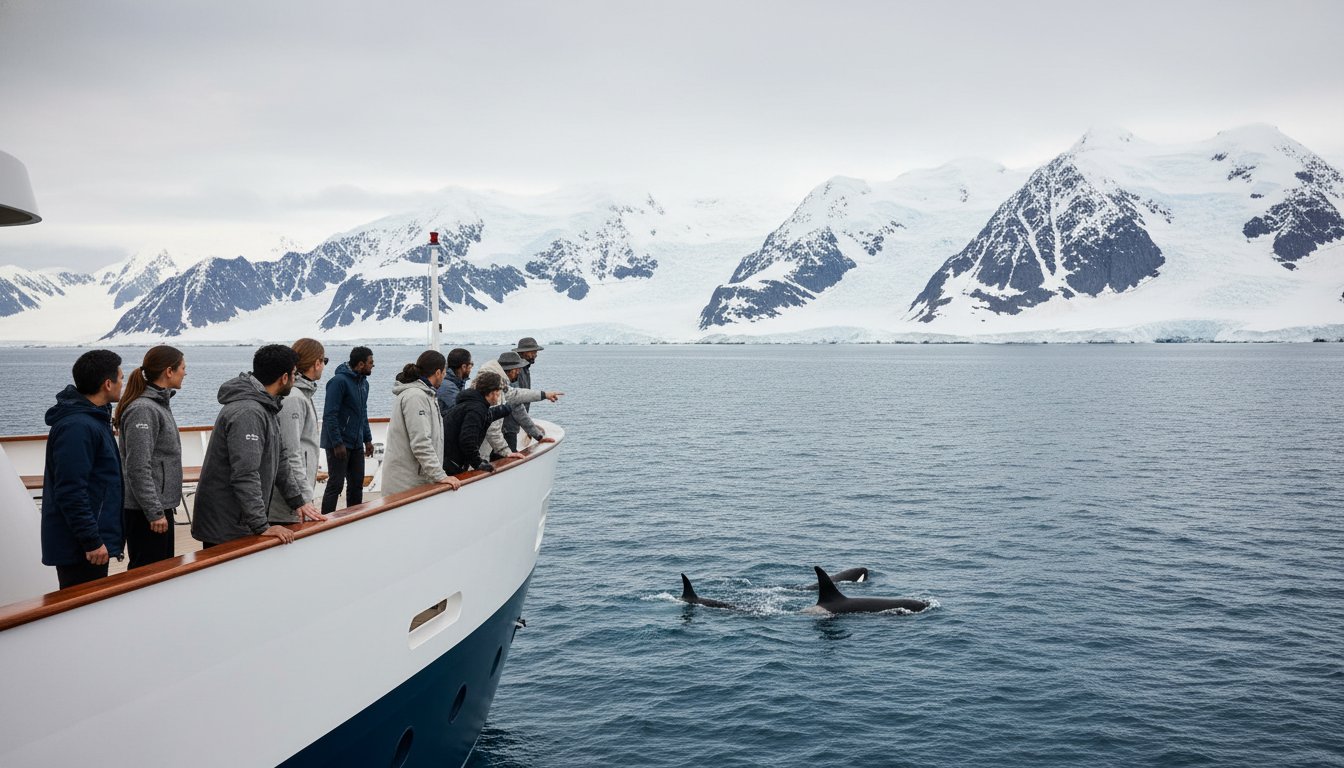
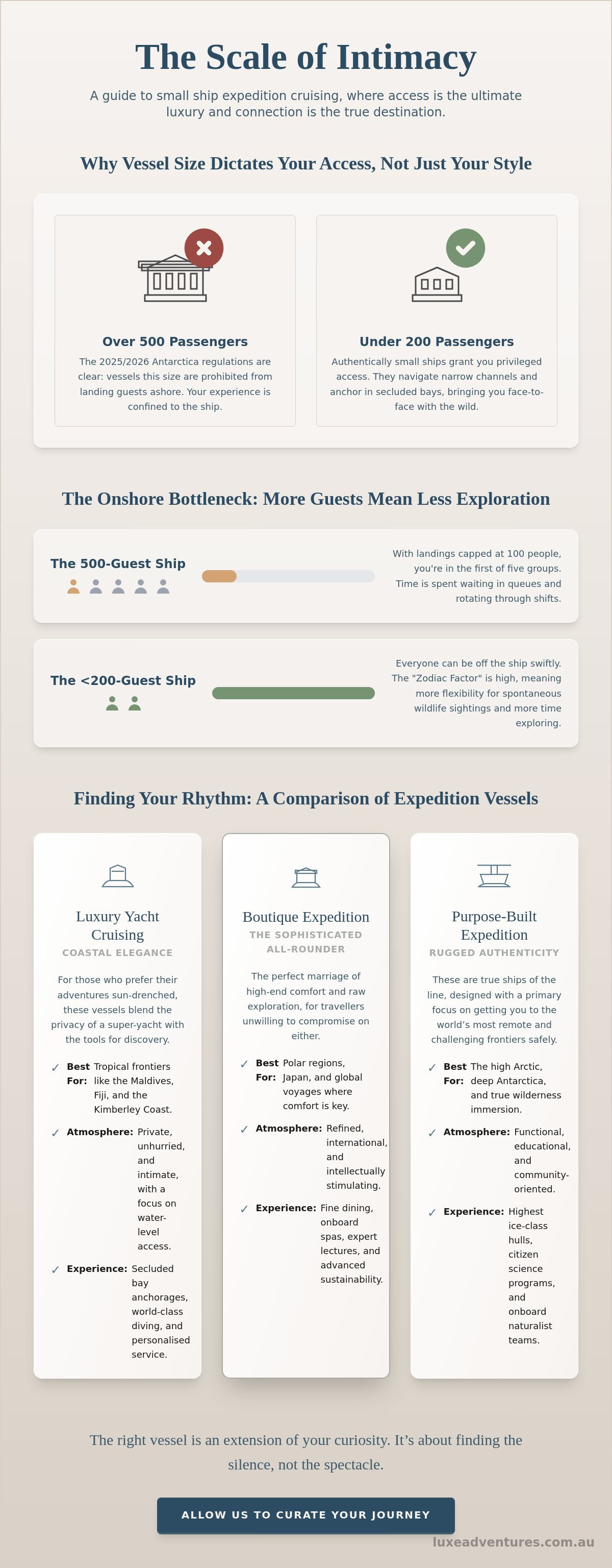
Why do we call it an expedition when you're sharing the shoreline with five hundred other strangers? Intimacy isn't found in the scale of a vessel, but in the silence it allows you to hear. You've likely felt that prickle of scepticism when "luxury" is used to mask a crowded itinerary. It's exhausting to decode technical ice classes just to ensure you won't be stuck in a queue when orcas appear. For the 2025/2026 season, regulations dictate that ships with more than 500 passengers cannot land guests in Antarctica at all; choice of vessel is now a matter of access, not just taste.
We believe the right small ship expedition cruises should feel like a private invitation to the world's fragile edges. This guide moves beyond the marketing gloss to explain how curation transforms a voyage into a connection with the wild. We'll provide a framework to differentiate ship styles, ensuring your vessel matches your personal rhythm and grants you entry to truly remote frontiers.
Key Takeaways
- Understand why passenger count is the ultimate arbiter of access, especially under strict 2026 landing regulations in fragile environments like Antarctica.
- Differentiate between yacht-style, purpose-built expedition, and boutique vessels to find the specific scale that suits your desired pace.
- Compare active adventure and intellectual expedition philosophies to ensure the onboard specialists match your personal style of exploration.
- Learn how the intentional curation of small ship expedition cruises transforms a standard voyage into a deeply personal connection with the wild.
- Discover the value of personal validation from a travel designer who prioritises destination texture and authentic immersion over superficial features.
Defining Small Ship Expedition Cruising: Beyond the Mainstream
Small ship expedition cruises are not merely smaller versions of their mega-ship cousins; they are an entirely different species of travel. While the mainstream industry builds floating cities that isolate guests from the ocean, an expedition vessel is designed to bring you into direct conversation with it. This is the essence of soft adventure. It is the marriage of high-end comfort with the visceral, unpredictable beauty of the wild. In the Arctic or the Amazon, the primary currency is not the variety of onboard buffets, but access. It is the ability to anchor in a shallow cove where a 3,000-passenger ship wouldn't dare to venture. This is quiet luxury in its most authentic form, where the value is found in the stillness of a remote fjord rather than the noise of a crowded atrium.
The Threshold of Intimacy: What "Small" Actually Means
The travel industry uses the word small loosely. A ship with 500 guests is technically small by modern standards, but it faces significant operational hurdles in remote regions. For instance, current regulations in fragile environments often limit the number of people allowed ashore at any one time to just 100. On a 500-guest ship, you are rotating through shifts, often spending more time waiting than exploring. Authentically small vessels, those carrying fewer than 200 guests, offer a different rhythm. Here, the guest-to-guide ratio is lower, and the "Zodiac Factor", which is the speed at which everyone can be off the ship and into the water, becomes the defining metric of your day. This category of Adventure travel prioritises your time on the ice or in the rainforest over time spent in a queue.
Refined by Experience: The Shift from Sightseeing to Immersion
We have moved past the era of the simple photo-stop. Discerning travellers now seek meaningful engagement, whether that is participating in citizen science projects in the Svalbard archipelago or engaging in deep cultural exchanges in the South Pacific. On these ships, the destination is the primary entertainment. There are no Broadway shows, only the sound of calving glaciers and the insights of onboard naturalists. Navigating these nuanced definitions requires a bespoke travel designer who understands that the right vessel is the one that aligns with your specific curiosity. It is about depth over noise, and luxury that is defined by connection rather than pretension.
The Scale of Intimacy: Comparing Yacht-Style, Expedition, and Boutique Vessels
Choosing between small ship expedition cruises is less about finding a generic "best" vessel and more about identifying the rhythm that matches your own. The physical texture of these ships varies significantly, from the rugged, reinforced hulls of ice-breakers designed to crunch through polar floes to the sleek, low-profile super-yachts that slip into Mediterranean coves. While a larger ship offers anonymity, these smaller vessels offer a sense of community. You aren't just a cabin number; you are part of a curated group of explorers. To connect with others who share these values and find the right companions for your journey, you can discover Nomadipity.com. The fear of boredom, often cited by those used to the frantic pace of mega-ships, is replaced here by a purposeful daily program. Your time is filled with spontaneous wildlife sightings, expert-led briefings, and the quiet luxury of reflection.
This sense of community and specialized focus is also a hallmark of niche European travel, where Bike Planet Tours creates immersive experiences by combining cycling with small barge accommodation, mirroring the expedition ethos of meaningful engagement with the landscape.
Boutique Expedition Ships: The All-Rounders
Vessels operated by lines such as Ponant or Seabourn represent the bridge between traditional luxury and raw exploration. These ships are built for those who value a fine degustation and a well-appointed spa as much as a morning spent navigating ice. The social dynamic is sophisticated and international. It attracts guests who are as comfortable discussing global history over dinner as they are donning a dry suit for a polar plunge. These operators often take a lead on sustainability, utilising advanced propulsion and waste management systems to protect the fragile environments they visit.
Luxury Yacht Cruising: Coastal Elegance
In tropical frontiers like the Maldives, Fiji, or the Indonesian archipelago, the expedition takes on a different texture. Here, the focus shifts to water-level access and restorative rhythms. These yachts prioritise secluded bay anchorages and world-class scuba diving. The atmosphere is private and unhurried. You might spend an afternoon paddleboarding in a silent lagoon or visiting a remote village where the only entry is by sea. It is a deeply personal way to travel, where the itinerary can often shift to follow a pod of dolphins or a spectacular sunset.
Specialist Expedition Vessels: The Deep Divers
For the modern explorer, ships from Swan Hellenic offer a journey rooted in scientific legacy. These vessels are designed for serious depth, often featuring "Citizen Science" labs where you can engage directly with researchers on board. These specialised small ship expedition cruises prioritisation destination immersion over extensive spa menus. They are for the traveller who wants to understand the "why" behind the landscape. If you are unsure which of these styles aligns with your next journey, you might find it helpful to speak with a specialist who has walked these decks personally.
Adventure vs. Education: Navigating Different Expedition Philosophies
Beyond the technical tonnage and ice ratings, the soul of small ship expedition cruises lies in their underlying philosophy. Every operator approaches the wild through a different lens. Some view the landscape as a grand, natural gymnasium for the body, while others see it as a living library for the mind. Choosing the right voyage requires you to look past the thread count of the linens and ask how the journey will actually feel at 4:00 PM on a Tuesday. Will you be drying off after a brief, icy reintroduction to your own nervous system during a Polar Plunge, or will you be huddled in the lounge with a glass of Pinot Noir, discussing the geopolitical history of the Northwest Passage with a former diplomat?
The Active Frontier: For the Restless Soul
The active adventure model is designed for those who find stillness through movement. It is for the traveller who wants to feel the spray of the Southern Ocean on their face rather than watch it through a panoramic window. These voyages prioritise physical connection. You might find yourself sea kayaking through brash ice, snowshoeing across a pristine Antarctic ridge, or scuba diving in remote reefs where few humans have ever descended. The luxury here is found in the craftsmanship of the hand-picked gear and the quiet confidence of expert-led safety protocols. It is a visceral, tactile way to engage with the planet that leaves little room for the superficial.
The Intellectual Frontier: For the Curious Mind
Conversely, the intellectual expedition model treats the destination as a subject for deep study. Here, the onboard team is not just there for safety; they are the architects of your understanding. World-class lecture series and intimate recaps transform a pretty landscape into a profound narrative. You aren't just looking at a glacier; you are learning about the specific geological pressures that formed it over millennia. This is the luxury of time. It is the unhurried observation of a polar bear’s gait or the nuanced history of a remote Arctic settlement. It is travel refined by experience and defined by the depth of your connection to the story being told.
Regardless of the model, the thread that binds these experiences is stewardship. We avoid the hollow buzzwords of eco-tourism in favour of a more grounded reality. These ships act as platforms for conservation, often hosting scientists who conduct vital research while you watch. By being a guest in these fragile homes, you are supporting the very experts who work to protect them. Whether you are holding a lens during a guided photography workshop or a paddle in a silent fjord, you are participating in a masterclass of intentional exploration.
Choosing Your Frontier: Mapping the Premier Expedition Regions
Selecting the right frontier is a matter of matching your internal compass to the external landscape. For some, the draw of a luxury African safari offers the definitive land-based immersion, yet there are textures of the world that can only be felt from the water. Modern small ship expedition cruises specialise in these otherwise unreachable corners, where the air smells of ancient ice or tropical salt. For 2026, the global map of exploration is defined by a shift toward deeper regional immersion, moving past the checklist and into the heart of the destination's emotional resonance.
The Polar Greats: Antarctica and the Arctic
The Antarctic is an investment of awe. It is a landscape defined by a silence so profound it becomes a sound in itself, broken only by the occasional crack of a calving glacier. The sensory impact of the ice, with its infinite shades of blue and white, creates a feeling of profound isolation. In contrast, the Arctic feels like a discovery. It is a region of life and light, bathed in the amber glow of the Midnight Sun. While the South is about the raw expedition feel of a frozen continent, the North is about the search for the elusive polar bear and the vibrant colours of tundra wildflowers, set against the backdrop of resilient Inuit cultures.
The Tropical Frontiers: Amazon, Galapagos, and Oceania
The Galapagos remains a naturalist’s masterclass, a place where evolutionary history sits unbothered on volcanic rocks. Every landing is a lesson in adaptation, observed with an intimacy that larger ships simply cannot facilitate. In the Amazon, you feel the pulse of the rainforest from the refined sanctuary of a luxury river vessel, where the sounds of the canopy provide a constant, rhythmic soundtrack. Meanwhile, the frontiers of Oceania, particularly in Fiji and Indonesia, offer a restorative blend of private island bliss and world-class diving. These regions are best experienced via small vessels that can navigate the intricate coral systems and anchor in silent, turquoise lagoons.
Ancient Frontiers: The Kimberley and Beyond
The Kimberley represents an ancient frontier that defies land-based travel. Its rugged coastline, carved by massive tidal power and home to 50,000-year-old rock art, is only truly accessible by sea. Choosing small ship expedition cruises for this region allows you to witness the Horizontal Falls or the red-rock majesty of the King George River without the noise of the modern world. It is the luxury of space, where the raw beauty of the Australian outback meets the sea in a spectacular display of tidal waterfalls and ancient geological formations. Ready to map your own journey? Enquire about our 2026 expedition departures here.
The Curation Factor: Why a Luxury Travel Designer Defines the Journey
In an era where digital aggregators offer an overwhelming sea of choice, the true luxury is the filter. Booking engines provide data points, but they lack the discernment to tell you if a ship's atmosphere feels like a rigorous academic seminar or a high-end social club. This is where the distinction between a booking agent and a travel designer becomes vital. One manages a transaction; the other curates a future. When planning small ship expedition cruises, the technical specs of a vessel are merely the starting point. The real work lies in the personal validation that comes from having walked those decks, met the expedition leaders, and understood the nuanced difference between a "luxury" label and a truly refined experience.
Refined by Experience: The Rachel Cleary Perspective
Rachel Cleary personally researches the itineraries we recommend, ensuring they meet a standard that goes beyond the generic marketing gloss. This isn't about following a brochure's hype; it's about identifying the destination texture that matches your specific rhythm. There's a certain dry humour in seeing a ship marketed as "ultra-luxury" only to find it has the soul of a well-appointed dental clinic. We look for the character of the vessel. We prioritise hand-picked journeys that avoid the predictable tourist traps, ensuring your encounter with the wild is as authentic as it is comfortable. Matching the "vibe" of a ship to the personality of the traveller is an art form that requires direct immersion and a life spent exploring.
The Virtuoso Edge: Value Beyond the Price Tag
As a Virtuoso member and CLIA Master, we provide access to a layer of "quiet luxury" that remains invisible to the general public. These aren't just industry titles; they are keys to a suite of tangible benefits that enhance the journey. These perks often include complimentary breakfasts, significant shipboard credits, and invitations to private events that feel like a natural extension of your voyage rather than a promotional add-on. This expertise is particularly critical for small ship expedition cruises, where the logistics are complex and the environments are unforgiving. Having a seasoned architect behind your itinerary offers a level of peace of mind that no self-service portal can replicate.
The planning process is a collaboration, a shared shaping of an experience that will stay with you long after you've returned home. It's about depth over noise. We ensure that your chosen vessel isn't just a way to travel, but a catalyst for a profound connection with the world. By prioritising substance over superficiality, we transform a simple holiday into a meaningful journey, refined by experience and defined by the quality of the connection you make with the wild.
Designing Your Path to the Remote
The true value of an expedition lies in the moments between the scheduled landings. It's found in the sudden hush of a zodiac engine as a whale surfaces, or the shared insight of a historian after a day spent in an ancient village. We've seen how the scale of a vessel determines your level of access, and how a ship’s underlying philosophy dictates whether your journey is one of physical challenge or intellectual depth. Choosing correctly is the difference between being a spectator and becoming a participant in the landscape.
Navigating the complexities of small ship expedition cruises is a craft we've refined through years of direct immersion. As an Australian-owned bespoke travel design studio, we offer more than just a booking. We provide the personal validation of a CLIA Master and Virtuoso Member who's personally vetted these global frontiers. The future of your exploration should be as intentional as the destinations themselves.
Begin your journey with a curated consultation from Luxe Adventures. Your next great connection with the wild is waiting to be designed.
Refining the Details: Frequently Asked Questions
What is the difference between an adventure cruise and an expedition cruise?
Expedition cruises are defined by their destination-first approach and the presence of a specialised expedition team. While adventure cruises might focus on coastal activities like kayaking in established ports, an expedition is about reaching remote, often uncharted frontiers where the ship's schedule is dictated by ice, weather, and wildlife. These voyages involve purpose-built vessels with ice-strengthened hulls and a heavy emphasis on education and field research.
How many passengers are typically on a small ship expedition cruise?
True small ship expedition cruises typically carry between 100 and 200 guests. This specific scale is critical for operational flexibility and environmental compliance. In Antarctica, for example, regulations limit the number of people on shore to 100 at any single time. Keeping the guest count low ensures you spend your time exploring the landscape rather than waiting in a rotation queue on the ship.
Do I need to be physically fit for an expedition cruise to Antarctica or the Arctic?
You don't need to be an athlete, but reasonable mobility is essential for safe Zodiac embarkation and disembarkation. Most landings involve stepping from a moving rubber boat onto a rocky shore or a slippery ice floe. While onboard teams are highly skilled at assisting guests, being comfortable with uneven terrain and short walks will significantly enhance your experience in these rugged environments.
What kind of clothing should I pack for a luxury polar expedition?
The key is a sophisticated layering system combined with high-performance waterproof gear. Most luxury operators provide a complimentary, high-quality expedition parka, but you will need moisture-wicking base layers and waterproof trousers. Onboard, the dress code is generally "expedition chic", which is relaxed yet refined. There's no need for formal wear; comfort and warmth take precedence when you're navigating polar latitudes.
Are small ship cruises suitable for families with children?
Expedition cruising is best suited for older, intellectually curious children rather than young toddlers. Many vessels have a minimum age requirement, often starting at six or eight years old, due to the safety requirements of Zodiac operations. For teenagers, these voyages are a masterclass in natural history and conservation, providing a far more meaningful connection to the planet than a traditional resort holiday.
How far in advance should I book a small ship expedition for 2026?
We recommend booking your 2026 expedition at least 12 to 18 months in advance. Because these ships are small and highly sought after, the most desirable suites and specific itineraries sell out quickly. Early booking also allows us to secure preferred airfares and ensure all technical requirements, such as medical forms and specialised gear sizing, are handled with unhurried precision.
What are the benefits of booking through a Virtuoso travel designer?
Booking through a Virtuoso travel designer provides you with a layer of quiet luxury and vetted quality. You gain access to unlisted perks such as shipboard credits, private shore events, and complimentary breakfasts that aren't available through standard booking channels. Most importantly, it means your journey is architected by someone who has personally researched the vessel and understands the nuanced vibe of the onboard experience.
How does expedition cruising impact the environment and local communities?
Modern expedition cruising prioritises stewardship and a minimal physical footprint. These vessels often serve as platforms for vital scientific research, hosting researchers who conduct field studies while you watch. By choosing small ship expedition cruises, you ensure that landings are managed responsibly, avoiding the strain that large-scale tourism places on fragile ecosystems and remote local communities. It is travel defined by respect and conservation.

Article by
Rachel Cleary
Rachel Cleary is the founder of Luxe Adventures and an endlessly curious explorer with a passion for meaningful, experience-led travel. Having visited every continent and travelled to more than 100 countries — and counting — she believes travel is one of the greatest educations for both children and adults alike.
Rachel is addicted to scuba diving and gets underwater at every opportunity. When she isn't in the office you'll find her exploring remote reefs in Fiji, drift diving in the Maldives, or scuba cruising Raja Ampat or French Polynesia.
Her second home is Fiji where she has explored all the island groups and has favourite boutique resorts she returns to every year, for the diving and the authentic Fijian hospitality.
Get her talking about kayaking in Antarctica or the Arctic, African safaris and where to find the highest density of big cats, underwater adventures, remote expedition destinations, or the science and magic behind the Northern Lights — including when and where they are most likely to dance — and you may be there a while.
Through Luxe Adventures, Rachel combines firsthand experience, global industry connections, and a deep appreciation for nature, culture, food, wildlife, and human connection to help curious travellers explore the world in a way that feels seamless, personal, and unforgettable.
Refined by experience. Defined by connection.
Disclaimer
The information in this article is intended as general travel inspiration and guidance only. Travel requirements, hotel standards, airline schedules, entry regulations, weather conditions, pricing, and experiences can change without notice.
While every effort is made to ensure accuracy at the time of publishing, Luxe Adventures recommends confirming all details relevant to your personal travel plans before booking or travelling.
Opinions, recommendations, and destination insights shared in this article are based on firsthand experience, industry knowledge, and research at the time of writing. Experiences may vary depending on season, supplier changes, local conditions, and individual travel preferences.
Some articles may reference luxury travel affiliations, preferred partner programs, or value-added amenities available through Luxe Adventures. Benefits and inclusions are always subject to availability and supplier terms at the time of booking.
Luxe Adventures strongly recommends comprehensive travel insurance for all international travel.
For personalised travel advice, tailored itinerary design, or the latest destination updates, please contact Luxe Adventures directly.


