
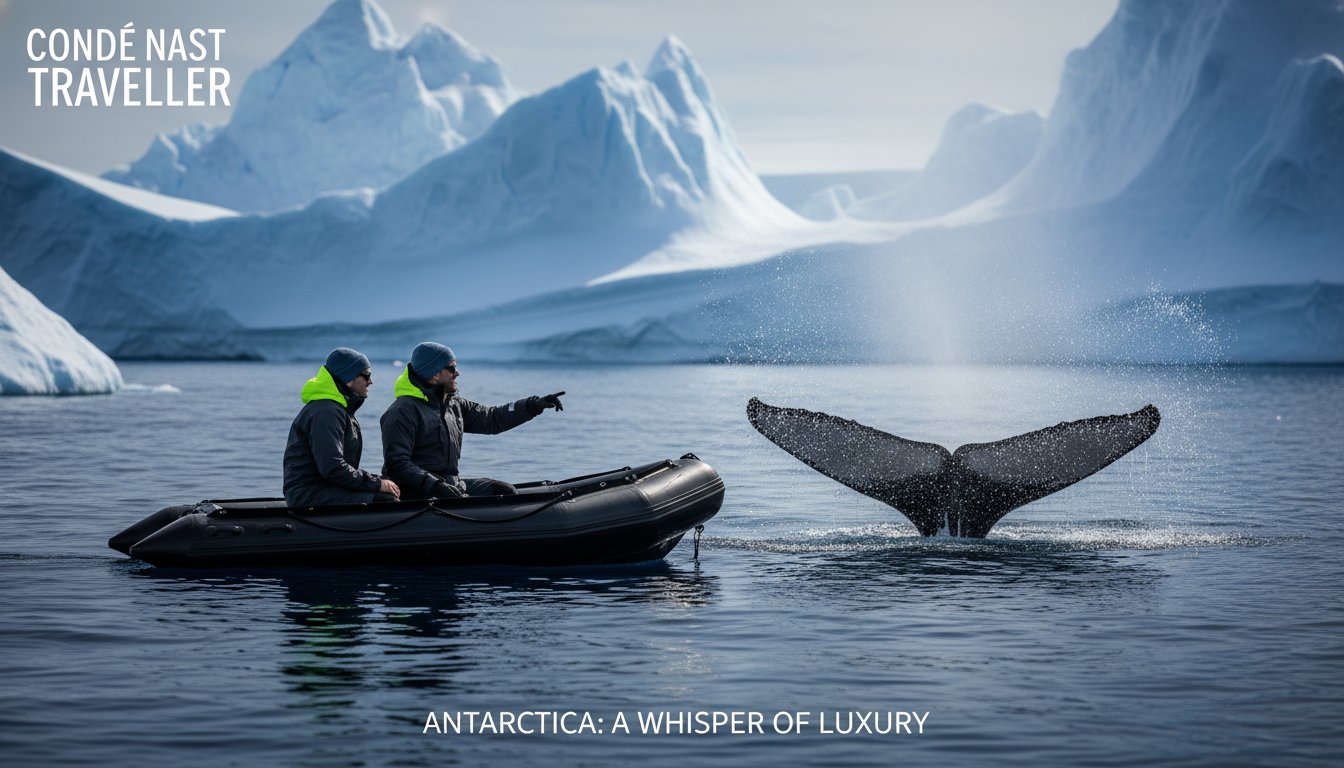
The most profound moments in the Southern Ocean aren't found through a high-powered zoom lens. They are found in the low-frequency vibration of a leopard seal’s hum against the hull of a Zodiac. For the discerning traveller, Antarctica wildlife viewing is not a spectator sport; it's an intimate, sensory dialogue with a wilderness that remains entirely indifferent to our presence.
You likely already suspect that the most authentic encounters don't happen from the glassed-in lounge of a thousand-passenger liner. You want to feel the cold mist of a whale's blow and witness the frantic energy of a penguin colony without the distraction of a crowd or the feeling of being caught in a tourist trap. It’s about finding that balance between refined comfort and the raw, unscripted reality of the ice.
In this guide, Luxe Adventures will share the expertise gained from years of researching these expeditions to help you understand the nuanced seasonal cycles of the Great White Continent. We will look at how to choose an itinerary that aligns with your specific interests, ensuring your journey is defined by deep connection and ethical stewardship rather than just distance travelled.
Key Takeaways
- Learn why the true depth of the Southern Ocean is found in sensory details, from the sharp crack of ancient ice to the resonant, low-frequency hum of a leopard seal.
- Identify the distinct personalities of the region's most iconic residents, including the difference between the regal Emperor and the comedic Gentoo penguins.
- Curate your ideal itinerary by understanding the geographic nuances of antarctica wildlife viewing, contrasting the dramatic Peninsula with the immense king penguin colonies of South Georgia.
- Master the seasonal rhythm of the Antarctic summer to time your journey for specific wildlife behaviours, from early-season courtship to late-season whale sightings.
- Discover why selecting a vessel with fewer than 200 passengers is the most critical factor in ensuring intimate, unscripted encounters without the distraction of crowds.
Beyond the Lens: The Sensory Reality of Antarctica Wildlife Viewing
To truly understand antarctica wildlife viewing, one must first abandon the notion of being a spectator. On the White Continent, you don't just watch; you are absorbed into a landscape where nature is entirely unscripted and indifferent to your arrival. It's a place where the air feels sterile, almost impossibly crisp, and the silence is so heavy it has a texture of its own. This profound quiet is only ever broken by the sharp, gunshot-like crack of a calving glacier or the rhythmic, misty huff of a humpback whale surfacing nearby.
The misconception many travellers hold is that wildlife encounters are distant or clinical. In reality, closeness in Antarctica is defined by the animal's own curiosity. Because these creatures have no terrestrial predators, they often lack the fear found in other wilderness areas. Whether you are sitting on a pebble beach or drifting in a Zodiac, the most memorable moments occur when a curious penguin chick pecks at your boot or a minke whale chooses to spy-hop alongside your boat. These small-boat excursions are the vital bridge to intimacy, allowing for a perspective that is impossible from the elevated decks of a large ship.
The Atmosphere of the Great White Continent
The visual scale here is often disorienting. You might find yourself watching a colony of Adélie penguins, their small frames silhouetted against icebergs the size of cathedrals. It's a study in contrasts. While the scenery is grand, the experience is often found in the minute details: the smell of a penguin rookery (which is far more pungent than photos suggest) or the crystalline sound of "bergy bits" fizzing as they melt. This is why we advocate for slow travel. It's only by lingering in a single bay that you witness the spontaneous drama of a leopard seal on the hunt or the intricate social rituals of a nesting colony. For a broader look at the species you might encounter, the Wildlife of Antarctica provides an excellent scientific foundation for the diversity of this ecosystem.
The Role of the Expedition Naturalist
A sighting only becomes a story through the lens of expertise. On a curated expedition, your naturalist isn't just a guide; they are a bridge between the visual and the intellectual. They explain why a certain whale is breaching or the complex migratory path an albatross has taken to reach your ship. These insights are often distilled during evening recaps, where the day’s raw experiences are contextualised. It transforms a simple photograph into a deep understanding of the delicate balance required for life to persist in the world's harshest climate. This expert interpretation adds a layer of intellectual depth that ensures your journey is as much about learning as it is about observation.
The Southern Ocean Cast: Identifying Antarctica’s Iconic Residents
Antarctica isn't merely a backdrop; it's a theatre where the "Big Five" of the Southern Ocean-Penguins, Whales, Seals, Orcas, and Albatross-perform a daily drama of survival. While many destinations offer glimpses of wildlife, antarctica wildlife viewing is defined by the sheer density and lack of fear exhibited by the residents. These animals don't just exist in the landscape; they dominate it, often approaching visitors with a level of curiosity that feels both humbling and deeply personal.
The cast is diverse, ranging from the regal Emperor penguin to the sleek, reptilian-looking leopard seal. Each encounter offers a different emotional texture. Witnessing a humpback whale's fluke break the surface is a lesson in quiet power, while watching a colony of penguins go about their business is an exercise in observational wit. For those who value scientific depth alongside visual beauty, the British Antarctic Survey offers extensive research into how these species have adapted to thrive in such an unforgiving environment.
Penguins: The Heartbeat of the Peninsula
The Antarctic Peninsula is home to the three "brush-tail" species: the Adélie, the Chinstrap, and the Gentoo. Gentoos are the comedians of the ice, often seen stumbling over pebbles or engaging in frantic nest-building. In contrast, the Adélie possesses a classic, understated elegance, while the Chinstrap is easily identified by the narrow band of black feathers under its chin. The "regal" Emperor penguin remains the most elusive prize, typically requiring specialised expedition cruising routes that venture deep into the Weddell Sea or the Ross Sea. Regardless of the species, the golden rule of the ice is simple: always give way on the "penguin highways," the well-trodden paths these birds use to commute between the sea and their rookeries.
Whales and Seals: Giants of the Deep and Ice
As the summer progresses, the nutrient-rich waters draw back the great cetaceans. Humpback and Minke whales are the most frequent visitors, often displaying a playful interest in Zodiacs. There is nothing quite like the sound of a whale’s blow echoing in a silent bay. On the ice floes, you'll find a contrast in temperament. The Weddell seal appears perpetually docile, often found dozing in the sun with a look of serene contentment. However, the leopard seal is a different creature entirely-a formidable, apex predator of the pack ice with a sleek, powerful frame. Further north, the beaches of South Georgia offer a sensory (and incredibly noisy) highlight: the massive colonies of Elephant seals, where the sheer volume of sound and movement is unlike anything else on Earth. If you're ready to curate your own encounter with these icons, connect with us to design your journey.
Geographic Curation: Where to Witness the Most Prolific Encounters
Deciding where to point the bow of your vessel is the first act of curation in any expedition. While the entire region is teeming with life, the specific texture of your antarctica wildlife viewing experience depends heavily on your chosen latitude. The Antarctic Peninsula offers the iconic aesthetic of cathedral-like ice and bustling colonies; however, the sub-Antarctic islands provide a level of biological density that can only be described as overwhelming. For those seeking the ultimate in isolation, the Ross Sea remains the 'Silent Frontier,' a remote expanse where the wildlife encounters are as rare as they are profound.
The Antarctic Peninsula: The Classic Expedition
For the first-time visitor, the Peninsula is the definitive choice. It delivers the quintessential Antarctic tableau: deep blue channels, towering glaciers, and the constant activity of Gentoo penguin colonies. Navigating the Lemaire Channel is often a highlight, where the steep cliffs reflect in still waters and humpback whales frequently surface within metres of the ship. This region provides an accessible entry point into the continent's ecosystem, blending dramatic scenery with reliable sightings. If you are departing from our side of the world, our guide to an Antarctica cruise from Australia offers a deeper look at the logistics of reaching these icy shores.
South Georgia: The Serengeti of the Southern Ocean
If your priority is sheer volume, South Georgia is non-negotiable. Often called the Serengeti of the Southern Ocean, places like Salisbury Plain and St Andrews Bay offer a visual impact that defies description. Imagine a single frame containing over 200,000 King penguins; the sound and scent are as much a part of the experience as the sight itself. There is also a poignant historical layer here. You'll see fur seals and penguins reclaiming the rusted remains of former whaling stations, a powerful testament to the resilience of nature. It’s a place where the wildlife doesn't just inhabit the land; it owns it.
The Falkland Islands offer a softer, more pastoral contrast. Here, the focus shifts to unique birdlife, including the spirited Rockhopper penguin and the majestic Black-browed albatross. Combining these destinations into a single itinerary allows for a comprehensive understanding of the Southern Ocean’s biological diversity. Each location serves a different purpose, whether you seek the quiet majesty of the ice or the chaotic energy of a million nesting birds.
The Seasonal Rhythm: Timing Your Expedition for Specific Behaviours
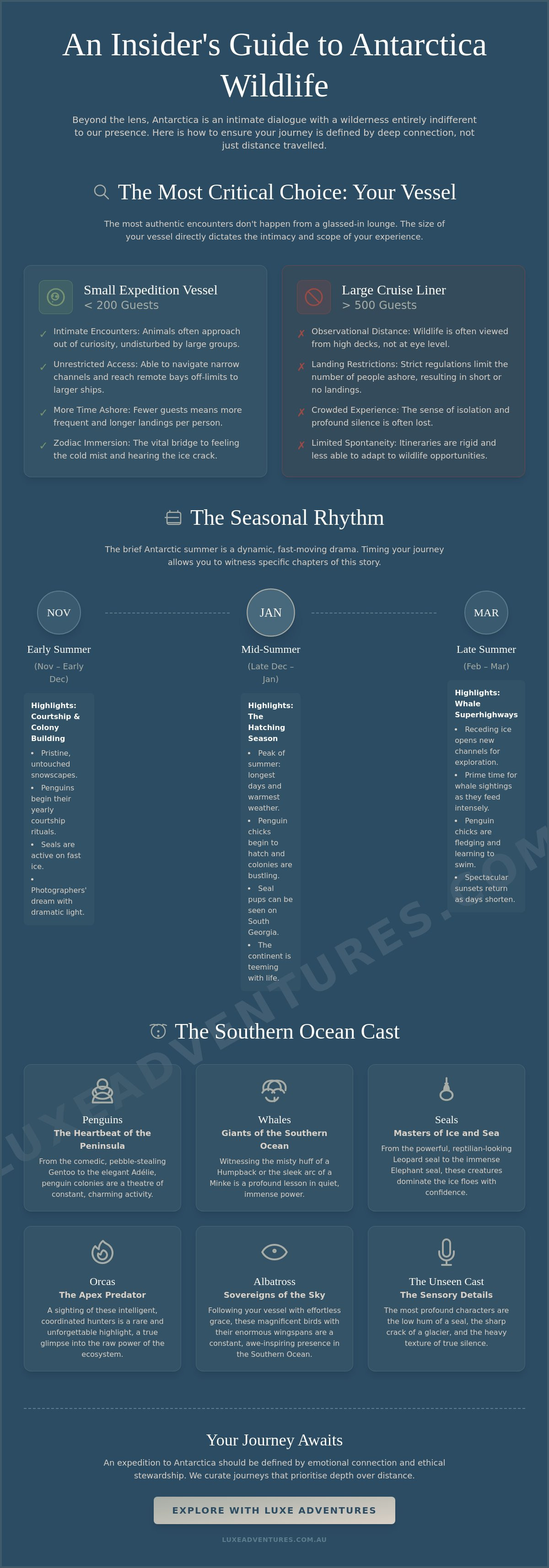
Antarctica is not a static destination; it is a rapidly evolving drama that unfolds over a brief, intense five-month window. Because the environment shifts so dramatically between November and March, the "best" time for antarctica wildlife viewing depends entirely on which act of this natural play you wish to witness. A week’s difference in your departure date can mean the contrast between seeing pristine, untouched snowscapes and witnessing the frantic, muddy chaos of a thousand hungry penguin chicks.
Understanding these subtle shifts allows for a more intentional approach to your journey. While the mid-summer peak offers the most daylight, the shoulder months often provide the most evocative light and specific animal interactions that the casual tourist might overlook. It is a cycle defined by the sun, where every month offers a different sensory texture and a unique set of biological milestones.
Early Season: The Romance of the Ice
November is the period of greatest landscape purity. During this "Pristine" phase, the continent is at its most photogenic; the snow is brilliant white, and the ice floes are large and sculptural. This is the season of courtship and anticipation. You'll witness Adélie and Gentoo penguins fastidiously building pebble nests and engaging in elaborate bowing rituals. On the beaches of South Georgia and the South Shetland Islands, massive southern elephant seal bulls engage in thunderous territorial battles, a raw display of power that defines the early season. For the traveller who values the "clean" aesthetic of the ice alongside these dramatic social beginnings, this is an incomparable time to visit.
Late Season: The Cetacean Celebration
By February and March, the narrative shifts from the land to the sea. This is the connoisseur's choice for whale enthusiasts. As the pack ice retreats, nutrient-rich waters become a banquet for humpback, minke, and orca. The whales are often at their most curious during these months, frequently approaching Zodiacs for close-range encounters. The light also changes beautifully; as the 24-hour sun begins to set again, the horizon is painted in long shadows and deep pinks that enhance the dramatic scale of the glaciers.
On land, the rookeries reach a state of productive chaos. Penguin chicks have grown into "teenagers," beginning to moult their grey down and taking their first tentative, often comedic, steps into the freezing surf. It is a period of transition and high energy, where the urgency of the coming winter is palpable in every interaction. If you have a specific wildlife behaviour you are dreaming of witnessing, ask us to help you time your expedition perfectly.
Designing the Encounter: Why the Vessel is Your Most Critical Wildlife Tool
The platform you choose to inhabit is the single most influential factor in the quality of your antarctica wildlife viewing. It is the difference between watching a pod of orcas through binoculars from a crowded promenade and being close enough to hear the resonant whistle of their blow. In these waters, the ship isn't merely transport; it is your mobile observatory, your base for exploration, and the primary tool that determines how much time you actually spend on the ice versus waiting your turn in a lounge.
Modern expedition ships have evolved far beyond the converted research vessels of the past. Technical advancements like dynamic positioning allow a captain to hover the vessel near a feeding whale pod without dropping anchor, protecting the delicate seabed while maintaining a stable view. The inverted X-bow design, now a hallmark of the most refined fleets, doesn't just provide a smoother crossing of the Drake Passage; it allows for a much closer, over-the-water perspective from the bow, bringing you into the immediate environment of the Southern Ocean.
The Small Ship Advantage: A Masterclass in Access
The "Intimacy Gap" is a reality dictated by strict IAATO regulations. These guidelines stipulate that only 100 people may be ashore at any given time. If you are on a ship with 400 passengers, your time on the ice is halved by a rotation system. This is why we almost exclusively recommend small ship expedition cruises with fewer than 200 guests. On these vessels, the schedule is dictated by the wildlife, not a rigid dining clock. If a blue whale is spotted during dessert, the ship stops, the Zodiacs are lowered, and the encounter begins. It’s a style of travel that feels more like a private club than a floating hotel, where the focus remains firmly on the unscripted world outside.
The Vetted Difference: Why Your Choice of Agent Matters
At Luxe Adventures, our approach is defined by connection and firsthand validation. We don't just book cabins; we vet the naturalist-to-guest ratios and the experience levels of the expedition leaders. We understand that a seasoned guide transforms a sighting into a profound educational moment. Through our Virtuoso affiliations, we also ensure that your journey is punctuated by quiet luxury, from room upgrades to bespoke shipboard credits, providing a refined sanctuary to return to after a day in the elements. We match your specific interests-whether it's photography, kayaking, or a particular species-to the ship and itinerary that will best deliver that outcome. To move beyond the generic and begin your curated Antarctic journey with a bespoke consultation, reach out to us today.
Curating Your Encounter with the Southern Ocean
The Southern Ocean is a landscape that demands intentionality. We've explored how antarctica wildlife viewing is defined by the sensory depth of the encounter, from the rhythmic huff of a surfacing whale to the chaotic energy of a summer rookery. Success in this wilderness is rarely accidental; it's the result of precise geographic curation and a deep understanding of the seasonal rhythms that govern the ice.
Choosing the right vessel remains the final, critical step in bridging the gap between distant observation and true immersion. As a Virtuoso Master Cruise Specialist and CLIA Master certified expert, I've personally vetted the expedition vessels that prioritise guest-to-naturalist ratios and genuine environmental stewardship. We look beyond the surface to find the itineraries that offer substance, ensuring your journey is defined by connection rather than just distance travelled.
The ice is waiting, indifferent and magnificent. When you're ready to experience the continent through the lens of a seasoned specialist, Design your bespoke Antarctic wildlife expedition with Luxe Adventures. Let's ensure your journey to the South is as profound as the destination itself.
Frequently Asked Questions
What is the best month for Antarctica wildlife viewing?
The ideal timing depends on which chapter of the Antarctic summer you wish to witness. November offers the most sculptural ice and dramatic penguin courtship rituals. If you want to see fluffy chicks, January is peak hatching season. For those prioritising antarctica wildlife viewing involving whales, February and March are the connoisseur's choice as cetaceans return in vast numbers to feed before winter.
How close can you actually get to penguins in Antarctica?
Official IAATO guidelines require a five-metre buffer between you and the wildlife. However, penguins haven't read the rulebook. If you sit quietly and remain still, curious chicks will often approach you to peck at your boots or inspect your camera bag. These unscripted moments of connection are far more profound than any forced proximity, provided the animal initiates the contact.
Do I need a special camera for Antarctica wildlife photography?
While modern smartphones capture the grand scale of the glaciers, a mirrorless or DSLR camera with a telephoto lens is essential for detail. A lens reaching 300mm or 400mm allows you to capture intimate portraits without breaching the required five-metre distance. Ensure your gear is weather-sealed, as salt spray and fine snow are constant companions during Zodiac excursions.
Can you see polar bears in Antarctica?
No, polar bears are found exclusively in the Arctic of the Northern Hemisphere. Antarctica is the realm of penguins, seals, and whales. In fact, the name Antarctica comes from the Greek "Antarktikos," which literally translates to "opposite the bear." If you see a large white mammal on the ice here, it's likely a crabeater or Weddell seal, not a bear.
Is South Georgia worth the extra time on an Antarctica cruise?
South Georgia is absolutely worth the additional week if you value biological density. It is often described as the Serengeti of the Southern Ocean for good reason. Nowhere else on Earth can you stand on a beach surrounded by half a million King penguins and thousands of brawling elephant seals. It's a sensory overload that provides a scale of life simply not found on the Peninsula.
What wildlife can you see while crossing the Drake Passage?
The crossing is an exceptional time for pelagic birdwatching and spotting deep-sea cetaceans. You'll likely see the Wandering Albatross, which has the largest wingspan of any bird, following the ship's wake for hours. Keep a sharp eye out for hourglass dolphins and the distinctive blows of fin whales as the vessel nears the Antarctic Convergence, where nutrient-rich waters meet.
Are there any ethical guidelines for viewing wildlife in Antarctica?
All antarctica wildlife viewing is governed by strict IAATO protocols to protect this fragile ecosystem. You'll be required to decontaminate your boots before and after every landing to prevent the introduction of non-native species. The core philosophy is to remain a silent observer, ensuring your presence doesn't disrupt the natural behaviours or nesting cycles of the animals you've travelled so far to see.
What is the difference between a 'sighting' and an 'encounter'?
A sighting is a passive observation, often through binoculars or from a distance. An encounter is a sensory dialogue where the animal shows a reciprocal interest in your presence. It's the difference between seeing a humpback whale's fluke on the horizon and having that same whale choose to swim directly under your Zodiac, allowing you to feel the low-frequency vibration of its blow.

Article by
Rachel Cleary
Rachel Cleary is the founder of Luxe Adventures and an endlessly curious explorer with a passion for meaningful, experience-led travel. Having visited every continent and travelled to more than 100 countries — and counting — she believes travel is one of the greatest educations for both children and adults alike.
Rachel is addicted to scuba diving and gets underwater at every opportunity. When she isn't in the office you'll find her exploring remote reefs in Fiji, drift diving in the Maldives, or scuba cruising Raja Ampat or French Polynesia.
Her second home is Fiji where she has explored all the island groups and has favourite boutique resorts she returns to every year, for the diving and the authentic Fijian hospitality.
Get her talking about kayaking in Antarctica or the Arctic, African safaris and where to find the highest density of big cats, underwater adventures, remote expedition destinations, or the science and magic behind the Northern Lights — including when and where they are most likely to dance — and you may be there a while.
Through Luxe Adventures, Rachel combines firsthand experience, global industry connections, and a deep appreciation for nature, culture, food, wildlife, and human connection to help curious travellers explore the world in a way that feels seamless, personal, and unforgettable.
Refined by experience. Defined by connection.
Disclaimer
The information in this article is intended as general travel inspiration and guidance only. Travel requirements, hotel standards, airline schedules, entry regulations, weather conditions, pricing, and experiences can change without notice.
While every effort is made to ensure accuracy at the time of publishing, Luxe Adventures recommends confirming all details relevant to your personal travel plans before booking or travelling.
Opinions, recommendations, and destination insights shared in this article are based on firsthand experience, industry knowledge, and research at the time of writing. Experiences may vary depending on season, supplier changes, local conditions, and individual travel preferences.
Some articles may reference luxury travel affiliations, preferred partner programs, or value-added amenities available through Luxe Adventures. Benefits and inclusions are always subject to availability and supplier terms at the time of booking.
Luxe Adventures strongly recommends comprehensive travel insurance for all international travel.
For personalised travel advice, tailored itinerary design, or the latest destination updates, please contact Luxe Adventures directly.


