

What if the most important part of a northwest passage cruise itinerary is knowing what might change? The route may be carefully planned, but Arctic ice, weather and local conditions can reshape the day’s plans, including whether a landing goes ahead. That uncertainty is part of expedition travel, though it’s natural to want a clearer picture before choosing a voyage.
A typical journey traces a broad passage through Greenland and the Canadian Arctic Archipelago, but similar-looking maps can conceal very different experiences. Embarkation points, time ashore, wildlife opportunities and the balance between remote exploration and onboard comfort all vary by voyage. The itinerary is a framework, not a promise that every sailing will make identical calls.
Here, we’ll explain the broad geographic progression, distinguish planned elements from decisions guided by conditions, and explore what to consider when comparing routes. Luxe Adventures designs bespoke travel, including expedition cruises, with expert support to help you weigh the details that shape a journey. Whether you’re drawn by Inuit culture, Arctic wildlife or the quiet scale of the landscape, understanding how these voyages work can help you choose one that suits your interests and appetite for flexibility.
Key Takeaways
- Read a northwest passage cruise itinerary as a broad geographic plan, then compare the actual endpoints and calls for each sailing.
- Separate scheduled elements from decisions made by the expedition team in response to ice, weather and navigation.
- Compare voyages by cultural focus, embarkation logistics and appetite for flexibility, rather than by map alone.
- Use a simple planning sequence to assess route, dates, travel arrangements, inclusions and how much change to expect.
- Match the voyage to your interests, preferred pace and comfort needs, and consider how the wider journey can be shaped around it.
Northwest Passage cruise itinerary: the route through Arctic Canada
The Northwest Passage isn’t one neat channel marked across the Arctic. It’s a network of sea routes through the Canadian Arctic Archipelago, the islands and waterways north of mainland Canada. In short, the Northwest Passage is a group of possible routes through Arctic Canada, not a single guaranteed shipping lane.
That distinction matters when comparing a northwest passage cruise itinerary. Voyages may link Greenland with Arctic Canada, but their starting and finishing points, and the waters they explore between them, vary by sailing. The map gives you the broad geography; the individual itinerary tells you which version of the passage is planned. For a wider historical and geographic overview, see the Northwest Passage.
Where does a Northwest Passage cruise usually travel?
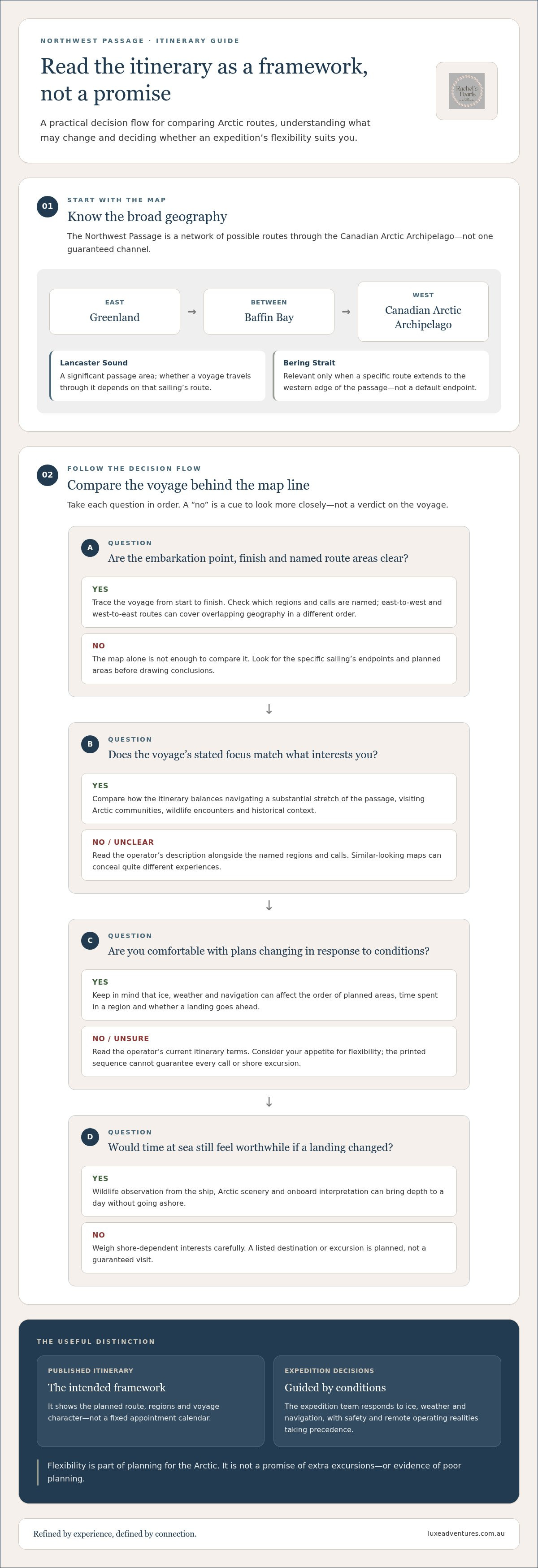
Begin with Greenland to the east, then locate Baffin Bay between Greenland and Canada. From there, the route enters the waterways of the Canadian Arctic Archipelago. Lancaster Sound is a significant passage area, but whether a particular voyage travels through it depends on that sailing’s route. Read the named regions and calls in the itinerary rather than assuming every voyage follows the same sequence.
To orient yourself, trace the planned journey from its embarkation point to its finish. An east-to-west voyage and a west-to-east voyage can cover overlapping Arctic geography while presenting it in a different order. The Bering Strait is relevant only when a specific route extends to the western edge of the passage; it isn’t a default endpoint for every cruise.
Why are there different Northwest Passage routes?
Start and finish points shape a voyage’s direction, geography and time available for exploration. An itinerary may place greater emphasis on navigating a substantial stretch of the passage, visiting Arctic communities, seeking wildlife encounters or exploring historical context. These priorities can overlap, but the balance differs from sailing to sailing.
When reading a route description, treat the sequence of regions as an orientation, not a promise of identical calls. Check which areas are named for the specific voyage and how its operator describes the focus. This gives you a more useful comparison than the line on a map, particularly in a region where the route’s character matters as much as its endpoints.
How Arctic conditions shape a Northwest Passage cruise itinerary
A published itinerary is the expedition’s intended framework, not a fixed appointment calendar. Ice, weather and navigational conditions can influence where a ship travels, how long it remains in an area and whether a shore visit goes ahead. The expedition team makes decisions during the voyage in response to conditions, with safety and the realities of operating in a remote region taking precedence over the printed sequence.
An Arctic itinerary can change because conditions shape what is possible, while the voyage’s wider purpose, exploring the Northwest Passage, remains the guiding thread. Flexibility isn’t evidence of poor planning. It’s part of planning for a place where conditions can’t be scheduled around a daily programme.
What may change from the published itinerary?
The order of planned areas may shift, a landing may be altered or missed, or the time spent in a region may differ from the schedule. These are possibilities, not predictions about any particular voyage. A listed destination or shore excursion shouldn’t be read as a guaranteed visit; expedition plans remain subject to conditions at sea and on shore.
Before booking, read the operator’s current itinerary terms alongside the route description. Look for how the operator explains changes, landings and scheduled activities. This helps set realistic expectations: the published plan shows the voyage’s intended character, but it can’t promise that every detail will unfold as printed.
What remains valuable when the route changes?
A day without a landing isn’t necessarily an empty day. Wildlife observation from the ship, Arctic scenery and onboard interpretation can all bring depth to time spent at sea. The view may be quiet and expansive, with light shifting over ice and water. The experience doesn’t always need to involve stepping ashore to feel connected to the region.
Expedition flexibility also allows the team to respond to conditions as they develop. That may mean adjusting plans rather than adding a substitute activity, so it’s best understood as a way to make considered decisions, not a promise of extra excursions. Luxe Adventures’ expertise in expedition cruising can help you distinguish an itinerary’s aspirations from its operational realities. For a thoughtful perspective on matching a voyage to your expectations, explore expedition cruise planning.
Compare Northwest Passage cruise itineraries by experience, not just map
Two routes can cross similar Arctic waters yet offer quite different journeys. To compare a northwest passage cruise itinerary, look beyond its line on a map: consider where you join and leave the ship, how the voyage describes its priorities, and how much of the experience depends on conditions. There’s no universally best route, only one whose character suits you better.
| Comparison point | What to look for | Why it matters |
|---|---|---|
| Route direction | Compare the stated start and finish points, the route outline and the time allocated to key regions. | Direction shapes the journey’s geographic progression. Similar regional names don’t necessarily mean the same route or emphasis. |
| Embarkation logistics | Note where the voyage begins and ends, and whether pre- or post-cruise arrangements feature in the wider travel plan. | Remote expedition travel involves more than the days at sea. The surrounding arrangements affect the pace and shape of the overall journey. |
| Cultural focus | Read how the operator describes community visits, cultural context, onboard experts and shore activities. | This helps distinguish an itinerary with a stated cultural emphasis from one whose description focuses elsewhere. Specific visits remain subject to the sailing’s plans and conditions. |
| Expedition flexibility | Review what the itinerary says about landings, planned activities and possible changes. | Compare the approach to adapting plans, rather than assuming a published stop or activity is guaranteed. |
Which itinerary details matter most when comparing voyages?
Start with the route outline and the time allocated to regions you most want to experience. Then look at how the operator describes landings, onboard expertise and shore activities. Separate stated inclusions from experiences that may depend on conditions. Finally, consider whether the wider plan accounts for travel before or after the cruise, rather than treating embarkation and disembarkation as minor details.
How do expedition and comfort priorities affect the choice?
Think about your preferred pace, appetite for activity and comfort with plans changing. A ship’s size alone doesn’t tell you what the expedition experience will feel like; the voyage description, onboard atmosphere and stated inclusions offer a fuller picture. Check those details for the specific sailing, as vessels and arrangements can differ.
If passage navigation is your priority, focus on the route outline. If you’re more interested in wildlife observation, cultural context or a broader Arctic journey, compare how each voyage describes those interests without treating possible encounters or visits as promises. The best fit is the one whose practical demands and expedition character align with what you value most.
Plan for a Northwest Passage cruise: timing, logistics and expectations
Once you’ve found a route that appeals, give the practical details the same attention as the map. A Northwest Passage cruise itinerary can differ in sailing dates, voyage length and embarkation arrangements, so compare the current information for the specific departure rather than relying on general descriptions. For Australian travellers, onward connections and the time needed to reach the embarkation point are part of the journey, not administrative footnotes.
When should travellers consider a Northwest Passage voyage?
Departure dates and operating windows vary by cruise and year. Compare the actual dates available for each sailing, then consider how they fit with your commitments, international connections and preferred pace. Expedition travel also calls for comfort with plans adapting to conditions. The most suitable date isn’t simply the one that looks convenient on a calendar; it’s the one that gives the wider journey room to work.
What should you review before choosing an itinerary?
Use this sequence to assess each option:
- Route outline: Note the stated start and finish points, direction of travel and regions named in the itinerary.
- Travel dates: Compare the exact sailing dates and voyage length in the operator’s current information.
- Embarkation logistics: Review departure and arrival arrangements, including how you’ll connect with the ship and continue after disembarkation. Allow flexibility around onward travel rather than planning every connection tightly against the cruise schedule.
- Inclusions: Read what the fare and voyage description say is included, including any stated onboard expertise or shore activities. Distinguish these from experiences that may depend on conditions.
- Flexibility: Read the cancellation terms and the operator’s conditions for itinerary changes. Make sure you understand how planned calls and activities may be affected by operational decisions.
Revisit these details as you plan and book, since schedules and operational information can change. Luxe Adventures designs bespoke travel and provides expert support for expedition cruises, helping bring the route, travel arrangements and your expectations into one coherent plan. For guidance on shaping your wider Arctic journey, discuss your Arctic expedition plans with Luxe Adventures.
Shape a Northwest Passage cruise itinerary around the journey you want
By now, the map is only part of the decision. The right voyage should reflect what draws you north, whether that’s the challenge of passage navigation, time spent observing wildlife, cultural context or the quieter rhythm of days at sea. Consider how much activity you enjoy, the level of comfort you prefer and how readily you can adapt when plans change.
A well-matched northwest passage cruise itinerary isn’t simply the one with the most destinations. It’s the voyage whose route, pace and practical demands make sense for you, with room in the wider travel plan for the realities of an expedition.
What can a travel designer add to expedition planning?
Itinerary descriptions can be difficult to compare when they use similar regional names but emphasise different experiences. A travel advisor can help interpret the route, distinguish stated inclusions from activities that depend on conditions, and consider how travel before and after the sailing fits together. Your priorities guide the discussion; they don’t guarantee a particular route, landing or wildlife encounter.
Luxe Adventures specialises in bespoke luxury travel design, including expedition cruises. The team’s extensive expertise in high-latitude travel supports informed guidance, while the focus remains entirely on finding a voyage whose character feels right for you.
How to take the next step with confidence
Begin with what matters most. You might prefer a voyage with a strong cultural focus, a particular geographic progression or a more spacious pace. Bring any shortlisted sailings and the questions they raise to a planning conversation. It’s a practical way to turn broad interest into a clearer sense of fit, including how embarkation, onward travel and personal expectations sit together.
There is no need to remove all uncertainty from an Arctic expedition; that would be an ambitious brief for any itinerary. The strongest choice is the one whose possible changes and potential rewards suit your temperament, interests and comfort. Start planning a considered Northwest Passage journey.
Choose an Arctic journey that feels right for you
The strongest Northwest Passage voyage is not necessarily the one with the fullest map. It’s the one whose route, priorities and practical demands fit your interests, pace and comfort, while leaving room for conditions to shape the experience. A northwest passage cruise itinerary is best understood as a considered plan, not a promise that every call or landing will unfold exactly as scheduled.
Comparing routes means looking closely at embarkation and disembarkation, the regions emphasised, what’s included and how the operator describes possible changes. Luxe Adventures brings its expedition cruise expertise and bespoke travel design to the details that distinguish one voyage from another. As a Virtuoso member, the team can also draw on its luxury travel network when shaping a wider journey.
To explore a voyage that suits your interests and travel style, start planning a considered Northwest Passage journey with Luxe Adventures. With thoughtful preparation and a clear sense of what matters to you, the Arctic’s uncertainties can become part of a journey chosen with confidence.
Frequently Asked Questions
What is included in a Northwest Passage cruise itinerary?
Inclusions vary by sailing. The operator’s itinerary should outline the route, planned activities and onboard programme, while its terms explain what’s included and what depends on conditions. Treat listed landings and wildlife encounters as possibilities, not guarantees, and check which travel arrangements are separate from the cruise.
How long does a Northwest Passage cruise take?
Voyages range from approximately 13 to 16 days for partial transits to around 24 to 29 days for more comprehensive passages. The exact length depends on the sailing. Check current operator information for dates and duration, then allow for travel to and from embarkation.
Can a Northwest Passage cruise itinerary change during the voyage?
Yes. Ice, weather and navigational conditions can affect the route, sailing order and shore visits. The expedition team adjusts plans as needed, so the published schedule is a guide rather than a promise of every call. Read the operator’s terms to understand how changes are handled.
When is the best time to take a Northwest Passage cruise?
These cruises typically operate in August and September, but schedules vary by operator and year. Compare the actual departure dates. Late August and September offer the best chances of seeing the Northern Lights, though sightings can’t be guaranteed.
Where do Northwest Passage cruises start and finish?
Embarkation and disembarkation points differ by sailing. Some voyages connect Greenland and Arctic Canada; others follow a different route or cover only part of the passage. Check the named endpoints and planned regions in the current itinerary, then consider how you’ll reach the ship and continue afterwards.
Is a Northwest Passage cruise suitable for a first-time expedition traveller?
It may suit a first-time expedition traveller who is comfortable with remote travel and changing plans. Travellers should be able to walk steadily over uneven ground and have stable health. Medical facilities are limited, so consider your health needs and comprehensive travel insurance with medical evacuation cover.
What wildlife might you see on a Northwest Passage cruise?
Wildlife varies with the route and conditions, and sightings can’t be guaranteed. Check the specific voyage description for its wildlife focus and remember that observation may happen from the ship as well as during shore activities. The expedition team’s decisions and local conditions shape opportunities throughout the voyage.
How do I compare different Northwest Passage cruise itineraries?
Compare the route, endpoints, time in key regions, cultural focus, inclusions and flexibility. Look beyond destination names to understand each voyage’s priorities and logistics. The northwest passage cruise itinerary that suits you best should match your interests, preferred pace and comfort with plans changing.

Article by
Rachel Cleary
Rachel Cleary is the founder of Luxe Adventures and an endlessly curious explorer with a passion for meaningful, experience-led travel. Having visited every continent and travelled to more than 100 countries — and counting — she believes travel is one of the greatest educations for both children and adults alike.
Rachel is addicted to scuba diving and gets underwater at every opportunity. When she isn't in the office you'll find her exploring remote reefs in Fiji, drift diving in the Maldives, or scuba cruising Raja Ampat or French Polynesia.
Her second home is Fiji where she has explored all the island groups and has favourite boutique resorts she returns to every year, for the diving and the authentic Fijian hospitality.
Get her talking about kayaking in Antarctica or the Arctic, African safaris and where to find the highest density of big cats, underwater adventures, remote expedition destinations, or the science and magic behind the Northern Lights — including when and where they are most likely to dance — and you may be there a while.
Through Luxe Adventures, Rachel combines firsthand experience, global industry connections, and a deep appreciation for nature, culture, food, wildlife, and human connection to help curious travellers explore the world in a way that feels seamless, personal, and unforgettable.
Refined by experience. Defined by connection.
Disclaimer
The information in this article is intended as general travel inspiration and guidance only. Travel requirements, hotel standards, airline schedules, entry regulations, weather conditions, pricing, and experiences can change without notice.
While every effort is made to ensure accuracy at the time of publishing, Luxe Adventures recommends confirming all details relevant to your personal travel plans before booking or travelling.
Opinions, recommendations, and destination insights shared in this article are based on firsthand experience, industry knowledge, and research at the time of writing. Experiences may vary depending on season, supplier changes, local conditions, and individual travel preferences.
Some articles may reference luxury travel affiliations, preferred partner programs, or value-added amenities available through Luxe Adventures. Benefits and inclusions are always subject to availability and supplier terms at the time of booking.
Luxe Adventures strongly recommends comprehensive travel insurance for all international travel.
For personalised travel advice, tailored itinerary design, or the latest destination updates, please contact Luxe Adventures directly.


