

The Drake Passage isn't a barrier to be endured; it's a curated transition from the world of noise to the world of silence. You've likely heard the more dramatic tales of the "Drake Shake," where the Southern Ocean allegedly tests the mettle of even the most seasoned travellers with mountainous swells. It's perfectly natural to feel a flicker of apprehension about the crossing the drake passage experience, especially when social media is often awash with grainy videos of tilting dining rooms and crashing waves.
This guide provides an expert look at the modern crossing, illustrating how revolutionary hull designs and stabiliser technology have turned this legendary stretch of water into a period of refined comfort. You'll gain a realistic understanding of the "Drake Lake" probability, find confidence in the safety of today's expedition vessels, and see why the time spent at sea is a vital part of the emotional journey. We'll also help you navigate the choice between sailing and flying, ensuring your path to the Great White Continent is defined by connection rather than just endurance.
Key Takeaways
- Understand why this 800-kilometre stretch of the Southern Ocean serves as a vital psychological threshold, preparing you for the profound silence of the Antarctic wilderness.
- Learn the statistical reality of the "Drake Lake" versus the "Shake" to set realistic, grounded expectations for your crossing the drake passage experience.
- Discover how advanced hull engineering and zero-speed stabilisers on modern expedition vessels have transformed the transit into a period of stable, high-end relaxation rather than mere endurance.
- Identify the essential elements of a curated "Drake Kit," focusing on proactive wellness strategies and specialist consultations to ensure your comfort regardless of sea conditions.
- Gain insight into how a travel designer matches your personal comfort levels with specific ship designs from premier lines like Ponant and Swan Hellenic.
Beyond the Infamy: The Drake Passage as a Sensory Transition
To truly understand the infamous Drake Passage, one must look past the sensationalism of maritime legends. This isn't merely a stretch of water; it's where the Atlantic, Pacific, and Southern Oceans converge in a powerful display of planetary energy. As your vessel leaves the sheltered embrace of the Beagle Channel, the jagged, snow-dusted peaks of Tierra del Fuego slowly recede into the mist. You're entering a wild, unowned space. The emotional weight of this departure is profound. It marks the precise moment you leave the familiar behind and commit to the raw, unscripted beauty of the deep south.
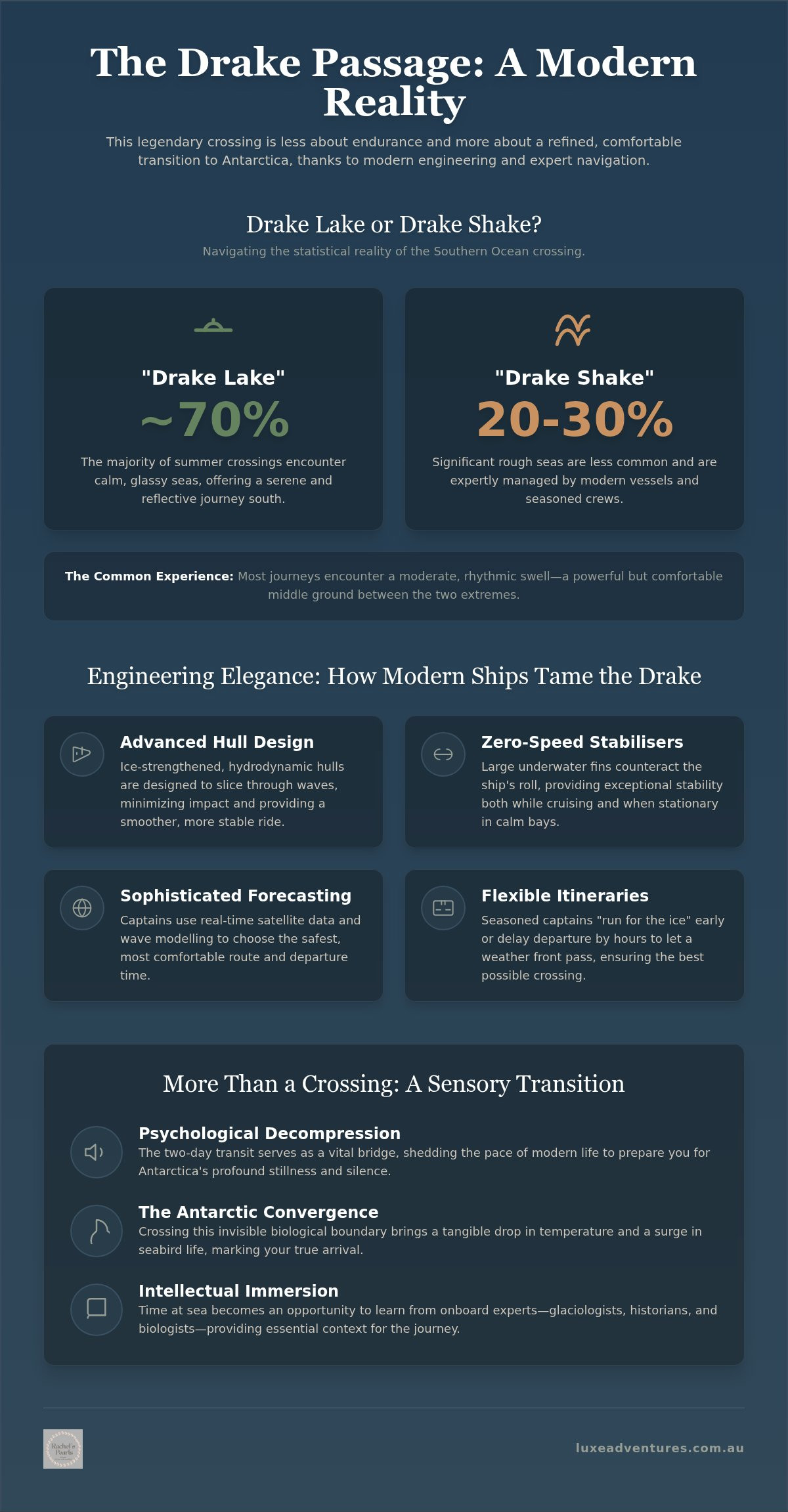
The atmosphere shifts with a subtle, chilling grace that signals your progress. A crisp, biting edge replaces the humid coastal air, and the first wandering albatrosses appear as silent sentinels. They glide effortlessly on the updrafts, their massive wingspans a signal that you've crossed a significant threshold. This two-day transit serves as a period of "polar decompression." It's a vital psychological bridge that allows the mind to shed the frantic pace of the modern world. By slowing down, you ensure you're mentally prepared for the profound stillness and the sensory deprivation that defines the Antarctic wilderness.
The Antarctic Convergence
The journey takes a biological turn at the Antarctic Convergence. This is an invisible boundary where cold polar waters meet warmer northern currents. It's a nutrient-rich collision that sparks a sudden abundance of life. Birdlife becomes prolific, and the air temperature drops sharply. This tangible shift in the crossing the drake passage experience provides a sense of scale that a brief flight cannot replicate. You feel the immense distance. You earn the arrival.
A Rite of Passage, Not a Barrier
We frame the Drake as a respected natural boundary rather than a hurdle. It's a time for intellectual immersion. While the ship moves south, the onboard lecture programme provides essential context. You'll spend time with glaciologists and historians, preparing for the delicate ecology ahead. This is the moment you transition from the "noise" of daily life to the "silence" of the ice. You arrive as an informed witness.
Drake Shake or Drake Lake? Navigating the Reality of the Southern Ocean
The Drake Passage is often presented as a binary choice between maritime chaos and eerie calm, yet the reality for most travellers is far more nuanced. While the "Drake Shake" dominates the narrative of the crossing the drake passage experience, statistics from polar operators suggest that approximately 70% of summer crossings result in a "Drake Lake." In these instances, the Southern Ocean is unnervingly glassy, reflecting the sky like a dark mirror. Even when the weather turns, significant rough seas only occur in about 20% to 30% of transits. Most of the time, the ocean sits in a moderate middle ground, a rhythmic swell that reminds you of the immense power beneath the hull without ever feeling overwhelming.
As a vital climatic transition zone, the passage is where the world's strongest current, the Antarctic Circumpolar Current, is squeezed through a relatively narrow gap. This convergence can create impressive swells, but it's important to remember that you aren't on a 19th-century wooden barque. You're on a sophisticated vessel designed specifically to dance with these waters. If you're unsure which vessel design best suits your personal comfort level, speaking with an expedition specialist can help you select a ship that matches your sea legs.
Predicting the Unpredictable
Modern expedition cruising has removed much of the "gamble" from the Drake. In 2026, weather forecasting is more accurate than it has ever been, with captains utilising sophisticated satellite data and real-time wave modelling to time their departure. Itineraries are intentionally flexible; a seasoned captain will "run for the ice" early to beat an incoming system or delay departure from Ushuaia by a few hours to let a front pass. This tactical navigation ensures that even if you encounter a "Shake," it's the safest and most comfortable version of it possible.
The Experience of the Swell
When the ocean does decide to show its strength, the sensation is one of rhythmic, heavy motion rather than sharp jolts. In 4 to 6 metre swells, a modern ship doesn't just ride the waves; it moves through them with a steady, predictable roll. There's a certain magnetic beauty to the grey, wild ocean during these moments, and watching the horizon from a well-positioned lounge can be surprisingly meditative. The Beaufort Scale is an empirical measure ranging from 0 to 12 that relates wind speed to observed sea conditions, providing a universal language for the Southern Ocean's intensity. Even at a Force 6 or 7, the atmosphere on a luxury vessel remains one of quiet confidence and refined safety.
Engineering Elegance: How Modern Ships Tame the Drake
The era of crossing the Southern Ocean in converted research vessels, where comfort was an afterthought to data collection, is firmly behind us. Today, the crossing the drake passage experience is defined by purpose-built luxury expedition ships that marry small-ship intimacy with heavy-weather capability. These vessels are masterpieces of maritime engineering, designed specifically to navigate the world's most demanding waters without sacrificing the refined atmosphere of a high-end retreat. While the ocean's power remains constant, our ability to move through it with grace has been fundamentally transformed by advancements in hull geometry and stabilisation.
It is a common misconception that larger ships are inherently more stable in rough seas. In reality, a well-engineered 100-passenger vessel can offer a smoother ride than a much larger ship if it possesses the right technology. The secret lies in the transition from passive stability, which relies on the ship's weight, to active stability, where the vessel dynamically responds to the environment. This shift ensures that the "noise" of the ocean is filtered out, leaving only the rhythmic, meditative movement of the journey.
X-Bow Technology and Piercing the Waves
One of the most significant breakthroughs in polar travel is the adoption of the Ulstein X-BOW®, an inverted bow design that looks as futuristic as it is functional. Traditional bows tend to ride over waves and slam down into the troughs, creating the jarring vibrations and "pitching" motion that often lead to seasickness. The X-Bow, however, pierces the waves. By distributing the buoyancy more evenly, it significantly reduces slamming and maintains steady speed through the swell. For guests, the sensory difference is remarkable; the ship feels like it is gliding through the water rather than battling it, providing a far more settled environment for those prone to motion sickness.
Stabiliser Fins: The Underwater Wings
Complementing the hull design are active stabiliser fins, which act like underwater wings to counteract the "roll" of the ship. These computer-controlled systems use sensors to detect the onset of a wave, extending large fins from the hull that move in real-time to keep the vessel level. Modern luxury ships are more stable than 20th-century liners because they utilise computer-driven active fins that respond in milliseconds to the ocean’s movement, whereas older vessels relied almost entirely on their sheer mass. These systems can offset more than 50% of the rolling sensation, allowing you to enjoy a glass of wine in the lounge while the Southern Ocean performs its dramatic dance outside the floor-to-ceiling windows.
Preparing for the Crossing: Wellness, Wardrobe, and Wisdom
Preparation for the Southern Ocean is a thoughtful act of stewardship over your own well-being. A discerning traveller understands that the crossing the drake passage experience begins long before the lines are cast in Ushuaia. We always recommend a pre-expedition consultation with a travel-specialist GP to discuss scopolamine patches or other pharmaceutical supports. This isn't about apprehension. It's about ensuring your focus remains on the wandering albatross and the approaching ice rather than the mechanics of your inner ear.
Your wardrobe during these two days should prioritise texture and ease. While the ship’s interior remains a sanctuary of climate-controlled comfort, choosing breathable layers like soft merino or high-quality cashmere allows for effortless transitions between the observation lounge and the bracing air of the outer decks. We also advocate for the "Horizontal Strategy." Resting in your suite for the first 12 hours of the transit allows your body to synchronise with the ship's rhythm. By giving yourself permission to be still, you make the rest of the journey far more enjoyable.
The Motion Sickness Toolkit
Curating a "Drake Kit" involves a balance of clinical precision and natural wisdom. While scopolamine patches are highly effective for many, ginger elixirs and acupressure bands offer gentler alternatives for those preferring a holistic approach. Staying hydrated and maintaining a light, steady intake of food is essential for grounding the body. The "fresh air" rule remains the most effective old-school remedy. A few minutes on deck, eyes fixed on the distant horizon, can do wonders for recalibrating your senses against the swell.
Onboard Wellness and Dining
Luxury expedition ships excel at adapting to the ocean’s temperament. During rougher transits, the galley teams often curate lighter menus featuring clear broths, simple proteins, and soothing teas. These choices ensure you feel nourished without feeling heavy. You might also utilise the ship’s spa or sauna. The warmth and stillness of these spaces provide a physical "anchor" during the crossing. Socially, the etiquette of the Drake is wonderfully relaxed. It's perfectly acceptable to skip a formal meal in favour of a quiet afternoon in your suite. To ensure your personal kit is perfectly matched to your itinerary, connect with us for a bespoke expedition consultation.
The Luxe Adventures Approach: Curating Your Journey to the Silence
At Luxe Adventures, we don't just book itineraries; we architect transitions. Our philosophy is "refined by experience," which means every vessel we recommend has been personally vetted to ensure it meets our standards for both safety and sophistication. We understand that the crossing the drake passage experience is a deeply personal one. Some travellers seek the cutting-edge technology and bold spirit of Swan Hellenic, while others prefer the French art de vivre and understated elegance found aboard Ponant. By matching your personal comfort levels with the right hull design and onboard atmosphere, we turn a legendary crossing into a curated highlight of your journey.
The role of a bespoke travel designer is never more critical than when planning a polar expedition. We navigate the nuances of ship size and staff-to-guest ratios to ensure you aren't just another passenger on a large vessel. As a Virtuoso member, we provide exclusive benefits that enhance your entire journey. This might include room upgrades and VIP access in Buenos Aires or Santiago, ensuring your time in South America is as refined as the expedition itself. It's the difference between a standard booking and a journey that's been hand-picked for your specific perspective.
Vetted Excellence in Polar Cruising
Small-ship intimacy is the cornerstone of our selection process. We prioritise vessels that offer a high guide-to-passenger ratio, ensuring your education during the crossing is as profound as the destination itself. This closeness allows for more spontaneous landings and a deeper connection with the expedition team. For a detailed look at how we select these journeys for our Australian clients, explore The Silent Frontier: A Discerning Guide to Antarctica Cruises from Australia.
Designing Your Personal Expedition
Managing the logistics from Australia to the southern tip of South America requires clinical precision. We handle the complex flight connections and pre-expedition stays, allowing you to arrive in Ushuaia refreshed and ready. For some, the "Fly-the-Drake" alternative is the preferred path. While flying avoids the swells, the traditional crossing the drake passage experience offers a profound sense of achievement and a slower, more intentional arrival. We'll help you weigh these options honestly based on your schedule and sea-legs. Ultimately, the Drake is the price of admission for a world few ever see. It is the final, respected boundary before the silence of the ice begins.
Embracing the Southern Ocean's Call
The Drake Passage is no longer an obstacle to be survived; it is a threshold to be savoured. We've explored how advanced maritime engineering, from X-bow technology to active stabilisers, has reimagined this transit. These innovations turn potential turbulence into a period of deep, intentional reflection. You now understand that the "Drake Shake" is a statistical rarity, and that the true value of the crossing lies in the profound silence it prepares you for.
As a CLIA Master Cruise Specialist and Virtuoso Member, I personally research and vet every polar expedition we recommend. This ensures your journey from Australia is defined by quiet luxury and expert stewardship. The right vessel, precisely matched to your sea legs, transforms the crossing the drake passage experience into a vital and rewarding chapter of your Antarctic story. Beyond the swells lies a world of pristine beauty that few will ever witness.
If you're ready to design a journey that balances raw exploration with refined comfort, curate your Antarctica expedition with Luxe Adventures. Let's ensure your path to the ice is as extraordinary as the destination itself. The Great White Continent is waiting, and the path there is just as meaningful as the destination itself.
Frequently Asked Questions
How long does it take to cross the Drake Passage?
A standard transit of the Southern Ocean takes approximately 48 hours each way. This duration allows for a gradual psychological transition from the tip of South America to the Antarctic Peninsula. During this time, you'll engage with expert led lectures and settle into the ship's rhythm. While the crossing is roughly 800 kilometres, the pace is dictated by the ocean's conditions and the captain's tactical navigation to ensure the most comfortable journey possible.
Is the Drake Passage dangerous on modern expedition ships?
Modern expedition cruising has rendered the historical danger of the Drake a relic of the past. Today's vessels are equipped with advanced satellite weather forecasting and ice strengthened hulls. Captains won't depart if conditions are deemed unsafe; instead, they utilise flexible itineraries to wait for better weather windows. With zero speed stabilisers and sophisticated hull designs, the focus is on passenger comfort and operational safety rather than mere survival.
What is the best medication for crossing the Drake Passage?
The most effective pharmaceutical option for many travellers is the scopolamine patch, though you must consult a travel specialist GP before departure. Natural alternatives like ginger elixirs and acupressure bands are excellent supplements for a holistic approach. We recommend starting any regimen before the ship leaves the sheltered waters of the Beagle Channel. Staying hydrated and maintaining a light, steady intake of food also helps your inner ear adapt more effectively to the swell.
Can you fly over the Drake Passage instead of sailing?
Yes, several operators offer itineraries that utilise charter flights between Punta Arenas and King George Island. This option bypasses the sea crossing entirely, saving approximately four days of travel time. However, flying often comes at a higher cost and depends heavily on clear weather for landing. Many of our clients find that sailing provides a more profound emotional transition and a greater sense of the continent's true isolation during the crossing the drake passage experience.
What is the "Drake Shake" vs the "Drake Lake"?
These terms describe the two extremes of the crossing the drake passage experience. A "Drake Lake" occurs when the Southern Ocean is unnervingly calm, with glassy water reflecting the sky. Conversely, a "Drake Shake" refers to the legendary rough seas and high swells caused by the Antarctic Circumpolar Current. Statistics show that approximately 70% of summer crossings are relatively calm, meaning the "Lake" is actually more common than the infamous "Shake."
Will I get seasick on an Antarctica cruise?
Seasickness is a possibility, but it is rarely debilitating on modern vessels equipped with active stabiliser fins. These systems can offset more than 50% of the ship's roll, significantly reducing the sensation of motion. When combined with proactive medication and the stable design of ships like those from Ponant or Swan Hellenic, most guests find they adapt within the first 24 hours and can comfortably enjoy the journey without significant disruption.
What is the best time of year to cross the Drake Passage for calm seas?
The Antarctic summer, specifically from December through February, generally offers the most predictable weather windows. During these months, the probability of encountering a "Drake Lake" is at its highest. However, the Southern Ocean remains a wild environment where conditions can shift rapidly regardless of the month. Choosing a ship with superior stabilisation technology is a more reliable way to ensure comfort than attempting to time the crossing based on the calendar alone.
Are smaller ships less stable in the Drake Passage?
Sheer size is not the primary factor for stability; rather, it's the sophistication of the hull design and stabilisation systems. A 100 passenger luxury vessel with an X-BOW and active fins can offer a much smoother ride than a larger, older ship without these features. We personally vet small ships that prioritise engineering excellence, ensuring you enjoy an intimate atmosphere without sacrificing the heavy weather capability required for a comfortable and refined Southern Ocean transit.

Article by
Rachel Cleary
Rachel Cleary is the founder of Luxe Adventures and an endlessly curious explorer with a passion for meaningful, experience-led travel. Having visited every continent and travelled to more than 100 countries — and counting — she believes travel is one of the greatest educations for both children and adults alike.
Rachel is addicted to scuba diving and gets underwater at every opportunity. When she isn't in the office you'll find her exploring remote reefs in Fiji, drift diving in the Maldives, or scuba cruising Raja Ampat or French Polynesia.
Her second home is Fiji where she has explored all the island groups and has favourite boutique resorts she returns to every year, for the diving and the authentic Fijian hospitality.
Get her talking about kayaking in Antarctica or the Arctic, African safaris and where to find the highest density of big cats, underwater adventures, remote expedition destinations, or the science and magic behind the Northern Lights — including when and where they are most likely to dance — and you may be there a while.
Through Luxe Adventures, Rachel combines firsthand experience, global industry connections, and a deep appreciation for nature, culture, food, wildlife, and human connection to help curious travellers explore the world in a way that feels seamless, personal, and unforgettable.
Refined by experience. Defined by connection.
Disclaimer
The information in this article is intended as general travel inspiration and guidance only. Travel requirements, hotel standards, airline schedules, entry regulations, weather conditions, pricing, and experiences can change without notice.
While every effort is made to ensure accuracy at the time of publishing, Luxe Adventures recommends confirming all details relevant to your personal travel plans before booking or travelling.
Opinions, recommendations, and destination insights shared in this article are based on firsthand experience, industry knowledge, and research at the time of writing. Experiences may vary depending on season, supplier changes, local conditions, and individual travel preferences.
Some articles may reference luxury travel affiliations, preferred partner programs, or value-added amenities available through Luxe Adventures. Benefits and inclusions are always subject to availability and supplier terms at the time of booking.
Luxe Adventures strongly recommends comprehensive travel insurance for all international travel.
For personalised travel advice, tailored itinerary design, or the latest destination updates, please contact Luxe Adventures directly.


