

The best time of year to visit galapagos islands depends less on finding a universally perfect month than on deciding what you want from the journey. Warmer water, seasonal wildlife behaviour and the pace of your itinerary can all shape your days, and the islands reward travellers who leave room to notice the details.
Conflicting advice about peak periods usually reflects different priorities. A recommendation that suits someone keen to snorkel may not suit a traveller more interested in cooler conditions or a particular style of wildlife observation. Instead of chasing one definitive answer, start with the experience you value most.
This guide compares the broad seasons and shows how to weigh them against your interests, comfort and preferred way of exploring. With those priorities clear, you can choose a travel window with intention and find an itinerary that makes sense for you.
Key Takeaways
- There’s no universal best time of year to visit galapagos islands. Choose dates around the wildlife, water conditions and style of exploration that matter most to you.
- Compare the warm-wet and cool-dry seasons to understand how rainfall, landscapes and ocean conditions may shape your days.
- Decide whether warmer water for snorkelling or seasonal marine wildlife should take priority when weighing your travel window.
- Before selecting dates, match your seasonal priorities with a cruise or island-based itinerary that suits your pace and interests.
- A thoughtfully tailored Galapagos journey can balance seasonal interests, comfort and the way you prefer to explore.
When is the best time of year to visit the Galapagos Islands?
There’s no single best month for every Galapagos traveller. The right window depends on what you want your days to include: warmer water for swimming and snorkelling, seasonal wildlife behaviour, or cooler conditions and the marine life associated with the Humboldt Current. Each season brings a different emphasis, not a lesser version of the islands.
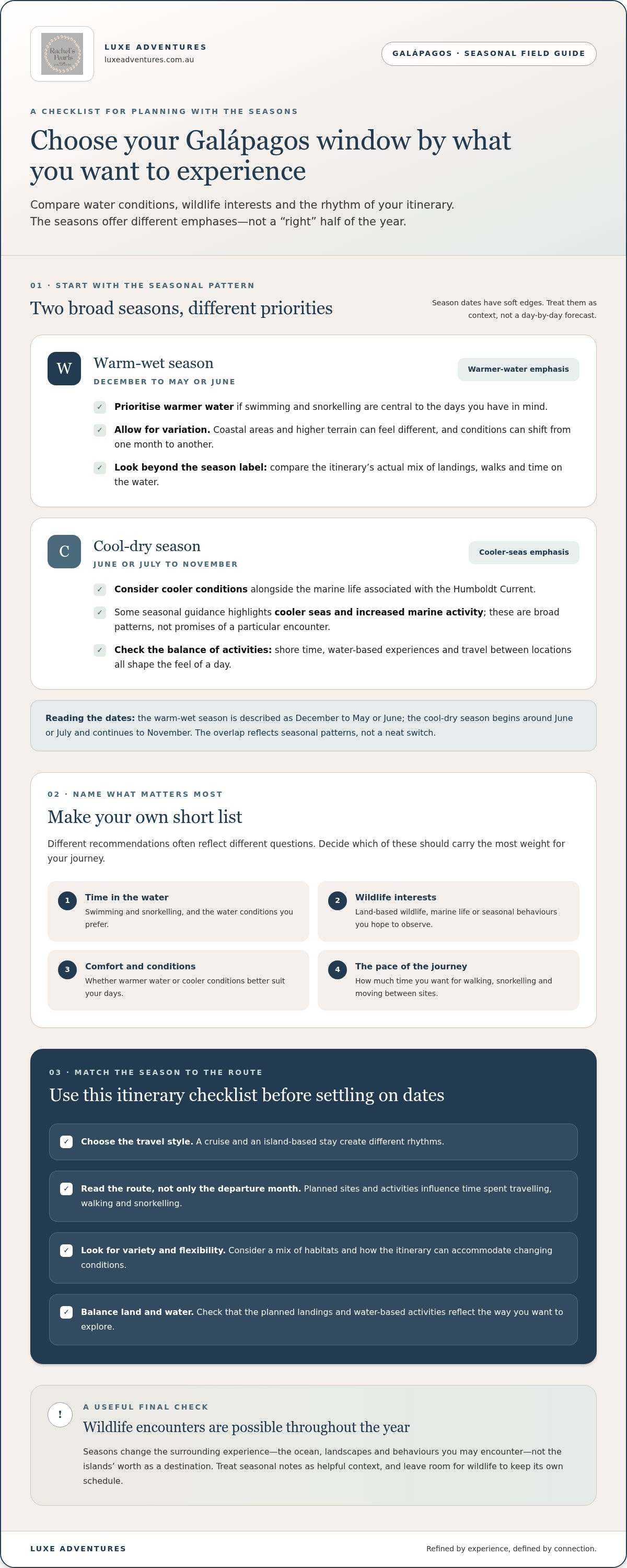
Broadly, the warm-wet season runs from December to May or June, while the cool-dry season begins around June or July and continues to November. Those overlapping edges matter: seasons are patterns, not neat switches. Rain, sea conditions and wildlife activity can vary, so a seasonal guide helps set expectations rather than forecast a particular day.
Wildlife opportunities continue throughout the year. What changes with the seasons is the surrounding experience, from ocean conditions and island landscapes to the behaviours you may encounter.
Why the Galapagos Islands are a year-round destination
Wildlife encounters are possible across the calendar, and the islands’ appeal doesn’t depend on one migration or a tightly timed event. Seasonal shifts influence which behaviours may be more prominent and how the landscape feels, but they don’t make one half of the year a poor choice. The Galapagos Islands climate and geography help explain why conditions vary across this distinctive archipelago.
That variation is part of the experience. Your visit is shaped by the places on your itinerary, conditions on the day and the patience to observe wildlife on its own terms. Animals, inconveniently for anyone planning a perfect photograph, don’t follow a performance schedule.
What “best time” means for your trip
One guide may favour a period for warmer water; another may focus on months associated with cooler seas and increased marine activity. Both can be useful, but they’re answering different questions. Before comparing recommendations, decide what matters most: time in the water, land-based wildlife, comfortable temperatures or the general rhythm of your journey.
Your travel style matters, too. A cruise and an island-based stay create different rhythms, while the route and planned activities influence how much time you spend travelling between sites, walking or snorkelling. If you have fixed leave dates, the practical question isn’t whether they’re universally ideal. It’s what those dates make possible and which trade-offs feel reasonable.
Treat “best” as a personal measure rather than a ranking. The seasonal comparison below looks at broad timing and likely differences in weather, landscape and wildlife. Use it to match a travel window to your priorities, without expecting nature to keep appointments.
How Galapagos seasons shape weather, landscapes and wildlife
Seasonal guidance is most useful when read alongside the islands’ varied geography. Conditions at a coastal landing and in higher terrain can feel quite different within the same itinerary. A broad seasonal label gives helpful context, but it can’t describe every site or predict the experience of a particular day.
Think of the seasons as a guide to the islands’ changing character, then use the route to understand how those changes may shape what you see and do.
| Seasonal lens | What to consider across the islands | Useful planning question |
|---|---|---|
| Warm-wet | Conditions can vary between coastal areas and higher ground, as well as from one month to another. | Does the itinerary include a mix of habitats and enough flexibility for changing conditions? |
| Cool-dry | Wildlife activity and the feel of a visit may differ by location and by the kind of site explored. | Does the route offer the balance of landings and water-based activities you want? |
These are planning prompts, not forecasts. Seasonal patterns are broad, and conditions at individual sites can vary.
Warm-wet season: changing conditions and seasonal highlights
Rather than treating this period as one uniform weather pattern, consider how your route moves between different settings. A day on an exposed shoreline can feel unlike a walk in higher terrain, even within the same visit. The sequence of activities is worth attention: an itinerary that includes different landscapes can give you a fuller sense of place than one built around a single type of outing.
When comparing options, look at the actual balance of landings, walks and time on the water, not just the season label. That helps you judge whether the day-to-day experience suits you, whatever the weather brings.
Cool-dry season: cooler conditions and productive waters
The same principle applies in the cooler months. A season associated with particular ocean patterns doesn’t make every marine site or wildlife encounter alike. Look at how the itinerary combines time on shore, time in the water and travel between locations. That broader view is more useful than judging the season by a single headline about wildlife or ocean conditions.
Seasonal wildlife behaviour is one part of the picture; the setting and the way you encounter it matter, too. A quiet walk, a coastal landing and a snorkel each reveal a different dimension of the islands. Treat seasonal notes as context for observation rather than a promise that a particular animal or behaviour will appear.
When comparing itineraries, consider how their sites and activities complement one another, not just which season they depart in. That’s a grounded way to understand how the islands’ changing character may shape your days.
Wildlife, snorkelling and sea conditions: what changes by season?
A Galapagos itinerary often alternates between walking on land, entering the water and travelling between islands. These are distinct parts of the experience, and they won’t all matter equally to every traveller. Someone who enjoys observing animals from a trail may be less concerned about snorkelling conditions. A keen swimmer may want to know how often the itinerary offers time in the water.
Wildlife activity and ocean conditions can influence one another, but they aren’t interchangeable planning measures. A season associated with active marine life doesn’t guarantee a particular encounter, and a comfortable day on land says little about how the water will feel. Underwater visibility can vary, too, so don’t treat a month or season as a promise of clear views.
Choosing dates for marine wildlife and snorkelling
Start by asking how you feel about cooler water and how much time you genuinely want to spend snorkelling. If a brief swim is enough, water temperature may matter less than the cruise route or the balance of activities. If you’d happily spend longer in the sea, comfort deserves more weight in your seasonal choice.
Think about the full water-based outing, not just the time with a mask on. Getting to a site, entering the water and returning to the vessel all contribute to the day. Choose an itinerary where those activities suit your energy and confidence in the water, while keeping expectations about visibility and animal encounters flexible.
Choosing dates for birds, reptiles and island landscapes
Land visits invite a different kind of attention: watching animal behaviour from a trail, noticing details in the terrain or simply taking time to observe without a snorkel or boat crossing in the picture. Wildlife may be encountered throughout the year, but seasonal behaviours are less predictable than a fixed itinerary. Treat timing as useful context, not a viewing guarantee.
Landscape also shapes how a walk feels. A route that moves between coastal terrain and higher ground may offer contrasting impressions, and conditions can differ from site to site. Think about the kind of land experience you enjoy: a longer walk, time near the shore or a varied mix. Those preferences can help you judge whether an itinerary feels balanced, whatever the season’s headline wildlife highlights.
Use these prompts to compare travel windows:
- For more time in the water: weigh your comfort with cooler conditions and how central snorkelling is to your plans.
- For wildlife observation on land: consider the route’s landing sites and the time available to explore at a measured pace.
- For a mixed experience: look for a thoughtful balance of walks, water activities and travel between sites.
- For flexibility: allow nature and local conditions to shape what each day brings.
The most useful choice fits both your interests and your preferred way to spend a day, rather than a season selected for one expected sighting.
How to choose your Galapagos travel window
Choosing the best time of year to visit galapagos islands becomes easier when you stop trying to optimise every detail at once. Start with the experience you care about most, then see how the season and itinerary support it. A preference for warmer water, for example, may point to a different window from a strong interest in marine wildlife. Neither is a compromise unless it feels like one to you.
Match your priorities to the season
Use this sequence to turn broad seasonal guidance into a practical decision:
- Define your leading priority. Choose the experience you’d most regret missing, whether that’s regular time in the water, particular wildlife behaviours or a comfortable balance of land and sea activities.
- Compare the seasonal conditions. Consider warmth, water comfort and the wildlife rhythms associated with each broad season. If warmer swimming conditions matter most, the warm-wet period may appeal. If cooler water and marine activity take precedence, weigh the cool-dry period.
- Check the itinerary fit. Look beyond departure dates to the route, planned land visits and opportunities for snorkelling. Expedition-style travel can have a different rhythm from an island-based stay, so the way you move between places matters as much as the month.
- Select dates that make sense for you. If your dates are fixed, focus on the itinerary and experiences that fit that window. If you have flexibility, use it to favour your leading interest while allowing for the natural variability of wildlife and conditions.
Be candid about competing preferences. You might favour warm water but also hope to see marine life associated with the cooler season. Rather than searching for a month that promises both at their peak, decide which matters more and which you’d be content to experience differently. A ranked list is more useful than a wish list with everything marked “essential”.
Consider the itinerary, not just the calendar
A cruise route determines which islands and visitor sites form part of the journey; an island-based plan creates a different pattern of travel and exploration. Compare how each option balances time ashore, time on the water and the pace of moving between locations. Consider your comfort with cooler snorkelling conditions and travel between islands, too. A season can sound ideal on paper but feel less suitable if its typical activities don’t match how you like to spend a day.
If your dates are flexible, an experienced travel designer can help weigh seasonal interests alongside comfort and itinerary style. Shape a personal Galapagos journey around the experiences you value most.
Plan a Galapagos journey around the season you want to experience
The best season is the one that fits how you want to meet the islands, not a universal winner on a calendar. Once you’ve identified your priorities, bring them together with a route, pace and style of travel that feel right. That may mean favouring warmer conditions for time in the water, or choosing an itinerary that gives more weight to land-based exploration and seasonal wildlife activity.
Luxe Adventures is a boutique travel design studio offering Galapagos cruises and resorts. Founder and Travel Designer Rachel Cleary shapes tailor-made journeys around each traveller’s preferences, balancing seasonal interests with comfort and the experience of being in a place. The aim isn’t to promise a particular wildlife encounter. It’s to make considered choices about how you spend your time and leave room for the islands to unfold on their own terms.
What a tailored Galapagos itinerary can help balance
A thoughtful itinerary connects the season you favour with practical details: the cruise route or island-based plan, the pace of travel, and how much of each day you want to spend on land or in the water. If snorkelling is a priority but cooler water is a concern, that trade-off can inform the timing and shape of the journey. If seasonal wildlife behaviour matters to you, it can guide the planning without being treated as a guaranteed sighting.
Rachel’s approach is grounded in researching travel experiences and listening carefully to how clients like to explore. Luxe Adventures’ personally vetted approach brings those preferences into focus, so the choices feel coherent rather than assembled from a list of seasonal highlights. The result is an itinerary designed around your interests and comfort, with thoughtful attention to connection with place.
Take the next step at your own pace
Begin with a short list: what you most want to experience, what conditions you’re comfortable with, and whether your dates are fixed or flexible. Then consider which itinerary style best supports those priorities. Travellers weighing an expedition cruise against other ways to explore may also find the Expedition Cruising Guide a useful companion as they think through pace and time on the water.
There’s no need to make every preference fit perfectly. A clear first priority is enough to start shaping a journey that feels personal, considered and in step with the season. When you’re ready, start planning a Galapagos journey around the experience you’d most like to have.
Let your priorities shape the journey
The best time of year to visit galapagos islands is ultimately the one that supports the experience you want to carry home. Before choosing dates, ask what you’d most like to give your attention to: a particular style of exploration, a more comfortable pace or time for quiet observation. That answer is a more useful starting point than searching for a month that promises everything.
From there, dates and itinerary can take shape together. Luxe Adventures designs tailor-made luxury travel, with founder and Travel Designer Rachel Cleary bringing a considered, personal approach to planning. As an expert luxury travel advisor and CLIA Ambassador, Rachel can help turn your preferences into a Galapagos journey that feels cohesive and true to the way you like to travel.
You don’t need every detail decided before you begin. A clear sense of what matters most is enough to start a thoughtful conversation about the journey ahead. Start planning a Galapagos journey at your own pace, with room to shape the details around you.
Frequently Asked Questions
Is there a bad time to visit the Galapagos Islands?
No season is universally bad for visiting the Galapagos Islands. The best time of year to visit galapagos islands depends on what you value: warmer conditions, time in the water or particular wildlife interests. A period that feels less appealing to one traveller may suit another whose priorities differ. If your dates are fixed, focus on choosing activities and an itinerary that fit the conditions, rather than assuming your travel window will diminish the whole experience.
What is the warmest month in the Galapagos Islands?
There isn’t one month that can be named confidently as the warmest across every island and every source. The warm-wet season, broadly December to May or June, is associated with warmer conditions, but local temperatures vary and monthly averages aren’t daily forecasts. If warmth is a priority, think in terms of this broader seasonal period rather than relying on a single month. Conditions can differ between locations, so pack for variation rather than one expected temperature.
Can you snorkel in the Galapagos Islands year-round?
Yes, snorkelling is possible throughout the year, although water temperature and conditions can affect how comfortable a session feels. If you’re happiest staying in the water for longer, warmer-season conditions may suit you; if cooler water is acceptable, weigh that against your marine wildlife interests. Visibility can change with local and daily conditions, so don’t plan around a guaranteed view underwater. Consider how much snorkelling you want in your itinerary.
Do Galapagos cruises operate throughout the year?
The islands can be visited year-round, but that doesn’t mean every cruise, vessel or route departs in every month. Operators set their own schedules, and individual itineraries may differ. Once you have a travel window in mind, compare the available route and onboard style with the experiences you’re seeking. This helps separate the destination’s year-round appeal from the calendar of a particular cruise, without assuming a preferred departure will run on your chosen dates.
How far ahead should I plan a Galapagos trip?
There’s no single booking window that suits every traveller. Starting once you know your priorities gives you more opportunity to compare dates, routes and cruise or resort styles, especially if your preferences are specific. Flexibility can make planning simpler; fixed dates may narrow the choices you’re weighing. Begin by identifying what matters most, then shape the itinerary around that. You don’t need every detail settled before exploring options, but a clear sense of priorities helps.
What should I pack for the Galapagos Islands in the wet season?
Pack for warm outdoor days, possible showers and time moving between land and water, while allowing for conditions to change. Lightweight clothing that can be layered, practical sun protection and a light rain layer are sensible starting points. Your plans matter: walking excursions, boat travel and swimming call for different choices. Rather than expecting a predictable daily forecast, choose adaptable items and refine your packing around the activities in your itinerary.

Article by
Rachel Cleary
Rachel Cleary is the founder of Luxe Adventures and an endlessly curious explorer with a passion for meaningful, experience-led travel. Having visited every continent and travelled to more than 100 countries — and counting — she believes travel is one of the greatest educations for both children and adults alike.
Rachel is addicted to scuba diving and gets underwater at every opportunity. When she isn't in the office you'll find her exploring remote reefs in Fiji, drift diving in the Maldives, or scuba cruising Raja Ampat or French Polynesia.
Her second home is Fiji where she has explored all the island groups and has favourite boutique resorts she returns to every year, for the diving and the authentic Fijian hospitality.
Get her talking about kayaking in Antarctica or the Arctic, African safaris and where to find the highest density of big cats, underwater adventures, remote expedition destinations, or the science and magic behind the Northern Lights — including when and where they are most likely to dance — and you may be there a while.
Through Luxe Adventures, Rachel combines firsthand experience, global industry connections, and a deep appreciation for nature, culture, food, wildlife, and human connection to help curious travellers explore the world in a way that feels seamless, personal, and unforgettable.
Refined by experience. Defined by connection.
Disclaimer
The information in this article is intended as general travel inspiration and guidance only. Travel requirements, hotel standards, airline schedules, entry regulations, weather conditions, pricing, and experiences can change without notice.
While every effort is made to ensure accuracy at the time of publishing, Luxe Adventures recommends confirming all details relevant to your personal travel plans before booking or travelling.
Opinions, recommendations, and destination insights shared in this article are based on firsthand experience, industry knowledge, and research at the time of writing. Experiences may vary depending on season, supplier changes, local conditions, and individual travel preferences.
Some articles may reference luxury travel affiliations, preferred partner programs, or value-added amenities available through Luxe Adventures. Benefits and inclusions are always subject to availability and supplier terms at the time of booking.
Luxe Adventures strongly recommends comprehensive travel insurance for all international travel.
For personalised travel advice, tailored itinerary design, or the latest destination updates, please contact Luxe Adventures directly.


