
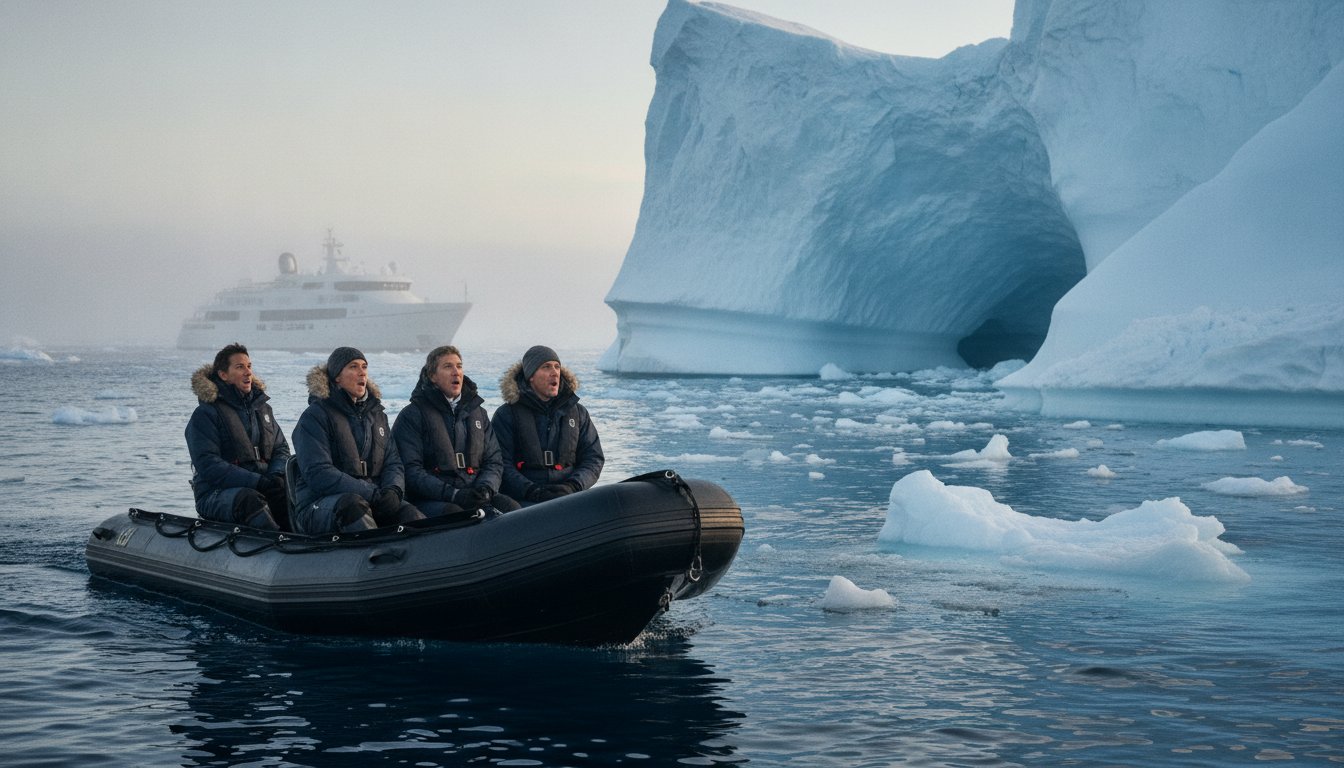
What if the most significant luxury of 2026 isn't found in a gold-leafed ballroom, but in the silence of a polar bay where you're one of only a handful of witnesses? When you look at the commitment required for these journeys, it's natural to ask: are expedition cruises worth it? You might worry about being confined to a ship with thousands of others, or perhaps you fear that the exploration side is too physically punishing for a relaxing holiday.
I understand that hesitation. It's a substantial investment of both time and capital. However, the true value isn't found in the price tag. It's found in the ability to reach places that remain entirely unreachable by any other means. This guide moves beyond the brochure fluff to examine the reality of modern exploration. You'll discover how expert-led education and curated access transform a simple trip into a deeply personal evolution. We'll look at why the Arctic, Antarctica, and the Amazon offer a return on investment that lasts long after you return to Australian shores.
Key Takeaways
- Understand why the question of are expedition cruises worth it hinges on the shift from superficial amenities to unscripted access in the world's most remote corners.
- Learn why small ship intimacy, specifically vessels limited to 200 guests, is a non-negotiable requirement for those seeking genuine connection with the landscape.
- Discover how to match your travel philosophy to specific destinations, ensuring the physical demands of the journey enhance your experience rather than detracting from it.
- Identify the logistical nuances that justify the investment, from ice-strengthened hulls to the expert-led education that adds intellectual depth to your holiday.
- Explore the value of a curated itinerary that balances high-end comfort with the raw, authentic exploration required to reach truly unreachable locations.
Beyond the Balcony: Defining the Real Value of Expedition Cruising
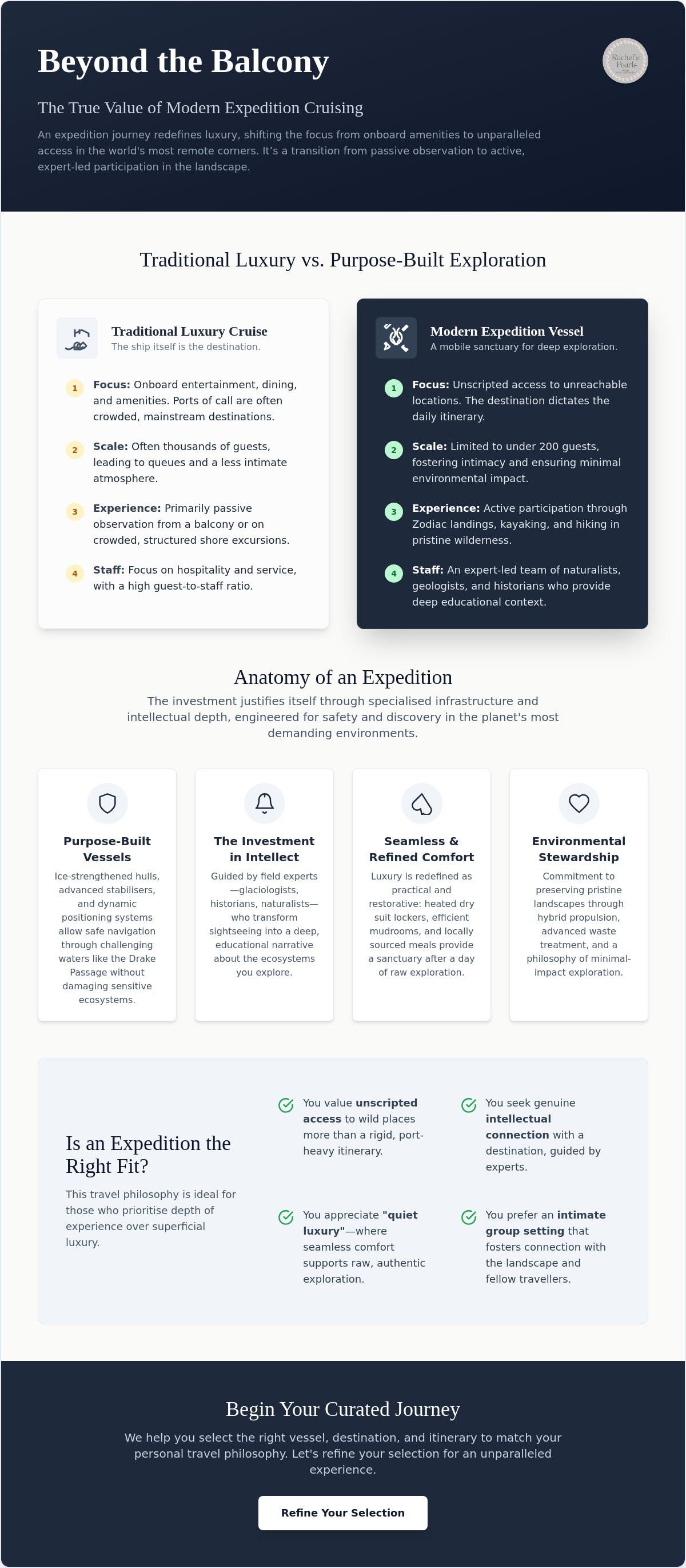
Traditional luxury cruising often prioritises the ship as the destination. You might find yourself judging a voyage by the thread count of the linens or the vintage of the champagne. While those details certainly have their place, Expedition cruising operates on an entirely different set of metrics. To determine if are expedition cruises worth it, you must look beyond the balcony and into the infrastructure of the experience itself.
We view the modern expedition vessel as a "mobile sanctuary." High-end comfort in 2026 isn't just about marble bathrooms; it's about having a heated locker for your dry suit and a mudroom that functions with the precision of a Swiss watch. It's about the ability to witness a calving glacier in the Arctic while knowing a refined, locally sourced meal and a restorative environment await you just metres away. The value here is measured in "access per hour" rather than cabin square footage. On a standard cruise, you spend hours in port queues. In an expedition setting, every hour is engineered for proximity to the unreachable.
When clients ask me if are expedition cruises worth it, I often point to the ratio of guests to expedition staff. This ratio determines the depth of your daily immersion. In these remote environments, the expedition team moves you from being a passive observer to an active participant in the landscape's story.
Soft Adventure vs. Hard Exploration
Modern technology has effectively smoothed the edges of traditional exploration. Dynamic positioning systems mean ships can hover over sensitive ecosystems without dropping an anchor, and advanced stabilisers turn once-daunting crossings into manageable transits. This allows for a profound psychological shift. You aren't a tourist looking through a glass pane; you're a participant in a living landscape. This is quiet luxury at its most potent, where the frontier is rugged but your experience is entirely seamless. It is adventure without the sharp edges that once defined polar or tropical exploration.
The Investment in Intellect
The real currency of an expedition is the calibre of the team. You aren't just accompanied by service staff; you're guided by naturalists, historians, and geologists who spend their lives studying these remote corners. This level of insight is what defines the most refined journeys, whether you're on a ship or exploring the Icelandic highlands with Kiddi's Travel. They move you beyond the simple photo op, explaining the intricate narratives of the ecosystems you're traversing. The true return on investment for an expert-led landing in a remote fjord is found in the moment a glaciologist explains the ancient history written in the blue ice right beneath your hand.
The Anatomy of an Expedition: Why the Investment Yields a Different Kind of Return
To understand the financial commitment, one must look at the unseen logistical feats required to operate in the world's most hostile environments. Operating a vessel in the Arctic or Antarctica is a masterclass in self-sufficiency. Every litre of fuel, every fresh vegetable, and every piece of safety equipment must be carried with you. When you ask if are expedition cruises worth it, you're really asking about the value of this invisible infrastructure. High-end lines invest heavily in technical superiority, such as dynamic positioning systems that allow a ship to hover in place without damaging the seabed. This technology is particularly vital when navigating the unpredictable waters of the Drake Passage, where advanced stabilisers turn a legendary challenge into a manageable transit.
Determining Is an expedition cruise right for you often comes down to your appreciation for these technical nuances. Beyond the mechanics, there's the commitment to environmental stewardship. The most refined expedition lines lead the maritime industry in sustainable technology, utilising hybrid propulsion and advanced waste treatment to protect the very frontiers they explore. This isn't about following a trend; it's about a long-term philosophy of stewardship that ensures these landscapes remain pristine. If you're beginning to map out your own polar journey, we can help you refine your selection based on these specific ship capabilities.
The Science of the Small Ship
Passenger count is the single most important factor in your return on investment. Under IAATO regulations in Antarctica and AECO guidelines in the Arctic, strict limits govern how many people can be ashore at once. On a ship with 400 guests, you spend half your day waiting in a lounge for your turn. On a vessel with fewer than 200, you're on the ice for every possible minute. This is the luxury of time, a non-negotiable for the discerning traveller who values depth over a simple tick-box exercise. Smaller ships also possess the agility to navigate narrow fjords and shallow bays that larger vessels simply cannot reach, providing a level of intimacy with the landscape that is otherwise impossible.
Sensory Details of the Frontier
The true worth of these voyages is found in the unscripted moments that cannot be staged. It's the absolute, heavy silence of a polar morning, broken only by the distant exhale of a humpback whale. It's the tactile crunch of ancient ice beneath your boots and the bracing salt spray on your face during a Zodiac excursion. These aren't choreographed performances; they're raw, authentic encounters with a world that remains indifferent to your presence. In an age of digital noise, the ability to stand in a place where the only sound is the movement of the earth itself is perhaps the greatest luxury of all. When you consider the depth of that connection, the question of are expedition cruises worth it finds its answer in the profound internal shift that occurs when you finally step off the ship.
Comparing the Journeys: Traditional Luxury vs. Purpose-Built Exploration
Traditional luxury cruising is often a performance of predictability. You know exactly when dinner is served, when the curtain rises on the evening show, and which ports you'll visit months in advance. Expedition cruising, by contrast, is a masterclass in elegant spontaneity. Here, the itinerary is merely a suggestion, written by the wind, the ice, and the wildlife. If a pod of orcas is spotted at 4:00 PM, the ship stops. The lecture is paused. The "show" is happening outside your window. When evaluating if are expedition cruises worth it, you must weigh the value of this unscripted access against the rigid schedules of standard luxury lines.
Gastronomy on these voyages also reflects this sense of place. While traditional ships focus on international variety, expedition dining is often curated to echo the journey's path. You might find yourself enjoying sustainably sourced Arctic char or flavours that reflect the biodiversity of the Amazon. It is dining with intentionality. Even the "hard product" of the ship is reimagined. While you'll still find expansive suites and world-class spas, the most critical architectural feature is often the mudroom. This is the engine room of your experience, designed to transition you seamlessly from the comfort of the ship to the raw reality of the frontier.
When Traditional Luxury Falls Short
Many travellers make the mistake of booking a large luxury ship for "scenic cruising" in regions like Antarctica or the Kimberley. The frustration arises when you realise you are merely a spectator, unable to step ashore due to the ship's size or lack of specialised landing permits. This is why a bespoke travel designer prioritises landings over loungers. We use the "Usable Hour" metric to determine if are expedition cruises worth it. If you spend twelve days on a ship but only six hours on the ground, the true cost of your time is far higher than on a purpose-built vessel that offers multiple landings every single day.
The ROI of Connection
The return on investment for an expedition is also measured in the calibre of your companions. On a small ship, a unique community forms through shared moments of awe. You aren't just one of thousands; you are part of an intimate group of fewer than 200 guests. Conversations with geologists and historians continue over dinner, turning every meal into an opportunity for intellectual expansion. Expedition cruising is a strategic choice for those who value depth of experience and meaningful connection over the superficial noise of standard tourism. It is a journey designed for the curious, where the greatest luxury is the insight gained from those who know the destination best.
Determining Your Suitability: Is an Expedition the Right Fit for Your Travel Philosophy?
Before committing to a journey of this scale, you must interrogate your own travel philosophy. If your idea of a perfect holiday involves a static poolside lounge and a predictable nightly cabaret, an expedition might feel like an unusual choice. However, for those seeking a "soft adventure" threshold, where the physical effort is rewarded by unparalleled access, the question of are expedition cruises worth it becomes a resounding yes. If you're just starting to explore this niche, our comprehensive expedition cruising guide provides the essential foundation for understanding these specialised voyages.
True luxury in remote travel is often defined by flexibility. You aren't paying for a rigid schedule; you're paying for a captain and an expedition leader with the expertise to pivot when a sea ice lead opens or a weather window appears. This ability to embrace the unknown is the hallmark of a seasoned explorer. If you're ready to discuss which vessel matches your specific requirements, you can request a tailored consultation with us today.
Choosing Your Frontier
Matching the destination to your specific interests is critical for ensuring a high return on your investment. Antarctica is the quest for the "Silent Frontier," a place of profound sensory deprivation and raw, monochromatic beauty that forces an internal reset. Conversely, a journey through the Kimberley offers a deeply tactile connection to ancient Australian landscapes and living indigenous culture, where the heat and the red dust tell a story of millennia. The Arctic provides a different texture altogether, focusing on cultural immersion in Inuit communities and the surreal, perpetual glow of the Midnight Sun. Each frontier demands a different version of you. For those who find their calling in the high mountains rather than the open sea, the guided Himalayan expeditions led by Brothers Adventure offer a similarly profound and expert-led connection to the world's most extreme environments.
The Discerning Traveller’s Checklist
When vetting a potential voyage, look beyond the glossy photography. Ask about the age of the ship, as newer vessels often feature the hybrid technology and stabilisers mentioned earlier. Inquire about the specific expertise of the expedition team; a historian who has spent twenty seasons in the Ross Sea is worth more than a dozen generic tour guides. Finally, ensure the "all-inclusive" label covers every excursion and landing. You don't want to find yourself on a remote beach in the Amazon only to discover the most meaningful cultural encounter requires an additional fee. A truly vetted itinerary ensures that the depth of your connection is never limited by a ledger.
The Curation Factor: Why a Vetted Itinerary is Your Best Insurance Policy
The final layer in determining if are expedition cruises worth it is the quality of the curation behind the booking. At Luxe Adventures, we operate under a singular philosophy: "Refined by experience, defined by connection." This isn't just a tagline. It's a commitment to moving beyond the generic lists found on the internet. We don't just sell cabins; we design journeys that safeguard your most precious asset-your time. By personally researching and vetting every expedition line we recommend, we ensure that the ship's operational reality matches the glossy promises of the brochure. We look for the intentionality behind the service and the authenticity of the exploration.
Our deep-rooted industry connections and privileged partnerships with leading expedition operators provide an edge that standard booking platforms cannot replicate. This translates into tangible benefits such as room upgrades, exclusive perks, and VIP treatment that feels particularly significant when you're in the middle of nowhere. It’s the difference between being just another passenger and being a recognised guest with a global network supporting your journey. This level of advocacy acts as your best insurance policy, ensuring that the substantial investment you're making yields the emotional and intellectual returns you expect. When you consider the added value of these exclusive benefits, the question of are expedition cruises worth it often finds its answer in the seamless, elevated nature of the experience.
Expertise Beyond the Brochure
Founder Rachel Cleary brings a level of personal validation that only comes from direct immersion. Her insights on an antarctica cruise from australia aren't based on third-party reports, but on the lived experience of navigating these waters and understanding the nuances of different operators. We often steer clients toward specific ships not just for their technical specs, but for their "texture"-the specific atmosphere on board that can make or break the feeling of connection. Working with a master-certified cruise specialist provides the peace of mind that every variable, from the ice-class rating to the specific expertise of the naturalist team, has been professionally evaluated for you.
Your Next Step Toward the Extraordinary
The design process for a 2026 expedition should begin well in advance. These specialised vessels fill quickly, and the most sought-after suites are often secured eighteen months before departure. We also view the flight as the foundation of your journey; arriving refreshed and well-rested is essential for hitting the ground running in a demanding environment like the Arctic or the Amazon. We take a holistic view of your travel, ensuring that every transition is as refined as the destination itself. Contact Luxe Adventures to begin designing your bespoke expedition journey.
Shaping Your Perspective on the Frontier
Deciding if are expedition cruises worth it ultimately comes down to what you value most: the comfort of the familiar or the transformation found in the unreachable. We've explored how purpose-built vessels with fewer than 200 guests provide the luxury of time and how the expertise of a dedicated team turns a simple sighting into a profound lesson in ecology. These journeys aren't merely holidays. They're strategic investments in your own perspective, designed for those who prioritise depth over noise and connection over consumption.
As a Virtuoso Member and CLIA Master-certified specialist, I've dedicated my career to personally vetting the expedition lines that deliver on these promises. We move beyond the glossy brochure to understand the texture of the experience, ensuring every detail is refined by experience. When you're ready to step away from the traditional deck and into the heart of the landscape, we're here to ensure your journey is as seamless as it is extraordinary. Design your bespoke expedition journey with Luxe Adventures and discover a world that remains, for most, entirely out of reach. The horizon is waiting.
Frequently Asked Questions
How much more does an expedition cruise cost compared to a traditional luxury cruise?
Expedition cruises typically command a premium of two to three times the daily rate of traditional luxury voyages. This investment reflects the immense logistical complexity of operating in remote regions and the high staff to guest ratios required for safe exploration. When you evaluate if are expedition cruises worth it, you're paying for the specialised ice-class hulls, the fleet of Zodiacs, and the world-class experts who facilitate every landing.
Is an expedition cruise worth it for someone who isn’t very physically active?
Modern exploration is designed to be inclusive rather than purely athletic. While some guests choose to kayak or hike, many find the experience just as rewarding by observing wildlife from the comfort of a Zodiac or the ship's observation lounge. The value lies in the proximity to nature and the depth of the educational program, which requires no physical exertion beyond stepping into a boat with the assistance of the crew.
What is the best time of year to take an expedition cruise to Antarctica?
The Antarctic season runs from November to March, with each month offering a distinct sensory experience. November provides pristine snow and the drama of the courting season, while December and January offer nearly 24 hours of daylight and the first penguin chicks. February and March are the peak months for whale watching as the sea ice retreats, allowing ships to push further south into the Antarctic Circle.
Can a travel designer help me find better value or exclusive perks on expedition cruises?
A dedicated travel designer provides a layer of advocacy and insight that a generic booking engine simply cannot match. Through our Virtuoso membership, we secure exclusive perks such as shipboard credits, private receptions, and room upgrades that enhance the overall value of your journey. We also leverage our direct relationships with expedition leaders to ensure your specific interests are prioritised throughout the duration of the voyage.
What should I look for in an expedition team when choosing a cruise line?
Look for a team comprised of career specialists rather than seasonal generalists. A high-calibre team should include PhD level naturalists, glaciologists, and historians who have spent decades studying your specific destination. Their ability to translate the landscape's complex narratives into engaging insights is what truly defines the journey. The guest to staff ratio should also be low enough to allow for meaningful, one on one conversations during the trip.
How does expedition cruising handle environmental sustainability and conservation?
Leading expedition lines view themselves as stewards of the environment rather than mere visitors. They adhere to strict IAATO or AECO protocols, utilising hybrid electric propulsion and advanced water purification systems to minimise their footprint. Many also host citizen science programs, allowing guests to contribute to real world research. This commitment ensures that the question of are expedition cruises worth it is answered through a lens of responsible, long term conservation.
Is business class worth it for the long-haul flight to an expedition departure point?
Business class is often considered an essential component of the expedition experience rather than a mere luxury. Given the long haul transit from Australia to departure points like Ushuaia or Longyearbyen, the ability to arrive rested is critical. You don't want to begin a demanding polar itinerary suffering from sleep deprivation. A flatbed seat ensures you step onto the ship ready to engage with the environment from the very first moment.
What is the main difference between "Soft Adventure" and "Hard Adventure" in cruising?
The distinction lies in the level of infrastructure and support provided during the journey. Soft adventure allows you to experience rugged frontiers with a refined safety net, featuring guided excursions and high end onboard comfort. Hard adventure typically involves more self reliance and physical demand, often in more basic conditions. Modern expedition cruising has mastered the soft approach, providing the raw thrill of discovery without sacrificing the amenities of a luxury sanctuary.

Article by
Rachel Cleary
Rachel Cleary is the founder of Luxe Adventures and an endlessly curious explorer with a passion for meaningful, experience-led travel. Having visited every continent and travelled to more than 100 countries — and counting — she believes travel is one of the greatest educations for both children and adults alike.
Rachel is addicted to scuba diving and gets underwater at every opportunity. When she isn't in the office you'll find her exploring remote reefs in Fiji, drift diving in the Maldives, or scuba cruising Raja Ampat or French Polynesia.
Her second home is Fiji where she has explored all the island groups and has favourite boutique resorts she returns to every year, for the diving and the authentic Fijian hospitality.
Get her talking about kayaking in Antarctica or the Arctic, African safaris and where to find the highest density of big cats, underwater adventures, remote expedition destinations, or the science and magic behind the Northern Lights — including when and where they are most likely to dance — and you may be there a while.
Through Luxe Adventures, Rachel combines firsthand experience, global industry connections, and a deep appreciation for nature, culture, food, wildlife, and human connection to help curious travellers explore the world in a way that feels seamless, personal, and unforgettable.
Refined by experience. Defined by connection.
Disclaimer
The information in this article is intended as general travel inspiration and guidance only. Travel requirements, hotel standards, airline schedules, entry regulations, weather conditions, pricing, and experiences can change without notice.
While every effort is made to ensure accuracy at the time of publishing, Luxe Adventures recommends confirming all details relevant to your personal travel plans before booking or travelling.
Opinions, recommendations, and destination insights shared in this article are based on firsthand experience, industry knowledge, and research at the time of writing. Experiences may vary depending on season, supplier changes, local conditions, and individual travel preferences.
Some articles may reference luxury travel affiliations, preferred partner programs, or value-added amenities available through Luxe Adventures. Benefits and inclusions are always subject to availability and supplier terms at the time of booking.
Luxe Adventures strongly recommends comprehensive travel insurance for all international travel.
For personalised travel advice, tailored itinerary design, or the latest destination updates, please contact Luxe Adventures directly.


