
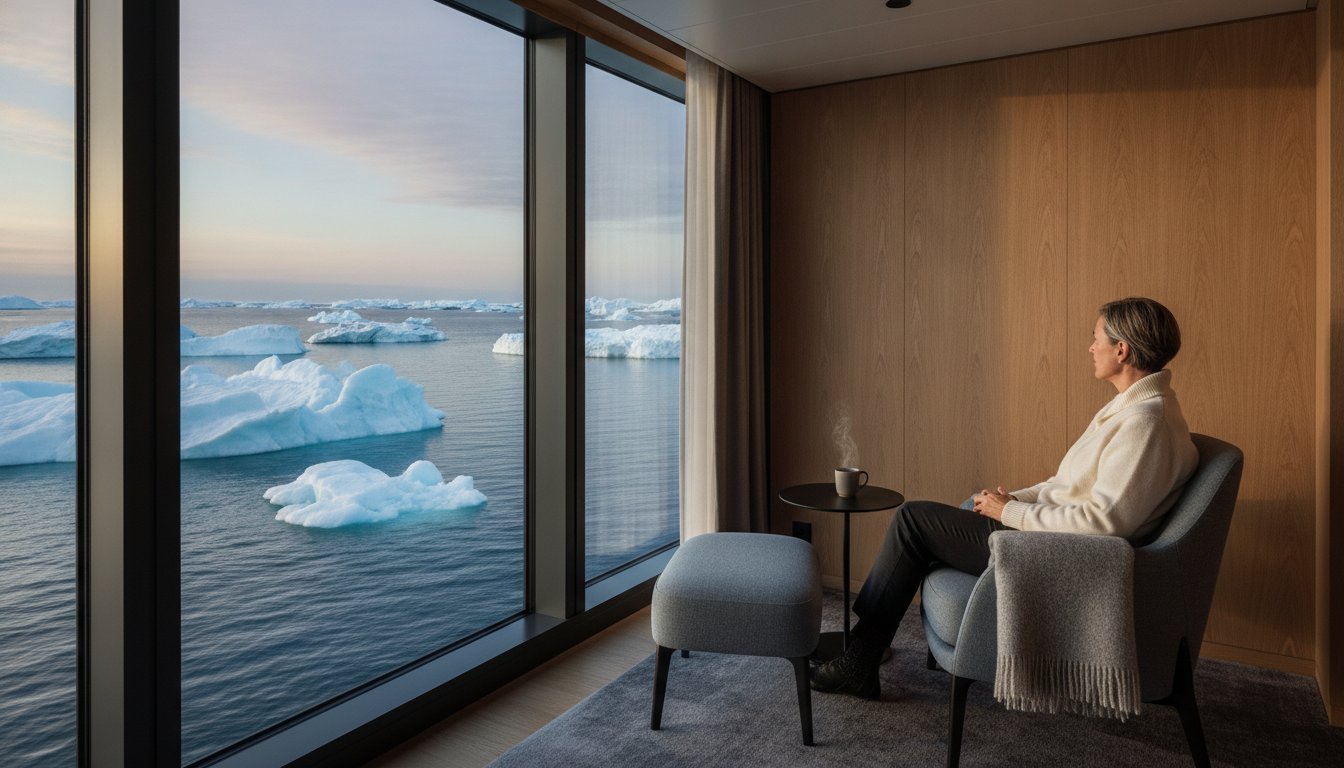
The greatest misconception about an arctic circle cruise is that you must choose between the grit of a true expedition and the grace of a refined retreat. It's a common concern; the fear that witnessing the world’s most fragile, frozen frontiers requires trading your comfort for a cramped cabin on a repurposed research vessel. You seek the raw geological power of Greenland or the polar bears of Svalbard, yet you shouldn't have to compromise on the intentionality and polish of your surroundings.
We understand that for the discerning explorer, the investment must be validated by an experience that is as seamless as it is profound. This guide strips away the tired clichés to reveal the sophisticated reality of modern polar travel. We'll explore how to navigate the 2025 Svalbard passenger limits, the 2026 zero-emission transition in Norway's heritage fjords, and how to choose the right region to ensure your journey feels both transformative and deeply personal.
Key Takeaways
- Understand that modern expedition ships have replaced cramped research quarters with sophisticated suites, ensuring your arctic circle cruise is an exercise in refined comfort rather than endurance.
- Decipher the seasonal trade-offs of the High North, acknowledging that the Northern Lights and the Midnight Sun are mutually exclusive experiences that require specific timing.
- Look beyond the polar bear to appreciate the full spectrum of Arctic life, including the elusive narwhal and the profound cultural depth of local Inuit communities.
- Distinguish between the concentrated wildlife of Svalbard and the immense, ice-sculpted landscapes of Greenland to find the itinerary that resonates with your personal sense of adventure.
Beyond the 66th Parallel: Myth-Busting the 'Frozen Wasteland'
Most travellers imagine the line of latitude at 66° 33′ N as a rigid border into a world of perpetual winter. In reality, Beyond the 66th Parallel lies a region that is less a wasteland and more a vibrant, breathing gateway. An arctic circle cruise provides a front-row seat to this transition, where the familiar rules of time and geography begin to dissolve. This is the entrance to the Land of the Midnight Sun, a place where the horizon glows with a perpetual golden hour and the boundaries between sea and sky often blur into a single, ethereal canvas.
We often speak of 'destination texture' when describing these voyages. It's the sharp, ozone-rich scent of air that hasn't touched a city in millennia. It's the thunderous, visceral crack of a calving glacier, a sound that resonates in your chest rather than just your ears. You aren't just looking at a landscape; you're feeling the ancient geological pulse of the planet. Understanding the distinction between the High Arctic and Sub-Arctic is vital for managing your expectations. The Sub-Arctic offers lush tundra and the chance for boreal forests, while the High Arctic, including the northernmost tip of Svalbard, is a polar desert where life is sparser but every sighting carries immense weight.
The Myth of Monotony
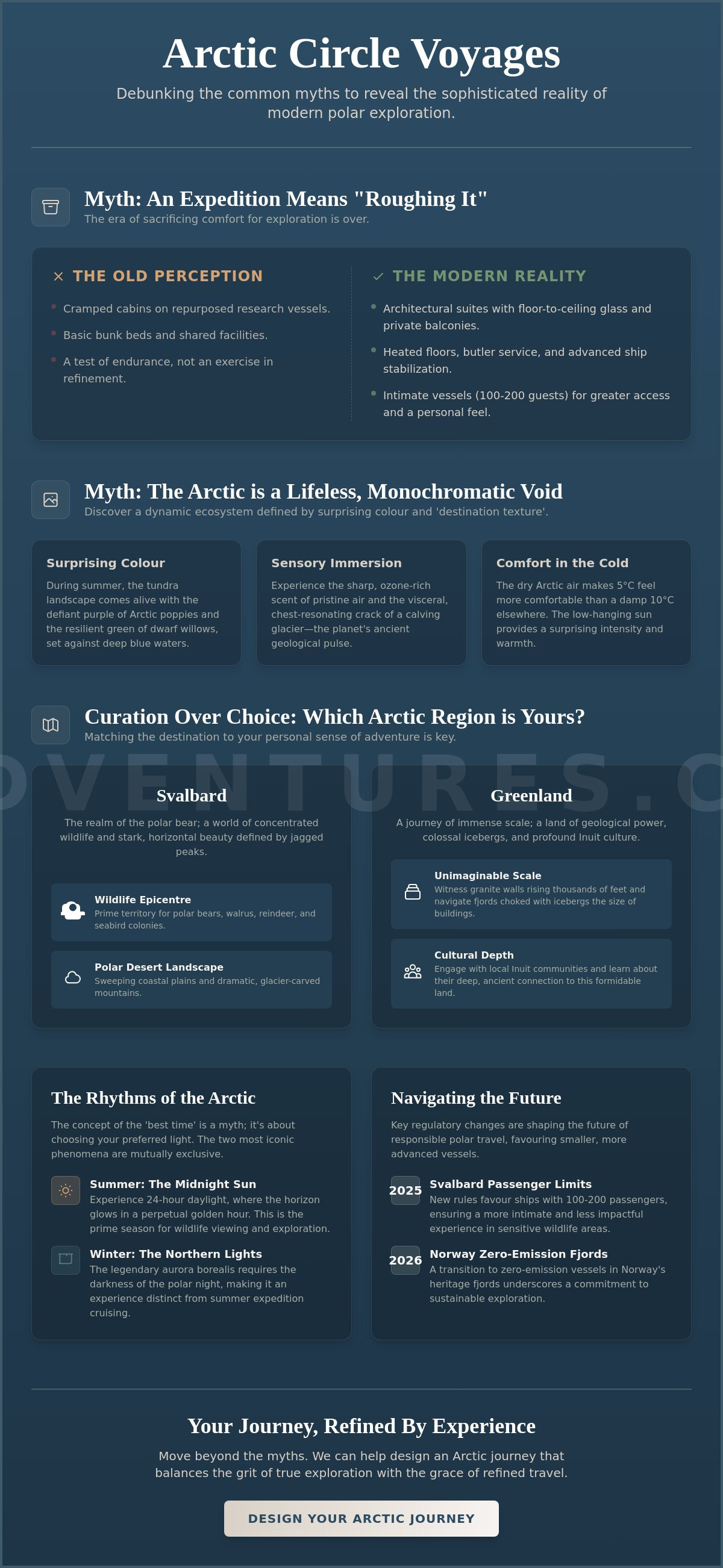
The Arctic is far from a monochromatic void. During the summer months, the tundra erupts with the defiant purple of Arctic poppies and the resilient, creeping branches of dwarf willow. The landscape offers a startling architectural variety. Greenland’s fjords provide immense verticality, with granite walls rising thousands of feet from the water, while Svalbard offers a starker, more horizontal beauty defined by jagged peaks and sweeping coastal plains. The Arctic Circle is a dynamic ecosystem that breathes with the seasons, not a static ice cap.
Temperature vs. Perception
Cold is a relative concept. The Arctic summer often surprises guests with its mildness. Because the air is exceptionally dry, a 5-degree day in the High North feels significantly more comfortable than a damp, biting 10-degree morning in a Melbourne winter. You may find yourself standing on the observation deck in a light jumper or even a t-shirt, basking in the intensity of the low-hanging sun. This constant light creates a strange, wonderful psychological shift. When the sun refuses to set, your internal clock yields to the rhythm of the wild, leaving you energized by the sheer scale of the environment. An arctic circle cruise invites you to stop fighting the clock and start living by the light.
Myth: Expedition Cruising Means 'Roughing It'
For decades, the image of a journey to the High North was synonymous with sacrifice. It suggested cramped cabins on rusty research vessels, communal dining, and a distinct lack of hot water. That era is over. Today, a sophisticated arctic circle cruise is defined by a paradox: the ability to witness the world's most unforgiving environments from a sanctuary of absolute refinement. The transition from bunk beds to butler service hasn't just changed the way we sleep; it has changed how we engage with the landscape. When you aren't preoccupied with basic comfort, you have the mental space to actually absorb the silence of the ice.
As travel designers, our role is to look beyond the glossy brochures to the technical nuances that define your daily experience. We vet vessels for their acoustic comfort, ensuring that the hum of the engine doesn't compete with the crackle of the bergs. We prioritise ships with advanced stabilisation systems, transforming potentially turbulent crossings into smooth, unhurried passages. Through our Virtuoso affiliations, these voyages often include quiet luxuries like cabin upgrades, shipboard credits, and private cocktail receptions, ensuring the investment matches the prestige of the destination. If you are ready to move beyond the myths, we can help you design a journey that balances grit with grace.
The Evolution of the Polar Suite
Modern expedition ships are architectural triumphs. They feature floor-to-ceiling glass that dissolves the barrier between your suite and the sea, heated bathroom floors for those crisp Arctic mornings, and private balconies where you can sip coffee while watching whales breach. Ship size is the most critical factor here. We typically recommend vessels carrying between 100 and 200 passengers. This scale maintains an intimate atmosphere and allows for more frequent landings under the strict 2025 Svalbard regulations. We often look to Ponant cruises as a benchmark for this specific brand of French-inspired polar luxury, where the aesthetic is as crisp as the air outside.
Gastronomy at the End of the Earth
The myth of 'canned food' in the Arctic is dismantled the moment you sit for your first dinner. World-class chefs now lead polar galleys, sourcing local Arctic char, reindeer, and cloudberries to create menus that reflect the region's culinary heritage. The transition between your adventures is equally refined. The 'Mud Room' is no longer a cluttered locker; it's a sleek, organised space where you transition from a rugged zodiac to a lounge filled with soft textiles and fine spirits. The modern expedition is a masterclass in duality, where you can have salt-sprayed hair by day and crystal glassware by night. When researching the region's cultural landscape through resources like the U.S. National Park Service, it becomes clear that the human history of the Arctic is as deep as its ice, and the food you eat is a vital part of that story.
More Than Just Polar Bears: Diversity of the High North
While the 'Ice Bear' remains the undisputed icon of the North, focusing solely on this apex predator is like visiting Paris only to glimpse the Eiffel Tower. It's a magnificent chapter, but it isn't the whole story. An arctic circle cruise is an exercise in patient, rewarding observation that reveals a far more complex biological tapestry. Beyond the charismatic megafauna, there is what we call the 'Investment of Awe'. This is the moment you realise that a bird cliff teeming with 100,000 puffins is just as moving as a bear sighting. The sheer scale of life, the cacophony of sound, and the frantic energy of the Arctic summer create a sensory overload that stays with you long after you've returned home.
The elusive narwhal, often called the 'Unicorn of the Sea', remains one of the most sought-after sights for the seasoned traveller. These whales are shy, preferring the deep, lead-filled waters of the Canadian Arctic and Greenland. Finding them requires a ship with a nimble footprint and an expedition leader who understands the subtle shifts in the ice. It's a game of chess played against the elements. When you do find them, the sight of their tusks breaking the glassy surface of a lead is a profound reminder of the Arctic's enduring mysteries.
The Marine Giants
The water's edge is where the Arctic truly comes alive. Walrus colonies offer a different kind of sensory experience. A haul-out site is a chaotic, vocal, and admittedly pungent assembly that provides a fascinating look at social hierarchy in the High North. You might also encounter the quiet residents of the ice edge: the ethereal white beluga or the massive bowhead whale, which can live for over 200 years. This stark, open aquatic world offers a fascinating contrast to the dense, hidden biodiversity found on Amazon River Cruises. Where the Amazon hides its treasures in a green wall of forest, the Arctic exposes them against the minimalist geometry of the ice.
Human Connection in the Arctic
The Arctic isn't just a wilderness; it's a homeland. Cultural immersion here means moving beyond folklore to engage with the living history of the Inuit and Sami people. We prioritise visits that focus on respectful stewardship rather than voyeuristic tourism. Following the ghosts of Franklin and Amundsen through the Northwest Passage isn't just a physical transit; it's a mental journey into the limits of human endurance. You begin to understand that the 'Northwest Passage' is as much a symbol of exploration as it is a geographical route. It's a chance to connect with the resilience of those who have called this 'frozen' world home for millennia.
The 'Best Time' Myth: Seasonality and the Midnight Sun
One of the most persistent misconceptions we encounter is the belief that an arctic circle cruise offers a simultaneous viewing of the Midnight Sun and the Northern Lights. Nature, however, is a disciplined curator. To experience one, you must forfeit the other. The choice of when to travel isn't merely a matter of checking a calendar; it's about deciding which version of the Arctic you wish to inhabit. Each month offers a distinct sensory profile, shifting the landscape from a monochromatic cathedral of ice to a vibrant, sun-drenched tundra.
In May and June, you enter the 'White Arctic'. The sea ice is still substantial, providing a dramatic backdrop for polar bear sightings and the intricate courtship rituals of Arctic birds. It's a time of immense purity. The air is crisp, and the snow hasn't yet been touched by the summer melt. By July and August, the region reaches the peak of accessibility. This is when the ice retreats enough for ships to push further into hidden fjords and potentially circumnavigate Svalbard. The tundra erupts in a brief, frantic bloom, and whale activity reaches its zenith as they feast in the nutrient-rich waters.
Midnight Sun vs. Northern Lights
The 24-hour daylight of June is a marvel, yet it makes Aurora viewing physically impossible. Darkness is a requirement the summer sun simply won't grant. If your heart is set on the celestial dance of the green lights, we would typically recommend a land-based Scandinavia Northern Lights tour during the deep winter months. For those on a cruise, the 'Blue Hour' in late August is a hidden treasure. It's that ethereal period when the sun sits just below the horizon, bathing the ice in a soft, painterly light that is arguably the most photogenic time of year.
Navigating the Ice
Ice is the ultimate architect of your itinerary. Its retreat dictates exactly where an expedition vessel can safely venture. The legendary Northwest Passage, for instance, is typically only a possibility in late August and September when the channels are most likely to be clear. By September, the shadows return, bringing autumn colours to the tundra and the first flickering hints of the Aurora. We provide bespoke seasonal advice to ensure your journey aligns with your specific priorities, whether you seek the pristine ice of spring or the golden transitions of the late season.
Curation Over Choice: Which Arctic Region is Yours?
The term 'Arctic' is a convenient shorthand for a vast territory that spans three continents and eight nations. Choosing the right arctic circle cruise isn't about finding the 'best' destination; it's about identifying the specific texture of adventure that resonates with your personal philosophy. Each region possesses its own frequency. Whether you seek the concentrated wildlife of a high-arctic archipelago or the immense, cathedral-like silence of a Greenlandic fjord, the choice defines the soul of your journey. It's the difference between a wildlife-focused expedition and a deep dive into geological and cultural history.
The Canadian Arctic and the fabled Northwest Passage appeal to the historian and the lover of vast, lonely spaces. This is a landscape of immense horizontal distance, where the stories of early explorers feel etched into the very stones of the shore. For those with limited time but a desire for the Arctic aesthetic, Iceland serves as a sophisticated 'Arctic Lite' option. It provides dramatic volcanic scenery and high-end infrastructure, though it lacks the true 'edge of the world' isolation found further north. Every region has its merits, but they are far from interchangeable.
Svalbard: The Realm of the Ice Bear
For those stepping into the High North for the first time, Svalbard is the logical starting point. It offers the highest density of polar bears and walrus haul-outs, set against the dramatic, jagged backdrop of the Spitsbergen coastline. Everything here feels immediate and intimate. The wildlife isn't just a possibility; it's a constant presence. If you've already experienced the vastness of Antarctica Cruises, you'll find Svalbard provides a more frequent, land-focused engagement with the polar world that feels remarkably accessible.
Greenland: The Cathedral of Ice
Greenland operates on a scale that defies easy description. In Disko Bay and the Ilulissat Icefjord, you'll encounter icebergs the size of city blocks, drifting with a slow, terrifying grace. This is the region for those who value deep cultural connection alongside geological power. The Inuit communities here offer a profound perspective on resilience and stewardship. Why We Love It: The absolute, ringing silence of a remote East Greenland fjord, where the only sound is the 'Seltzer crackle' of ancient air bubbles escaping from melting ice. It's a sensory reset that few other places on earth can provide.
The Designer’s Final Word
Selecting an itinerary is only the first step. The true value lies in the vetting of the expedition team, the ship's environmental credentials, and the specific nuances of the daily operation. In a market crowded with marketing noise, a Bespoke Travel Designer serves as your most critical filter. We ensure the reality of the experience matches the weight of your investment. An arctic circle cruise is a significant undertaking, and it deserves a level of curation that reflects its importance. Ultimately, the Arctic doesn't change you; it clarifies you. It strips away the unnecessary, leaving you with a profound sense of connection to the planet's raw, enduring spirit.
Charting Your Path Through the High North
The Arctic is far more than a destination; it's a sensory reset that demands a high degree of intentionality. We've seen that a modern arctic circle cruise doesn't require the sacrifices of the past, but rather offers a sophisticated hybrid of raw exploration and refined comfort. By understanding the nuances of seasonality and the distinct personalities of regions like Svalbard and Greenland, you can ensure your journey is as purposeful as the landscape itself.
As a Virtuoso Member with CLIA Master certification, we specialise in looking beyond the marketing noise to find the truth of an itinerary. It's why we rely on personally vetted expedition partners to deliver the level of quiet luxury and authentic connection our clients expect. The ice is waiting, and the right curation makes all the difference.
Let Luxe Adventures curate your Arctic expedition, refined by experience and defined by connection.
Your journey into the silence of the High North is a rare opportunity to see the world with fresh eyes. We look forward to helping you find your place within it.
Frequently Asked Questions
Is an Arctic Circle cruise suitable for people with limited mobility?
Modern expedition ships are increasingly equipped with lifts and accessible suites, but the true challenge lies in the shore excursions. Navigating a Zodiac onto a shifting ice floe or a rocky, ungraded beach requires a degree of physical agility. We can recommend specific vessels with expansive observation decks and floor-to-ceiling windows if you prefer to experience the landscape's grandeur without the rigours of daily landings.
What is the difference between an Arctic cruise and an Antarctica cruise?
The Arctic is an ocean surrounded by land, while Antarctica is a continent surrounded by ocean. This geographical distinction means an arctic circle cruise offers land-based wildlife like polar bears and muskoxen, alongside the living cultures of the Inuit and Sami people. Antarctica is a world of ice and penguins where no permanent human settlements exist, offering a different kind of profound isolation.
Will I get seasick on an Arctic expedition?
Seasickness is generally less of a concern in the Arctic than on the notorious Drake Passage, though certain stretches like the Greenland Sea can be lively. Most contemporary expedition vessels are fitted with advanced stabilisers that significantly dampen the ship's motion. If you're particularly sensitive, we suggest selecting a mid-ship suite on a lower deck where the vessel's movement is least perceptible.
What should I pack for an Arctic cruise in the summer?
Layering is the essential strategy for the High North's unpredictable microclimates. You'll need high-quality merino wool base layers, a fleece or down mid-layer, and a professional-grade waterproof shell. Don't overlook a high-quality eye mask; the Midnight Sun is a marvel, but it can make sleep elusive for those unaccustomed to twenty-four hours of daylight. Sturdy, waterproof boots are also non-negotiable for shore landings.
Are Arctic cruises environmentally friendly?
Modern polar travel is shifting toward a model of stewardship defined by increasingly stringent regulations. The 2026 zero-emission mandate for Norway's heritage fjords and the 2025 passenger limits in Svalbard are driving the industry toward a lighter footprint. We exclusively partner with operators who prioritise hybrid propulsion, waste reduction, and local conservation efforts to ensure the region's fragile beauty remains intact for future generations.
Can children go on an Arctic Circle cruise?
Children are welcome on most expeditions, typically from the age of eight or twelve, depending on the specific cruise line's policy. These journeys are immersive, educational experiences rather than traditional holidays with supervised play areas. For curious children with an interest in marine biology or history, the Arctic serves as the ultimate living classroom, though the long days of observation require a certain level of patience.
Do I need a special visa for Arctic travel?
Visa requirements depend entirely on your nationality and the specific territories included in your itinerary, such as Norway, Greenland, or Canada. Australian travellers generally don't require a visa for short stays in Norway or Greenland, but an Electronic Travel Authorisation is usually mandatory for transiting through Canada. We verify these details as part of our bespoke design service to ensure your transit is seamless.
How far in advance should I book an Arctic expedition?
You should aim to book your journey twelve to eighteen months in advance to secure your preferred suite and itinerary. The most refined ships, which carry between 100 and 200 guests, have limited capacity and tend to fill quickly. Booking early is particularly important for specialised routes like the Northwest Passage or for voyages that align with specific wildlife events like the peak of the whale migration.

Article by
Rachel Cleary
Rachel Cleary is the founder of Luxe Adventures and an endlessly curious explorer with a passion for meaningful, experience-led travel. Having visited every continent and travelled to more than 100 countries — and counting — she believes travel is one of the greatest educations for both children and adults alike.
Rachel is addicted to scuba diving and gets underwater at every opportunity. When she isn't in the office you'll find her exploring remote reefs in Fiji, drift diving in the Maldives, or scuba cruising Raja Ampat or French Polynesia.
Her second home is Fiji where she has explored all the island groups and has favourite boutique resorts she returns to every year, for the diving and the authentic Fijian hospitality.
Get her talking about kayaking in Antarctica or the Arctic, African safaris and where to find the highest density of big cats, underwater adventures, remote expedition destinations, or the science and magic behind the Northern Lights — including when and where they are most likely to dance — and you may be there a while.
Through Luxe Adventures, Rachel combines firsthand experience, global industry connections, and a deep appreciation for nature, culture, food, wildlife, and human connection to help curious travellers explore the world in a way that feels seamless, personal, and unforgettable.
Refined by experience. Defined by connection.
Disclaimer
The information in this article is intended as general travel inspiration and guidance only. Travel requirements, hotel standards, airline schedules, entry regulations, weather conditions, pricing, and experiences can change without notice.
While every effort is made to ensure accuracy at the time of publishing, Luxe Adventures recommends confirming all details relevant to your personal travel plans before booking or travelling.
Opinions, recommendations, and destination insights shared in this article are based on firsthand experience, industry knowledge, and research at the time of writing. Experiences may vary depending on season, supplier changes, local conditions, and individual travel preferences.
Some articles may reference luxury travel affiliations, preferred partner programs, or value-added amenities available through Luxe Adventures. Benefits and inclusions are always subject to availability and supplier terms at the time of booking.
Luxe Adventures strongly recommends comprehensive travel insurance for all international travel.
For personalised travel advice, tailored itinerary design, or the latest destination updates, please contact Luxe Adventures directly.


